What are the key cultivation points of the "heavy watering" orchid-growing method?
Key points of the "heavy watering orchid growing" method
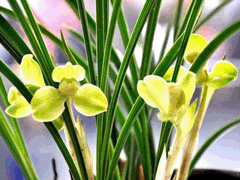 Key points of the "heavy watering orchid growing" method
The "heavy watering orchid growing" method has four key elements: "small pot, hard potting medium, watering, sunlight." 1. First is the "pot." The pot is the relative space in which the orchid grows; its material, size and shape should be chosen according to the orchid plant's growth habits and root system conditions. The pot shape should mainly be a slender type, which favors air circulation and drainage. Choosing the pot size is the most critical step, emphasizing the word "small." How is small defined? The orchid's root system should be used as the reference: a pot that allows the roots to be placed naturally is the most suitable; if it looks to you as if it might be slightly on the small side, that is probably the most suitable, also known as "choosing the pot by the roots." As the orchid seedlings gradually grow, the pot should also gradually increase in size accordingly. 2. Second is the "soil." The potting medium should be formulated on the principle of "water flow and air permeability," and materials can be freely sourced locally. The usual formula is "humus material plus granular material." The humus material, during fermentation when it meets water, can provide the nitrogen fertilizer most needed for plant growth, while the granular material provides various minerals and other trace elements, and at the same time increases the overall gaps in the potting medium, providing aerobic space to promote orchid fungus growth. The choice of potting medium particle size should be determined by the pot size: use coarse material for large pots and fine material for small pots. The author has deep personal experience of "large particles grow large roots, small particles grow small roots," and for orchid planting uses large-particle Jinshi plus small-particle Xiantu, which both prevents empty roots caused by overly large particles and compensates for the weak aeration of small-particle material. 3. Third is "water." The ancients said, "Three parts planting, seven parts management." Orchid cultivation is a process of management, and there are many aspects of management: environmental management, water management, nutrition management, temperature and humidity management, and pest and disease control, among many others, but water management is the most important of all in orchid management. The three major conditions for orchid growth are sunlight, water and air. Sunlight and air need no elaboration, as they are everywhere, but for orchids growing in a relative "pot environment," the water they need is controlled by people. This method advocates "heavy water management," meaning the amount of watering need not be restricted, because before watering, a relatively "small pot" and "coarse material" have already been chosen, so even more water will not accumulate in the pot and cause root rot. Just think of orchids in nature: even several weeks of rain will not waterlog them. Watering in the orchid-growing process means watering thoroughly once, that is, letting all the potting medium be rinsed through. The benefit of thorough watering is that the water flow drives the airflow in the pot, renewing the oxygen inside the pot and promoting root-fungus symbiosis. When the orchid plant is first potted, the potting medium ferments quickly upon contact with water, producing high heat and many waste gases that harm the orchid roots. The only solution is heavy water; heavy water can reduce the heat and wash away the waste gases. Of course, heavy water will also wash away excess nutrients, causing the potting medium to age prematurely. The solution is to supplement fertilizer or shorten the repotting interval. Under the premise of heavy water, adopt "micro-fertilization," that is, apply fertilizer evenly with each watering, which also conforms to the principle of "light fertilizer applied frequently." In summer, water 1-3 times a day; in cold weather and cloudy days, it can be reduced to once every 3-5 days. The characteristic of "heavy watering orchid growing" lies in the casualness of watering. "Heavy water" can be understood in two aspects: first, increasing the amount of water; second, increasing the frequency of watering. This is extremely easy for new orchid growers to grasp, but casualness does not mean random watering. Random watering, though it may not ruin things, will not accomplish anything good either. Within casualness there is non-casualness; the key is to grasp one principle well: water more on hot days, water less on cold days; water more on sunny days, water less on cloudy days; water more for small pots, water less for large pots; water more for new soil, water less for old soil; water more when evaporation is high, water less when evaporation is low. "Alternating dry and wet" speeds up the rhythm and stimulates orchid root growth. 4. Fourth is sunlight management. Sunlight is a necessary condition for plant growth. As the saying goes, "All things grow by the sun," and orchids are no exception. Sunlight first provides photosynthesis: orchid leaves, through light, synthesize organic compounds from water and carbon dioxide in the air to supply orchid growth, while also supplying the chlorophyll necessary during the orchid plant's growth process and ensuring that existing chlorophyll is not "etiolated." Second, through sunlight exposure, it can provide the normal accumulated temperature needed for orchid plant growth. If accumulated temperature is insufficient year-round, the off-season blooming that everyone knows about is precisely the result of excessive or insufficient light. The orchid plant cannot grow normally. Third, light can regulate the orchid's physiological cycle. Sunlight management should be moderate; "do not expose to strong light, do not avoid scattered light." The specific handling depends on the environment, on the specific orchid plant, and on human judgment. The principle is: "For robust plants and plants with excellent root systems, supplement more sunlight in cold and cloudy seasons; for thin and weak plants and plants with unsound root systems, supplement less light in hot seasons." Heavy watering orchid growing can make orchid root systems complete and robust, accelerate the seedling production rate, strengthen growth speed, and improve the overall stress resistance of the orchid plant. Attention must be paid to the completeness of the four elements, and one must absolutely not focus only on "heavy water" while neglecting the coordination of pot and medium, and light.