Orchid leaf characteristics can help diagnose diseases
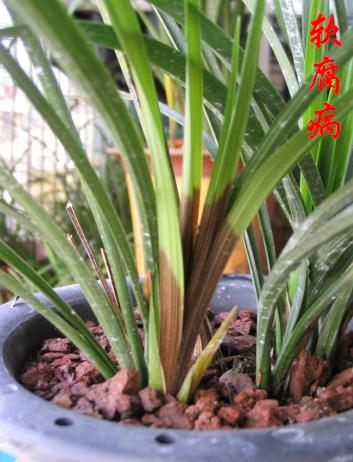
A bit of knowledge on identifying orchid diseases by looking at orchid leaves
Symptoms of orchid leaf diseases
1) Leaves turn yellow, growth is normal:
Light is too strong.
2) Leaves turn yellow, new shoots are smaller:
Excessive light, lack of nitrogen fertilizer and necessary humidity.
3) Old leaves yellow and fall off:
Caused by normal aging or repotting.
4) Old leaves rapidly yellow and fall off:
Overwatering too frequently, improper repotting and planting.
5) Tips of new leaves are scorched:
Excessive fertilization, planting material not clean.
6) Both new leaves and old plants have scorched black tips:
Excessive damp heat in the pot, root rot among the roots.
7) New shoots stop growing after emerging:
There is root rot or unclean matter beside the new shoots; turn over the planting material around the new shoots and remove the unclean matter and growth will resume.
8) There are scorch spots on the leaves with no yellow around the edges:
Burns from scorching sun.
9) Leaf tips appear scalded and shriveled:
Watering water temperature is too high; air temperature is too high when watering; exposure to sudden rain during high summer temperatures, etc.
10) New shoots rot at the center:
After water is poured into the shoot center, the water cannot evaporate or be absorbed, and unclean planting material in the pot causes leaf rot disease, etc.
11) Spots on leaves with water-soaked edges:
Excessive humidity, pot moisture and air humidity trapping each other causing suffocation, accompanied by leaf rot pathogens. Poor ventilation and air movement.
12) Yellow-brown spots on leaves:
Caused by roots being exposed to heat.
13) Irregular yellow spots on leaves, leaf mesophyll tissue necrotic and sunken:
Caused by viral disease, also called “Balas”.
14) Small yellow spots on leaves:
Caused by scale insects.
15) Purple-black appears on leaves, while the underside is still green:
Caused by low-temperature frost. Can also occur with phosphorus deficiency.
16) Leaves dehydrated, pseudobulbs wrinkled and shrunken:
Caused by long-term excessive dryness and dehydration in the pot.
I think this is fertilizer damage; the characteristic is that new seedlings grow relatively well, but old seedlings begin to yellow from the roots, especially when the roots were not strong to begin with, more leaves will turn yellow
This is also fertilizer damage. If this happens and it is not serious, water less and then grow them plainly for a period; if serious, change the planting medium
Introduction to commonly used fungicides for orchids
1 Product name Orchid diseases treated Properties Method Dilution ratio
2 Chlorothalonil 75% WP Leaf spot, blight, anthracnose Broad-spectrum, non-systemic Preventive before onset 800-1000x solution
3 Thiophanate-methyl 70% WP Leaf spot, flower rot, anthracnose Broad-spectrum antibacterial Spray 1000-1500x solution
4 Carbendazim 50% WP Leaf blight, root rot, anthracnose Systemic Spray 800-1000x solution
5 Kocide 77% WP Blight, root disease, leaf spot Copper agent, broad-spectrum long-lasting Spray, root drench 600-800x solution
6 Agricultural streptomycin 72% WP Bacteria Spray, root drench 500-800x solution
7 Medical streptomycin Bacteria Spray, root drench
8 Potassium permanganate Disinfectant Chemical agent Soak 800-1000x solution
9 Zineb 80% WP Anthracnose, spot disease Contact killer Spray at early stage of onset 800-1000x solution
10 Mancozeb 70% WP Anthracnose, spot, blight Broad-spectrum antibacterial Spray 600-800x solution
11 Decis 2.55% EC Aphids, leaf-eating caterpillars Contact poison, stomach poison Spray 2000-2500x solution
12 Supracide 40% EC Scale insects, spider mites Contact poison, stomach poison Penetrating, spray, root drench
13 Bingkeke Viral disease Penetrating, spray, root drench 800-1000x solution
14 Bingdubike Viral disease Penetrating, spray, root drench 600-800x solution
15 Houttuynia cordata Dual nutritional and sterilizing Disinfection, sterilization
16 Dakeningjing Broad-spectrum Spray, root drench 1000x solution or as appropriate
17 Chlorothalonil 75% WP Leaf spot, blight, anthracnose Broad-spectrum, non-systemic Preventive before onset 800-1000x solution
18 Ridomil MZ 58% WP Blight, root disease Systemic, leaves spray marks Spray, root drench 800-1000x solution
19 Polyoxin 10% WP Various leaf spot diseases Systemic, safe Spray 1000-1200x solution
20 Score 10% WP Leaf spot, anthracnose Systemic Spray 3000-60000x solution
21 Previcur 66.5% Blight, rot disease Inhibits bacteria, stimulates crop growth Spray, soil treatment 600-800x solution
22 Sporgon 25% WP Leaf spot, blight, anthracnose Broad-spectrum, inhibits certain fungi Spray 800-1000x solution
23 Iprodione 50% WP Blight, Fusarium, rot, root rot, sclerotinia Broad-spectrum, contact at early stage of onset Spray or root drench 1000x solution
24 Hymexazol 70% WP Fusarium, Pythium Systemic, soil disinfection Root drench, spray 1500-2000x solution
25 Dimethachlon 40% WP Sclerotinia disease, leaf blight Contact, systemic penetration, long residual effect Root drench or spray 800-1000x solution
26 Dexon 75% WP Root disease, stem rot, anthracnose Systemic, penetrating Soil treatment 800x solution
27 Tuzet 50% WP Sclerotinia, root rot, anthracnose Systemic, leaves spray marks after application 800-1000x solution
28 Triadimefon 25% WP Rust disease Systemic Spray 1500x solution
29 Zhibingling 1.5% WP Viral disease Inhibits virus, promotes plant growth Spray
30 Yekuning 20% WP Bacterial diseases Systemic, long-lasting Spray 1000x solution
31 High-fat film 27% emulsion Fungi, bacteria, protects plants, isolates pathogens Spray, environmentally friendly agent
32 Thiram 50% WP Rot, spot, anthracnose Broad-spectrum antibacterial Spray, soil application 800-1000x solution
33 Benlate 50% WP Leaf spot, Fusarium Broad-spectrum antibacterial Spray 1000-1200x solution
34 Sumilex 50% WP Sclerotinia, root rot, flower rot Systemic, prone to resistance Spray, root drench 1500-2000x solution
35 Sandofan 64% WP Stem rot Contact, systemic, prone to resistance Spray
36 Fosetyl-aluminum 80% WP Blight, downy mildew Systemic, translaminar and upward/downward movement Spray, root drench
37 Weixiuling 20% EC Rust disease Systemic Spray
Notes: 1: Generally apply once every 7-10 days, and can also be adjusted according to different situations; 2: Carbendazim, benomyl and thiophanate-methyl cannot be used in rotation;
3: Copper preparations and alkaline pesticides cannot be used at the same time as thiophanate-methyl; 4: Best planting medium: large-grain Kanuma soil and small-grain Sendai soil, or Qingcheng Mountain black Sendai soil and Huayi orchid fungus soil.
Now introducing Balas virus (BLS)
Orchid viral disease is also called Balas disease. Its pathogen is not bacteria, nor fungi, but a virus, a highly damaging and very difficult-to-cure disease known as the “AIDS” and “cancer” of orchids. It not only spreads but is also inherited, and currently there is still no way to prevent or cure it. Once infected, an entire patch of orchids suffers devastating losses. Ten years ago, when I first entered the orchid world, I encountered such a disaster. In this contest with the disaster, through exploration I found that medical Banlangen tablets, used to spray leaves and drench roots to treat orchid viral disease, opened up an effective path for preventing and treating orchid pests and diseases. Now I briefly introduce it to fellow orchid growers for reference.
In the mid-1990s, I began learning to grow orchids. After about half a year of growing them, on the new leaves of a purchased pot of Daxuesu, I found several milky-white white spots, with boundaries like water stains formed when water drops diffuse into highly absorbent paper, lusterless and slightly translucent. On the leaves of the two small shoots it sent out, ten cm tall, the same spot pattern also appeared. At that time, I did not know it was a disease, and mistakenly thought the orchid seedlings had mutated, so I was happy for quite a while and gave them preferential treatment such as focused fertilization. It was only because the orchid seedlings grew worse and worse, the water color faded, the spots sank inward, the front and back of the spots appeared gray-green and transparent, and there were no other-colored dots within the spots. When held up in strong light and viewed through, they appeared lusterless, wrinkled and shrunken. Only then did I realize it might be caused by disease, so I used pesticides such as chlorothalonil, carbendazim, Kocide, Sporgon, and Score in rotation to spray the leaves once every three days. After spraying more than ten times in succession, there was still no improvement. Instead, the orchid leaves became even more shrunken. Over half a year, the entire pot of Daxuesu gradually withered and died from old to young.
Even more serious was that not long after disposing of the diseased and dead pot of Daxuesu, on the new leaves of more than ten pots of Daxuesu, Lianbansu, Chunjiang and Suhua Hutoulan placed around it, that kind of disease spot also appeared one after another, indicating they had been infected by the disease. If not treated in time, the orchids bought for tens of thousands of yuan would be at risk of being lost. In order to clarify the condition and suit the remedy to the case, I actively consulted experienced old orchid friends. Under their guidance, it was confirmed that what the orchids had was viral disease. The pesticides previously used were only effective against orchid diseases caused by bacteria or fungi, and had no effect on viral disease. But as for what medication could prevent and treat this disease, no one was sure either. Guided by the mentality of seeking any possible treatment when ill, I once used ribavirin and aspirin solution to spray the leaves seven or eight times, but there was still no improvement. After extensively consulting materials, I finally saw in the book One Hundred Questions on Growing Orchids at Home Mr. Xu Dong's suggestion: “You may try two of the Chinese herbal medicines Banlangen, honeysuckle, Dryopteris crassirhizoma, Scutellaria baicalensis, gardenia, and Andrographis paniculata, boil them in water, dilute and spray or water.” I thought that these Chinese herbal medicines are effective drugs used to treat colds, myocarditis, and meningitis caused by viral infection in people, so they might be effective in preventing and treating orchid viral disease. Moreover, Banlangen tablets were readily available in pharmacies, “sugar-coated tablets do not dissolve easily, so they were not chosen.” After buying the Banlangen tablets back, at a ratio of 2 tablets to 100 ml of water, I made a basin of Banlangen solution. I took the upper clear liquid portion and put it into a sprayer to thoroughly spray the leaves of the entire orchid plant; the remaining portion mixed with residue was used to drench the roots of diseased orchid pots with 100-200 ml. This was done once every three days for seven times in total. After that it was changed to once a week for another three times. A total of ten times were carried out. At this point, a miracle finally appeared: the disease spots on the orchid leaves in the orchid shed gradually faded. Not long after, the haggard leaf color gradually turned emerald green, and growth became vigorous. The newly issued small shoots grew well. Until now, seven or eight years have passed, and orchid viral disease has not been found again.
The above successful case of preventing and treating orchid viral disease proves that medical Banlangen can indeed effectively cure orchid viral disease. The “AIDS” and “cancer” of orchids are no longer incurable diseases. If any orchid friend's orchid plants are infected with this disease, please give it a try!
Although Balas virus is an incurable disease, it is not absolutely untreatable. Experts and orchid growers in various regions have made certain progress in treating orchids with Balas disease. Some orchid friends, after several years of treatment, have brought the virus under effective control, which can be called success. The methods are summarized as follows:
First, build up a strong constitution. Place diseased orchids in a place with natural ventilation, adjust light, temperature and humidity well, create good ecological conditions, and provide suitable fertilizer and pesticide application, so as to strengthen the plants and improve antiviral ability.
Second, medication treatment: 1. Among finished pesticides, Bingdu Bike 500x solution is an effective drug; add edible rice vinegar 250x solution with very strong penetrating function to lead the drug directly to the diseased part; 2. Apply heat-clearing and detoxifying Chinese medicinal materials: Banlangen, Daqingye, honeysuckle, Scutellaria baicalensis, Andrographis paniculata, gardenia, Paris polyphylla, etc., choose 3—5 kinds to combine into a formula, and use them alternately each month. First use the infusion, then the decoction, and finally spread the medicinal residue with medicinal liquid at 10x—100x solution; 3. Spray 1000x solution of the analgesic aspirin once each season. Apply the medicine by both drenching and spraying, spraying to treat the aboveground part and drenching to treat the underground part. For comprehensive treatment, spray once every 7 days and drench once every 10—15 days. After 10—15 consecutive times, change to once every half month or once a month, and persist for one year to consolidate the curative effect.
Third, support the upright and dispel the pathogenic, gradually increase the amount of light, provide more natural ventilation, let them bathe in more dew, fertilize normally, drench once every half year with No. 2 trace element fertilizer and plant growth essence, and spray a medium-concentration foliar fertilizer once every half a month, such as Zhuwu Dongli 2003, Gaolida, Gaole, and Aishi brand foliar fertilizer.
With unremitting efforts according to this method, short-term curative effects can be obtained, or at the very least its spread can be controlled