Why did the price of Shine Muscat grapes plummet?
Shine Muscat is known as King of Sunshine in Japan and as Shine Muscat in China. Its price once reached 500 yuan per jin, and only 6 years after it was introduced in 2015, its market price is 10 yuan. For the market, this is a good thing, but for the majority
Shine Muscat is known as King of Sunshine in Japan and as Shine Muscat in China. Its price once reached 500 yuan per jin, and only 6 years after it was introduced in 2015, its market price is 10 yuan. For the market, this is a good thing, but for most farmers, it means they have once again done useless work. This is the same problem faced by most agricultural products that have formed industries: when prices are high, large-scale introduction follows, and policy guidance promotes mass planting, with acreage treated as king. By the time everyone's efforts bloom and bear fruit, the price falls from its altar. This pattern has appeared with coffee in Yunnan, with Shine Muscat in Yunnan, and will also appear with macadamia nuts in Yunnan, because in just a few short years Yunnan jumped macadamia nuts from tens of thousands of mu to several million mu, and it takes time for the market to absorb and allocate this capacity.
Since last year, various grape varieties have appeared one after another in supermarkets, among which "Kyoho," "Summer Black," and "Shine Muscat" remain the mainstream varieties. However, a reporter from the Beijing News Rural Channel noted that in recent years, the prices of so-called "high-end grapes," represented by Shine Muscat grapes, have continued to decline. A reporter visited supermarkets in Beijing and found that Shine Muscat, which in previous years cost hundreds of yuan, was sold at its lowest price in August this year for only 16 yuan per jin. Behind the price decline is a sharp increase in planting area. Wang Haibo, an expert at the Chinese Academy of Sciences Institute of Fruit Science, said that the national planting area of "Shine Muscat" has now reached 800,000 mu, while in 2016 there were only tens of thousands of mu nationwide. Although the price plunge has left farmers who rushed in unable to see "sunshine," Wang Haibo also said that growers do not need to worry; the current way out is not to continue expanding production, but to "control production and increase quality." High-quality Shine Muscat can still sell at a high price even during the peak market period.
Falling from 100 yuan per jin to 16 yuan
Shine Muscat is a variety introduced from Japan. Its place of origin is Okayama Prefecture, Japan, and it is also an emerging internet-famous grape variety in recent years, with a delicate texture, full sweetness, and plump berries. Its price is much higher than common varieties such as Kyoho, Muscat Hamburg, and Red Globe, and it has the title of "Hermes among green grapes."
When it first came out, a bunch of this grape in Japan once sold for as much as 500 yuan, averaging 10 yuan per berry. In 2010, China began to introduce Shine Muscat, but only around 2015 did this grape gradually enter the public eye. When it first entered supermarkets, the price was once 300 yuan per jin. Later, as production increased, the price declined slightly, though it still hovered around 100 yuan per jin. Driven by the high price, more and more farmers began to grow Shine Muscat, but this also caused its price to become increasingly affordable.
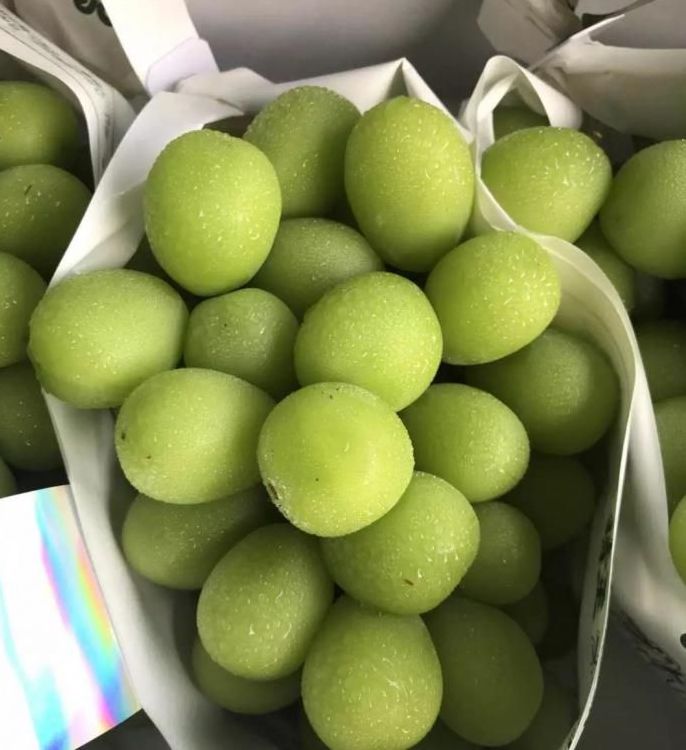
This year, however, the price trend of Shine Muscat grapes has changed so much that consumers find it somewhat hard to understand. Yunnan Province is the earliest place in the country where Shine Muscat comes to market, with online pre-orders available in May at about 100 yuan per jin. Entering June, Shine Muscat from Sichuan, Zhejiang, and other places also began to come to market. As the market volume increased, the retail price in Beijing supermarkets quickly fell to about 30 yuan per jin. Starting in August, large volumes of Shine Muscat came to market one after another, and the retail price in Beijing supermarkets fell to about 16 yuan per jin, while by this year it had fallen to 8 yuan per jin.
According to Red Star News, right now is the market season for Shine Muscat grapes. Xichang City in Sichuan, as the "Hometown of Chinese Late-Maturing Grapes," has a grape planting area of more than 100,000 mu and is the region in Sichuan Province with the most Shine Muscat planting.
On August 18, Shine Muscat grapes in the Yonghui Supermarket in Xichang were priced at 8.98 yuan per jin. Image source: Red Star News
On the morning of August 18, in the Chang'an Farmers Wholesale Market in Xichang City, tourist Ms. Yang from Chengdu bought 20 jin of Shine Muscat grapes, preparing to take them home to share with relatives and friends. The purchase price was only 10 yuan per jin, which surprised her greatly: "Is this really the Shine Muscat grape I know?" She first encountered this variety in 2016, when the group-buy price was as high as 100 yuan per jin. "At this time last year, I bought Shine Muscat grapes in Xichang at 18 yuan per jin. I didn't expect the price to be so much cheaper this year."
This year, the price of Shine Muscat grapes has continued to show a sharp downward trend, and fruit sellers also feel it deeply. "Last year, Shine Muscat grapes of relatively good quality like this sold for more than 40 yuan per jin, but this year the highest price has not exceeded 20 yuan." Ms. Yang, a fruit wholesaler in Xichang, told Red Star News that compared with last year, the price of Shine Muscat grapes this year has nearly "halved." "Although the price has dropped, Shine Muscat grapes are being sold everywhere, competition is fierce, and the market is not ideal."
China's planting area expands rapidly
Shine Muscat, this green grape variety from Japan, is called "Hermes among grapes" because of its emerald appearance, sweet taste, and high price. In Japan, the average price of a bunch (about 500g) of Shine Muscat green grapes is between 2,000 yen and 3,000 yen (about 120 yuan to 180 yuan), and a gift-grade premium bunch of Shine Muscat can reach 10,000 yen (about 600 yuan).
In 2010, China began to introduce Shine Muscat, but only around 2015 did it gradually enter the public eye. At first, when Shine Muscat grapes entered supermarkets, the price was once 300 yuan per jin; later, as production increased, the price declined slightly, though it hovered around 100 yuan per jin. But starting in 2020, the domestic market price of this variety dropped to several dozen yuan per jin, and in some areas the price once fell to three or four yuan per jin.
This is mainly related to the rapid increase in China's Shine Muscat grape planting area. According to data from the Chinese Academy of Sciences Institute of Fruit Science, by 2020 China's Shine Muscat planting area had reached 800,000 mu and was still expanding, with an expected breakthrough of 1 million mu in 2021. In 2016, however, the planting area of Shine Muscat grapes in China was only tens of thousands of mu.
According to another report by Nikkei, after this Japanese-bred brand, Shine Muscat, was introduced to South Korea and China, its current sales scale and production scale have already far exceeded Japan's. In South Korea, Shine Muscat has become the main export fruit, with export value increasing to nearly 5 times that of Japan; China's Shine Muscat planting area has reached more than 40 times that of Japan.
Japan has lost "control" over Shine Muscat grapes
It is worth noting that the outflow of products originating from Japanese brands, such as Shine Muscat, has attracted the attention of the Japanese government.
In April this year, the Japanese government began implementing the new Plant Variety Protection and Seed Act, which prohibits registered varieties from being taken overseas. The new regulation prohibits individuals and legal entities from taking registered Japanese agricultural seeds and seedlings out of Japan without permission. Without the permission of the brand owner, the seeds of related varieties may not be harvested for planting; if such seeds and seedlings are illegally taken out of Japan, the offender will be punished with imprisonment of up to 10 years or a fine of up to 10 million yen, and if the act is committed by a legal entity, a fine of up to 300 million yen will be imposed.
However, this new regulation can hardly work in the case of "Shine Muscat."
According to a report by Jiemian News, agricultural breeding requires high human and time costs. Data shows that for common fruit trees in Japan such as apples, citrus, and peaches, the average time to cultivate a new variety is 24.5 years. Therefore, most common new fruit varieties in Japan have intellectual property protection and have even applied for brands to protect the rights of developers.
But earlier there were certain loopholes in Japan's overseas export of seeds and saplings.
Taking Shine Muscat green grapes as an example, this variety applied for intellectual property protection in Japan in 2006, but at that time the government did not make an export decision, nor did it apply for overseas variety registration protection. According to Japan's earlier seed and seedling law, seeds or saplings could be taken to countries or regions that had joined international treaties related to the protection of seeds and seedlings, so South Korea and China also successively introduced the Shine Muscat variety and began large-scale planting.
When the Japanese side realized this problem, the deadline for applying for overseas intellectual property protection had already passed, so the so-called fruit seedling "infringement" is also difficult to define legally.
Not only Shine Muscat, but in 2020 the Japan Association for the Promotion of Agricultural, Forestry, Fisheries and Food Industry Technology found that more than 30 bred fruit varieties in Japan had earlier been taken overseas, such as Shizuoka's "Benihoppe" strawberry, "Red Beauty" citrus, and Saga's "Seiko" strawberry.