Laying Hen Welfare Upgrade: Carrefour to Sell Only Cage-Free Eggs Starting in 2025
To improve animal welfare, Carrefour supermarket together with the Taiwan Animal Society Research Association (hereinafter referred to as "the Association") jointly announced today that all of Carrefour's hypermarkets and supermarkets will sell only "cage-free eggs" starting in 2025. Chen, Deputy Executive Director of "the Association"
To improve animal welfare, Carrefour supermarket together with the Taiwan Animal Society Research Association (hereinafter referred to as "the Association") jointly announced today that all of Carrefour's hypermarkets and supermarkets will sell only "cage-free eggs" starting in 2025.
Chen Yumin, Deputy Executive Director of "the Association," thanked Carrefour for being an industry pioneer, and also pointed out that the EU and other Asian countries already have advanced policies on laying hen welfare, questioning that Taiwan has no corresponding policy to provide industry upgrading guidance. The Livestock Division of the Council of Agriculture stated that a draft has been announced, and in the future "egg shells" will be sprayed with production method codes to provide consumers with identification. However, when reporters actually interviewed several consumers, most said they would not open the egg carton to inspect the eggs, let alone memorize the codes for identification, and suggested that directly noting the production method on the egg carton would be more feasible.
Only when laying hens live in an environment suited to their natural behavior does it conform to animal welfare and help the health of the people. (Photo provided by / the Association)
Carrefour Cares About Animal Welfare, to Completely Stop Selling Caged Eggs in 2025
"Taiwan eats over 7 billion eggs a year," said Su Xiaozhen, Director of Corporate Social Responsibility and Communication at Carrefour. Where do so many eggs come from? It is worth everyone's attention. While the global livestock industry is developing toward sustainable goals, Taiwan's laying hen industry still mostly cares about output value, and the hidden risks of zoonotic diseases, food safety, and environmental sustainability will all be borne by the people in the future.
To this end, Carrefour has cooperated with the Association since 2018, leading domestic retailers, and after gradually completing "cage-free egg sections, private-label barn-laid eggs, and carefully selected pasture-raised eggs," today it further promised to completely stop selling caged eggs in 2025, while actively driving brand suppliers to move toward the same goal.
"In 2018, people might not have believed this could succeed, but caged eggs will definitely be completely eliminated, and everyone needs to start taking action." Su Xiaozhen thanked the egg farmers who made the transition, academia, the Association, and all stores that adopted cage-free eggs, and especially thanked consumers for their recognition, which has kept increasing the proportion of cage-free egg sales at Carrefour. During the pandemic, cage-free eggs even sold out.
The EU and Asian countries have all adopted policy-based transition regulations for "caged eggs," but Taiwan is still moving at a snail's pace.
Spending Money on Healthy Eating Is Better Than Spending Money on Doctors
Chen Yumin pointed out that if we cannot treat farm animals well, humans cannot obtain safe food either. Although the nutritional value of caged and cage-free eggs is the same, at first glance cheap eggs seem more cost-effective, but caged hens are raised weak, and if disease leads to large-scale culling, the economic losses should be spread across the cost of each egg. Not to mention that because caged hens cannot remove parasites such as feather lice through dust bathing and other methods, pesticides must be sprayed in the henhouse, resulting in "fipronil residue eggs," which instead harm consumer health.
Chen Yumin said that the price of friendly eggs is not necessarily higher than caged eggs. Chen Yumin pointed out that about 70% of eggs are priced at 7-12 yuan each, while friendly eggs are about 9-15 yuan each. She called on consumers to choose carefully, consume smartly, support egg farmers who are friendly to animals, and also take care of their own health.
The Era of Cage-Free Farm Animals Arrives, Taiwan's Policy Moves at a Snail's Pace
⟦NL>
Chen Yumin also pointed out that the EU completely banned the use of battery cages for egg production as early as 2012, and announced in June this year that it would propose legislation before the end of 2023, with a plan to completely abolish inhumane caging and confinement and raising methods for farm animals within the EU by 2027, "officially declaring the arrival of the era of cage-free farm animals."
At the same time, Asian countries have not stopped their pace of "abolishing caged laying hens." In 2011, South Korea established a farm animal welfare standard certification system; in 2021, Thailand set cage-free egg production standards and launched cage-free laying hen certification, hoping to increase the market share of cage-free eggs year by year; also in 2021, the Philippines established the cage-free "Philippine National Standard."
Although Taiwan has also made efforts on laying hen welfare, for example in 2015, the Council of Agriculture published the "Definition and Guidelines for Friendly Egg Production," encouraging egg farmers to transition to barn-laid, pasture-raised, or enriched cages according to the guidelines. In the same year, Article 25 of the "Act Governing Food Safety and Sanitation" was amended to require that friendly-produced eggs be labeled on the outer packaging as "barn-laid," "pasture-raised," or "enriched cage"; however, non-friendly-produced "caged" eggs actually need no labeling at all.
In 2016, to encourage egg farmers to transition, the Council of Agriculture even provided low-interest loans, but Chen Yumin questioned that from 2015 to now, the Council of Agriculture has never been able to propose policy guidance like the EU, only thanking civil society for its promotion, and hoping to rely on the power of consumers to decide the timing of abolishing battery cages. "Clearly knowing what the international trend is, the Council of Agriculture still has no vision or policy to lead industry progress," Chen Yumin expressed regret.
Council of Agriculture Draft: In the Future, the Production Method of Eggs Can Be Known from the Shell
Zheng Zhujing, Section Chief of the Animal Protection Section of the Livestock Division of the Council of Agriculture, responded that the government cares very much about farm animal welfare, "but the most important crux is consumer demand." Zheng Zhujing emphasized that efforts should be focused on consumer education and advocacy; when consumers want cage-free eggs, the market will naturally respond.
However, when reporters further asked what work the government had done to educate consumers, Zheng Zhujing responded that any system design and investment involves administrative costs, and the government can only steadily promote it according to budget and capacity. "How eggs should be labeled has actually been discussed within the council all along. If a certification system needs to be proposed, we can also communicate further with relevant teams."
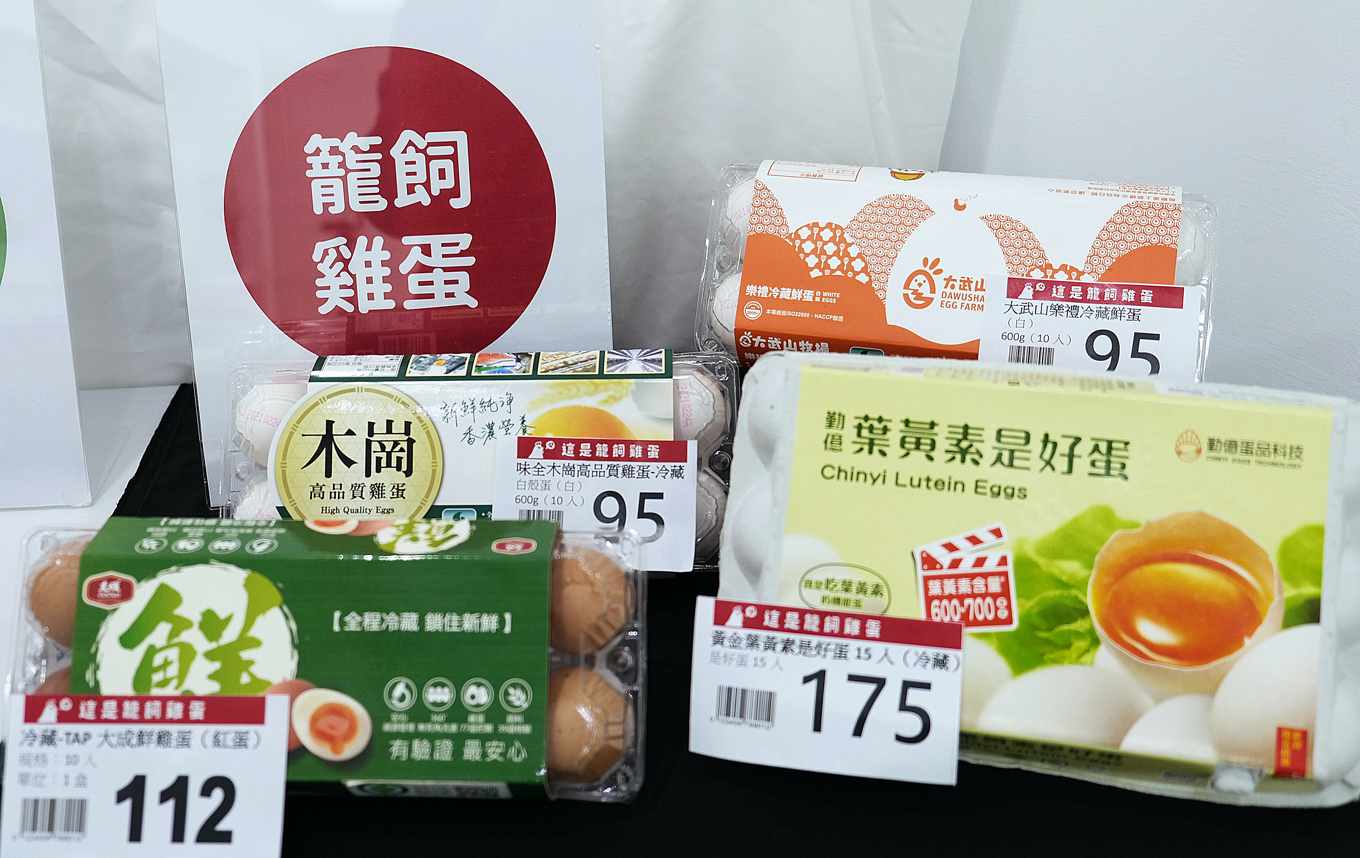
Chen Yumin then pointed out that currently the "Act Governing Food Safety and Sanitation" only requires friendly-produced eggs to be labeled on the outer packaging as "barn-laid," "pasture-raised," or "enriched cage," but does not require "caged eggs" to be labeled, leading many caged eggs to claim they have added lutein, reishi, etc., or to put photos of running hens on the packaging, which instead makes consumers mistakenly think they are good eggs worth buying at a high price. "We have protested to the Council of Agriculture for a long time; the information consumers get is not equal."
These caged eggs come from laying hens that have suffered physically and mentally. The Association calls on consumers to support "cage-free" eggs and protect the welfare of laying hens. (Photo / Yang Yuyun)
Codes to Be Sprayed on Egg Shells in the Future; Consumers: Chinese Labeling on Egg Cartons Is More Convenient
Cheng Junlong, Section Chief of the Poultry Production Section of the Livestock Division of the Council of Agriculture, responded that the government has already established the "Designated Washed Fresh Eggs as Agricultural Products That Shall Be Registered with Traceability Information and the Items to Be Registered and Labeling Methods." In the future, washed fresh eggs supplied for school ingredients, military supplementary foods, convenience stores, supermarkets, hypermarkets, wholesale stores, and online shopping channels must, before circulation and sale, register traceability information in the "Taiwan Egg Traceability Platform System" and spray codes on the egg shells, so that consumers can then distinguish the production method of the eggs.
Recommended Reading
Food Safety
Chlorpyrifos May Harm the Fetal Brain and Cause ADHD in Children; Banned in the EU, and the Latest U.S. Ruling Requires Stricter Management or a Ban
May 17, 2021
However, on closer inspection, the so-called "labeling" of the Livestock Division is to spray two rows of numbers on the egg shells. The first row has 6 digits, which are the livestock farm and washing plant numbers; the second row has 7 digits, with digits 1-6 being the packaging date, and the 7th digit using different codes to represent different production methods: R: pasture-raised production, F: barn-laid production, E: enriched cage production, C: conventional cage production.
Consumers ask, how can these codes for laying hen production methods be remembered?
The problem is that eggs are placed in cartons. If it is a transparent plastic carton, perhaps it can still be seen, but many paper cartons also have an outer sleeve added, making it impossible to closely inspect the labeling on the egg shells. Moreover, when consumers shop at convenience stores, they still have to memorize or look up the meaning of different codes, which completely loses the simple and easy-to-understand principle that labeling should have.
"Upstream and Downstream" found in a street survey that most consumers do not have the habit of opening egg cartons, and just take them and pay directly. Some also said, "The meaning of the codes should be explained next to the shelf, because without promotion, it will be difficult for consumers to remember the numbers." Another consumer pointed out more directly: "Rather than learning to memorize the numbers, it would be better to just label the egg cartons in Chinese from the start: pasture-raised production, barn-laid production, enriched cage production, conventional cage production."
Council of Agriculture: The Draft Is Still in the Public Notice Period; Suggestions Can Be Expressed
Cheng Junlong said that labeling friendly eggs on egg cartons is based on the "Act Governing Food Safety and Sanitation." Later, some people reported that eggs might be "swapped out secretly," and that every egg should be labeled, so this year, in accordance with the "Agricultural Product Labeling Regulations," every egg shell is required to be sprayed and printed. If "caged eggs" must be labeled on the egg carton, the "Act Governing Food Safety and Sanitation" would need to be amended. Cheng Junlong pointed out that the regulation on egg shell spraying and printing is still in the public notice period, and if the public has suggestions, they can express them on the draft platform.
As for whether the government is moving at a snail's pace in forcibly promoting friendly raising or abolishing cages because caged producers have pushed back, Cheng Junlong emphasized that this is absolutely not the case. "As long as consumers have demand, producers will follow up." He believes consumers are the ones with the power to change the market.