Cucumber cultivation is highly challenging, but young farmer Lin Kai-yao uses technology to solve the problems
When describing cucumbers, people usually say they are sweet, crisp and refreshing, but have you ever heard that cucumbers are "mischievous"? That's right! Young farmer Lin Kai-yao says cucumbers are animals wearing a plant's skin, and the mischievous kind at that. He once set up
When describing cucumbers, people usually say they are sweet, crisp and refreshing, but have you ever heard that cucumbers are "mischievous"?
That's right! Young farmer Lin Kai-yao says cucumbers are animals wearing a plant's skin, and the mischievous kind at that. He once set up a camera to record their movements around the clock for twenty-four hours, and found that not only do they "grow three inches in one night," they also love to toy with their tendrils, one moment bothering the neighboring leaves, the next provoking the neighboring flowers. What exasperated Lin Kai-yao most was that they would strangle the fast-growing cucumbers, leaving a ring-shaped mark on the fruit, "ruthlessly turning premium-grade produce into second-grade produce. I really want to tell them to stop causing trouble!"
Yet his "angry" tone was full of laughter, much like parents who say their child is naughty when really they just can't bring themselves to praise the child's cleverness directly. His growing skills are excellent, his cucumber yields are high, and the livelier the cucumber patch, the more boundless its vitality.
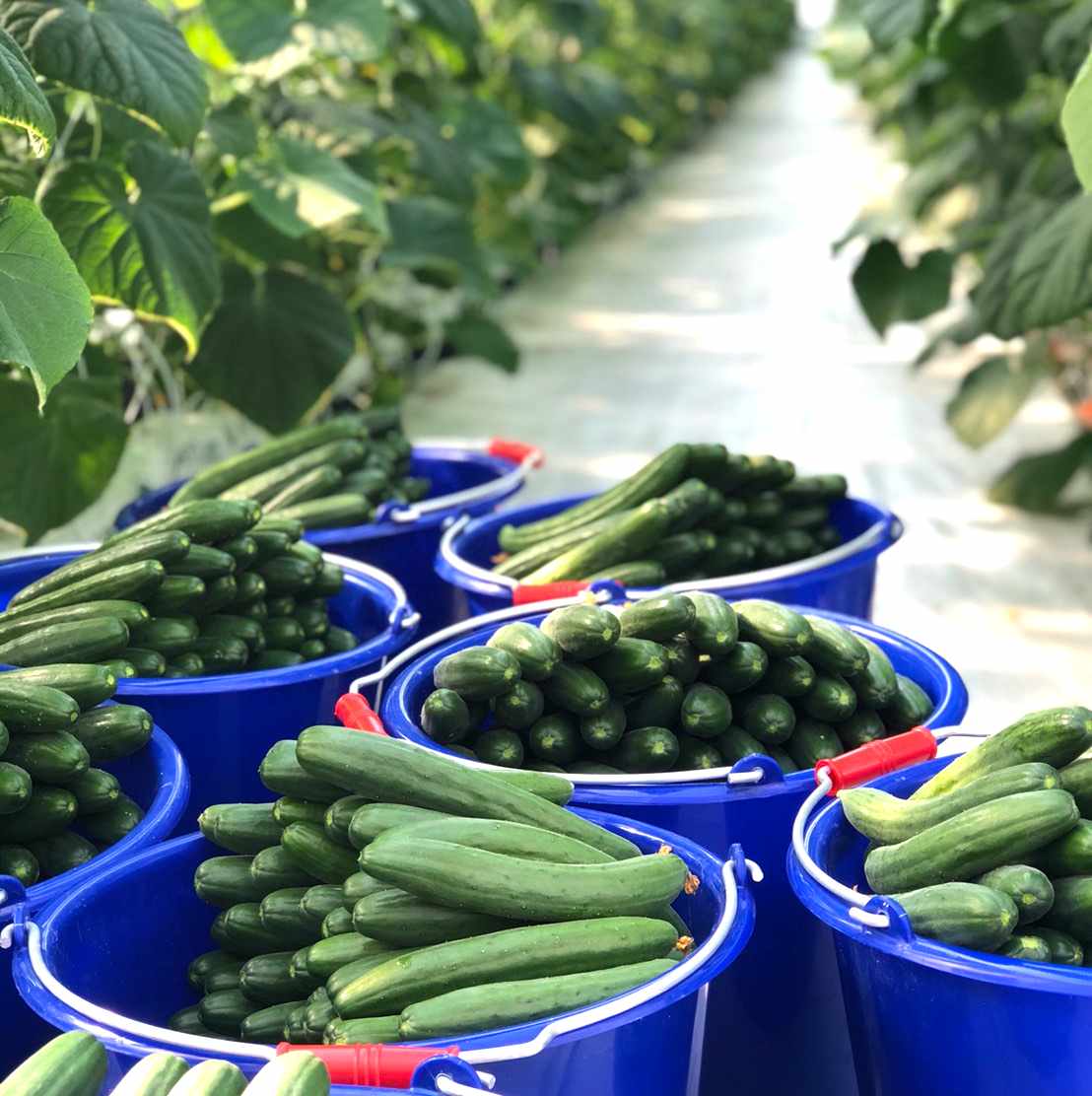
Lin Kai-yao's cucumber patch is full of life, with cucumbers that "grow three inches in one night." (Photo courtesy of Lin Kai-yao)
Never planned to be a farmer, but found agriculture deeply fascinating after coming into contact with it
Lin Kai-yao is a young farmer who has just passed the age of thirty. His cucumber patch is right beside the Chiayi interchange. On a plot of more than two fen of farmland, three greenhouses have been built, growing a single crop: the Japanese variety CU87 cucumber. Looking only at his two major achievements, winning a Tech Farmer Award and achieving crop yields far above the statistical average of the agricultural research and extension station, it would be easy to assume he must be either a farmer's son steeped in agriculture since childhood or a veteran expert with years of farming experience. Unexpectedly, he has no family farming heritage, and had only been a professional farmer for two years.
"I've loved animals and plants since I was a child. I studied life sciences in university and dreamed of becoming a biologist." Lin Kai-yao admitted that farming had never been on his career plan. After completing his military service, he first worked in marketing, design and distribution-related jobs, and later worked at the Yonglin Farm, which was how he first stepped into the field of agriculture.
This small step changed Lin Kai-yao's life from then on. He was responsible for the farm's crop production management and organic auditing, so naturally there was no shortage of chances to bend over and sweat in the fields. The farm had several hundred kinds of crops, from greenhouse leafy vegetables to open-air fruit trees, all of which passed through his checks, and he also had to keep full records throughout. Only then did he realize that the abundance on the dining table comes from farmers' hard work, and that the way seeds break through the soil and crops rise from the ground is truly fascinating.
Young farmer Lin Kai-yao is full of passion for farming, specializing in cucumbers with traceable production and sales records, with abundant results. (Photo by Yang Yu-yun)
With the support of a smart system, he learns quickly and grows well
After staying in Kaohsiung for more than a year, Lin Kai-yao wanted on the one hand to move back to Chiayi, and on the other hand felt ready to stand on his own. He chose cucumbers as his target crop, rented land, took out loans, built greenhouses and set up a trademark, efficiently constructing the stage for his farming career within just a few months. Wearing a bamboo hat and pulling on rain boots, he made his debut in the role of a farmer.
Lin Kai-yao said that aside from the "reckless courage" in his personality, the reason he dared to take on a young farmer loan was entirely because a master-level tech farmer was supporting him, filling him with confidence.
As early as when he worked at Yonglin Farm, Lin Kai-yao had visited Chang Keng-he in Chiayi to ask about various technological farming techniques, and the two hit it off very well. Upon learning that his student wanted to strike out on his own, Chang Keng-he not only offered moral encouragement but also provided various kinds of substantive assistance, including his patented "smart nutrient solution supply system," so that Lin Kai-yao did not have to stumble down many detours like many young farmers.
In Chang Keng-he's eyes, the refined Lin Kai-yao seemed more like an office worker, yet he had an agricultural passion from who knows where. Not only was he earnest and eager to learn, he was also unafraid of exhaustion, and with his high comprehension ability, Chang Keng-he was very willing to mentor him.
Lin Kai-yao explained that the smart nutrient solution system feeds environmental values sensed on site, such as temperature and humidity, back to smart equipment in real time to flexibly adjust the water and fertilizer formula. "Scientific quantification can be discussed very precisely. For fertilizer concentration, how many ppm of calcium, how many ppm of potassium, we communicate with scientific data, so progress naturally comes faster." On top of that, his teacher was also in Chiayi, essentially serving as his private tutor in farming, so it is no wonder Lin Kai-yao's cucumber patch is thriving.
Field water and fertilizer conditions can be monitored from a mobile app. With technological assistance, farming is more relaxed. (Photo by Yang Yu-yun)
Smart system resolves cucumbers' "difficult" symptoms, with yields far above average
When asked why Lin Kai-yao only grows cucumbers, he admitted it is because "the turnover is relatively fast. Planting for one month allows harvesting for two months, very cost-effective." In addition, although cucumbers are not difficult to grow, achieving a high quality rate and high yields requires a certain technical threshold. Furthermore, as a crop that can be eaten raw, the market demands relatively high safety standards. He had confidence in his cultivation techniques and also had traceable production and sales records as backing, so all these advantages could be brought into play with cucumbers.
Cucumbers are afraid of heat, but their leaves are large and need a lot of sunlight for photosynthesis. They need fertilizer, but fear soil that is too salty. They have high water demand, but their root systems cannot be waterlogged. These various "difficult" traits can be resolved one by one by using the smart system's small-amount, frequent-application mode of supplying fertilizer and water. As soon as the environment changes, the supply system immediately adjusts flexibly, so it will not become overly wet, nor will it give a lot of fertilizer when the weather is hot. Only then can the quality rate and output value be raised.
The smart system can also effectively control plant diseases. Most bacterial and fungal diseases occur because the environment is humid and hot. "Even rags get moldy, so how could plants not get sick?" But through smart drip irrigation supplying water and fertilizer, the humidity in the field area can be controlled, greatly reducing the probability of disease.
⟦NL>
In addition, the greenhouse can keep out rain, and two layers of insect-proof netting are set up around it. At the same time, personnel entry and exit are controlled. Work must always begin from the cleanest greenhouse (that is, the area just planted shortly after clearing), then move to older plant areas, and if one needs to go to another greenhouse, one must change all clothing.
"Those who know how to grow and those who don't differ greatly in yield"
Lin Kai-yao said that even with such caution, cucumber plants still get thrips and whiteflies in the later stage. However, as long as the clearing operation is thorough and care is taken in the early cultivation stage, using only some non-toxic materials after harvest begins can still last through the harvest period. "This is also why I chose cucumbers. The most you grow is just two months of harvest."
Also worth mentioning is that Lin Kai-yao chose relatively expensive white weed-suppressing mats, which on the one hand increase the brightness of the greenhouse and raise the efficiency of photosynthesis, while also reducing the possibility of insects hiding under the leaves.
"Those who know how to grow and those who don't differ greatly in yield." Lin Kai-yao said that according to statistics from the agricultural research and extension station, one fen of land can harvest more than three tons of cucumbers in one season. Although he was unwilling to state his own harvest directly, he smirked proudly while stressing that "the yield should not be too high-profile." All this protestation of innocence made one applaud his confidence.
Creating his own brand to promote his philosophy: cucumber appearance does not affect taste
For restaurants, whether for showcasing knife skills or for the aesthetics of plating and decoration, cucumbers are excellent material. In cooking, cucumbers also have endlessly varied compatibility. They are suitable both raw and cooked, and can also be pickled into side dishes or blended into drinks, offering extremely diverse ways to enjoy them.
Lin Kai-yao mentioned that fresh cucumbers should have small spines, bloom, and even retain the flower. Since these three features easily disappear during transport and handling, the presence of any one of them is a guarantee of freshness. In addition, many people stress that cucumbers must be straight and plump to be premium grade, but so-called premium grade is only relative to certain restaurants. Lin Kai-yao said that straight cucumbers are easier for chefs to handle, but taste and flavor are actually completely unrelated to appearance. "Some of my group-buy customers even specifically ask for curved cucumbers, because they know these cucumbers are good quality but lower priced."
As early as the beginning of his business, Lin Kai-yao decided to create his own brand. He believed that intermediaries and wholesale markets might not recognize the value of traceable production and sales records, and often priced products only by appearance, but he had confidence in his crops. Selling them himself allowed him to promote his philosophy to customers, so the price could be raised.
Using a homophone of "noisy" to convey a lively feeling, Lin Kai-yao named his brand "Hao Gua Zao," emphasizing his determination to persist in growing good cucumbers and that "good cucumbers are made for you." He also stressed that he hopes to use agriculture to find methods that can maintain food safety, farmers' livelihoods and sustainable land use. He hopes agriculture can be profitable and also hopes it will not be regarded as an exhausting industry, so that more young people can be attracted to join.
With two harvests possible in one day, Lin Kai-yao's cucumber patch yields far above the statistical average. (Photo courtesy of Lin Kai-yao)
Winning two major tech agriculture awards, investing a million in prize money into the farm
As a tech farmer, Lin Kai-yao won two major awards: the Yonglin Foundation's "Tech Agriculture" competition and MediaTek's "Smart in Hometown" digital social innovation competition. The competitions were entered by Chang Keng-he and Lin Kai-yao as a team. Although Chang Keng-he held the technology patent, winning awards could increase Lin Kai-yao's visibility, and the competitions also needed more scientific data, so the teacher and student teamed up together to create outstanding results.
Also using smart systems, Chang Keng-he's greenhouse crops are grown in soil, while Lin Kai-yao uses media cultivation. Because long-term cultivation of the same item easily leads to continuous cropping obstacles, in order to break free from the existing nutrient influence of the soil, he chose coconut fiber as the medium. Its characteristics of fast drainage and resistance to salinization allow the smart system to produce a water and fertilizer rhythm completely different from that of soil, proving that both soil and media can benefit under smart management. With comprehensive scientific evidence, the awards were well deserved.
After receiving the million in prize money, how did Lin Kai-yao spend it? "I invested it all." He answered as if it were only natural, sparing no effort for the progress of his cucumber patch.
Lin Kai-yao said that as long as one can use a computer and knows how to operate a mobile phone, the smart system is very suitable for farmers growing high-economic-value crops. Turning climatic conditions into scientific data, quantifying fertilizer and water formulas, and using the interaction of data to compare with the on-site plant responses can raise cultivation techniques step by step. "We have been looking at this data for a long time and are already very sensitive. We can feel the current temperature and humidity at any time, and also observe changes in the plants. We retain the essence of farmers, but greatly save labor."