Linux Foundation launches open source project AgStand for agriculture to achieve intelligent agricultural information
The AgStand Foundation will build and maintain global food and agriculture data infrastructure to help with digital transformation and address climate change, rural participation, and food and water security issues. On May 5, 2021, Calif. San Francisco, the Linux Foundation, a nonprofit that drives innovation on a massive scale through open source
The AgStand Foundation will build and maintain global food and agriculture data infrastructure to help with digital transformation and address climate change, rural participation, and food and water security issues.
On May 5, 2021, Calif. San Francisco——the Linux Foundation, a nonprofit organization that achieves innovation on a massive scale through open source, today announced the launch of the AgStand Foundation, an open source digital infrastructure project for the world's agricultural ecosystem. The AgStand Foundation will improve global agricultural efficiency by creating, maintaining, and enhancing free, reusable, open, and specialized data and application infrastructure.
Founding members and contributors include leaders from the technology and agriculture industries as well as across sectors and regions. Members and partners include Agronomy, Call for Code, Centricity Global, Digital Green, the Farm Foundation, FARMOS, HPE, IBM, Mixing Bowl and Better Food Enterprises, NIAB, OpenStand, Our SCI, the Produce Marketing Association, Purdue University/OATS and the Agricultural Informatics Lab, the University of California Agriculture and Natural Resources (UC-ANR), and the University of California, Santa Barbara Smart Farm project.
“The global agricultural ecosystem urgently needs digital transformation. Too much productivity and innovation are lost due to a lack of reusable tools and data. I am delighted to lead this community of leaders, contributors, and members from different industries and countries to help build this shared, reusable resource——AgStack, which will use free and open digital tools and data to help every stakeholder in global agriculture,” said Sumer Johal, Executive Director of AgStack.
33% of food is wasted, while 9% of the world's people are hungry or malnourished. These social drivers are intertwined with traditional technology systems that are too slow and inefficient to function in a growing and increasingly complex agricultural supply chain. AgStack will use collaboration and open source software to build 21st-century digital infrastructure that will become a catalyst for new applications, efficiency, and innovation at scale.
AgStack includes an open repository for creating and publishing models, free and convenient access to public data, an interoperability framework for cross-project use, and topic-specific extensions and toolboxes. It will leverage existing technologies such as agricultural standards (AgGateway, the UN Food and Agriculture Organization, CAFA, the U.S. Department of Agriculture, and NASA-AR); public data (Landsat, Sentinel, NOAA, and Soilgrids); models (UC-ANR IPM); and open source projects such as Hyperledger, Kubernetes, Open Horizon, Postgres, Django, and many more.
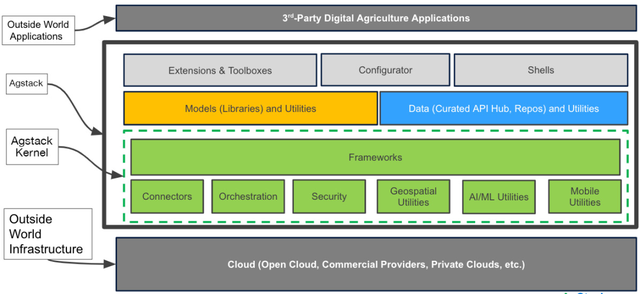
“We are delighted to provide a forum for AgStand to build and grow,” said Mike Dolan, General Manager and Senior Vice President of Projects at the Linux Foundation. It is clear that by using open source software to standardize agricultural digital infrastructure, AgStack can reduce costs, accelerate integration, and enable innovation. It is truly amazing to see industries such as agriculture innovating using open source principles.”
For more information about AgStack, please visit: http://www.agstack.org
Member/Partner Statements
Call for Code
“Through Call for Code and IBM's Tech for Good program, we have seen amazing grassroots innovation created by developers who build solutions to address local agricultural problems affecting them personally,” said Daniel Krook, IBM Chief Technology Officer for Call for Code. As thriving, sustainable open source projects hosted at the Linux Foundation, applications like Agrolly and Possible Prip can access a powerful ecosystem of partners and can accelerate their impact through a shared framework of open machine learning models, datasets, libraries, message formats, and APIs provided by AgStack.”
Centricity Global
“Interoperability means working together, and open source has proven to be the most practical way. Centricity Global looks forward to bringing our team, tools, and applications into the AgStack community and driving projects that can deliver meaningful value over the long term,” said Drew Zabrocki of Centricity Global. Now is the time to get the job done. AgStack's docking concept is a novel way to bring people and technology together under a common but sovereign framework; I think the potential to promote interoperability and data sovereignty is enormous and can deliver tangible value to farms across the entire supply value chain.”