No pesticides, no chemical fertilizers: Lin Yilong's 16 years of farming with stable income
Lin Yilong's home sits on the mountainside of Luye Highland, where time paces between the Coastal Range and the Central Range. In the morning, he watches the mist drift through the Beinan River Valley; at night, he observes the moon wax and wane, letting the stars lull him to sleep. Dulan Mountain and Luye River sing in harmony, a performance of "The Four Seasons" he never tires of hearing.
Lin Yilong's home sits on the mountainside of Luye Highland, where time paces between the Coastal Range and the Central Range. In the morning, he watches the mist drift through the Beinan River Valley; at night, he observes the moon wax and wane, letting the stars lull him to sleep. Dulan Mountain and Luye River sing in harmony, a performance of "The Four Seasons" he never tires of hearing.
As if echoing the long, narrow shape of the East Rift Valley, Lin Yilong's 7-fen farm is also long and narrow: 220 m long and 30 m wide. At the farm's entrance, he planted two rows of native Taiwanese tree species. Elaeocarpus, sweetgum, and zelkova have grown from thumb-thick, knee-high saplings into the present tree-lined avenue, bearing witness to Lin Yilong's 16 years of farming.
"Carambola and pineapple are my two main economic pillars. Other secondary crops and scattered crops help me spread out the production seasons and risks." Before touring the farm, Lin Yilong offered this explanation. With practical strategies, he builds a romantic pastoral dream. He divides the farm into numbered zones and knows the historical texture of the land like the back of his hand: which year's abundance left him so exhausted he could not straighten his back, which year's poor harvest made him want to cry without tears... In his mind is a chronicle recording the blood and sweat of a middle-aged man, as well as the joys of a farming life.
Farmer Lin Yilong builds a romantic pastoral dream with down-to-earth strategies. (Photo / Yang Yuyun)
Once an engineer in the Hsinchu Science Park, he quit because his soul was starved of oxygen
Under the premise of "having no great ambitions since childhood, just following the tide," Lin Yilong's first half of life was quite successful. The career-oriented training at Ming Chi Institute of Technology and Taiwan University of Science and Technology led him after graduation into the Optoelectronics Institute of ITRI, and then to struggle in the Hsinchu Science Park. In 15 years of a science park career, every time he changed jobs, his salary jumped a level, from rookie section manager to senior assistant vice president. At the time, his goal was to maximize the use of time and earn more money.
Lin Yilong said his daily science park routine was "nine in the morning to nine at night," but at his busiest, he once lived for two consecutive months on a "nine in the morning to two in the morning" schedule: entering the company at 9 a.m., busying himself until 2 a.m. before returning home, burning the engine of life on adrenaline. Although this brought wealth and glory that nine out of ten people would envy, "for some reason I couldn't explain, I felt this kind of work lacked a bit of vitality." In addition, excessive work pressure had already affected his family life and created parent-child conflict -- his soul was severely starved of oxygen, and Lin Yilong decided to resign.
A simple trip made him begin to feel drawn to farming
Impulsively leaving a job with a million-yuan annual salary, Lin Yilong had no ideas about the future. For an engineer who demanded plans and goals in everything, this was truly inconceivable, yet perhaps it exactly reflected how impatient he was to leave, as well as the romantic feelings in his character that had long been buried.
Although he had no plan for the future, fate led Lin Yilong step by step closer to the land. The first step was a 20-day long trip to Hualien-Taitung. Because he had for many years drunk the natural vinegar from Dulan's Wandhwa Farm, he brought his family to visit unannounced. Unexpectedly, he hit it off with the farm owner at first sight. Xu Lanxiang not only chatted with them all day, kept them for a wild-vegetable meal, but even invited them to come pull radishes the next day.
After harvesting 2 or 30 sacks of radishes, they sat on the hillside drinking hot tea and feeling the sea breeze. The sky was clear and the sun gentle, and Green Island swayed on the sea like a small boat. This simple ease and comfort made Lin Yilong suddenly feel, "What more could one ask for?" The radishes had the fragrance of soil and real weight. The fine clothes and delicacies he had earned through busy days and nights before seemed no more comforting than the clear breeze and hot tea in his hands. At that moment he felt, "Farming for the rest of my life seems like a pretty good choice."
Several months after that trip ended, Lin Yilong moved his whole family south and has farmed for 16 years to date.
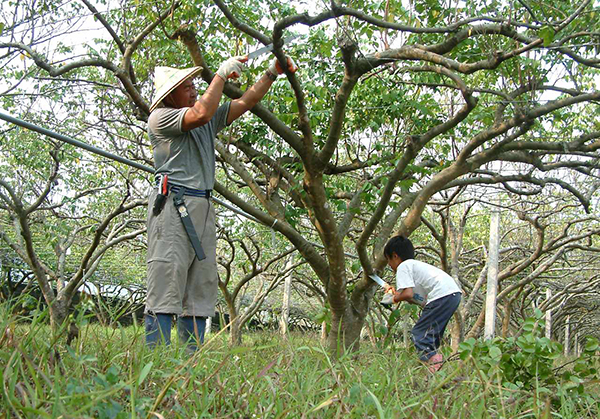
Lin Yilong and his son saw off a large branch of the carambola tree together. (Image provided / Lin Yilong)
His first attempt ran straight into a sales crisis
Lin Yilong has a total of 1.55 hectares of farmland, with different harvests in different seasons, and during that time he also sells processed products such as enzymes and fruit vinegar. Of course, none of these results were immediate. When Lin Yilong, a complete farming outsider, first entered the field, he also felt lost and did not know where to start. Fortunately, the farmer who sold him the land threw in 240 ten-year-old crystal carambola trees and told him that he could harvest over ten thousand jin a year and ship them to the Homemakers United Foundation and Leezen, and that he would know there was at least 480,000 yuan in income each year. "My heart felt more settled."
The next year, Lin Yilong harvested 8,000 jin of carambola, "not hitting the target, but not far off" from ten thousand jin. Unexpectedly, that year was a leap year, and the Lunar New Year fell in mid-February, exactly overlapping with the carambola harvest period. The Homemakers United Foundation and Leezen closed for a week and did not accept goods, but the carambola did not take a holiday; hanging on the trees, they ripened day by day.
⟦NL>
In an era before Facebook marketing, the anxious Lin Yilong first wrote emails to relatives and friends asking them to buy, and also sold through his own blog. Miraculously, no matter how much he harvested later, he was able to sell it all smoothly. He also accumulated a lot of customer data this way: "I felt that even without relying on distribution channels, selling by myself was no problem." He also believed that by facing consumers directly, he had a better chance to tell everyone about his insistence on "no pesticides and no chemical fertilizers."
In his first year of farming, Lin Yilong harvested 8,000 jin of carambola. (Image provided / Lin Yilong)
Crystal carambola became famous for being delicious; the farmer moonlights as a content editor and sells it himself
Lin Yilong's carambola is very famous. Everyone who has eaten it says their view of carambola completely changed. He boasts a little shyly: "It really is quite delicious." But after this delicious carambola made its glorious debut, the next year production immediately dropped by 90 percent, with only 880 jin harvested. That was not even the worst time. One year, the carambola harvest was only 300 jin, and the pineapple output was also painful to look at.
After dipping into some savings, borrowing a little working capital, and taking a few natural farming classes, Lin Yilong gradually understood: "Growing well is not my skill; it is all nature's decision!" In good times, he can pay off loans and add buildings; in bad times, he can get by on the coins in his piggy bank. The key is to be worthy of himself. Whether carambola, pineapple, or the later enzyme-processed products, he sells them all himself. He is the farm's public relations, accountant, general affairs, and content editor, while also being a farmer who has to go into the fields every day.
Build a customer list: take care of regulars while also "raising" new customers
⟦NL>
Lin Yilong generously shares his sales approach: "Small farmers have to write posts and take photos to win traffic for what they do." Because he writes diligently, blog readers are not only his main customer source; his articles also attracted the attention of Aquarius Publishing, which invited him to publish the book "Planting 200% LOHAS Happiness." Many readers came looking for him along that trail, supported his crops, and strengthened his customer base.
Second, from a place of empathy, Lin Yilong found that the simpler the transaction method, the better. Do not make customers fill out a pile of forms every time. "For example, some of my customers just tell me 'same as usual,' very straightforward."
To make things convenient for customers, he has to manage things well himself. Lin Yilong has a list of more than 2,000 people. He adjusts it regularly, moving the most frequent customers forward, and whenever crops are for sale, he sends them messages to build their brand loyalty. In addition, because some old customers are lost every year, he also gives priority to letting a certain number of new customers buy products, "raising them" as well.
Lin Yilong shares his farming methods in the book "Planting 200% LOHAS Happiness." (Photo / Yang Yuyun)
No pesticides, no fertilizers, yet financially secure: three key secrets
Most people's impression of no pesticides and no fertilizers is that farmers are struggling terribly. Why can Lin Yilong be financially secure? Compared with conventional farming, his crop yields are indeed on the low side, but because the unit price is higher, this can somewhat balance things out. "Letting your products stand in the high-end position in market segmentation" is Lin Yilong's first secret.
Second, the second-grade products from his harvest are easier to turn into processed goods than under conventional farming, and income from secondary industry is also one of his economic pillars. Finally, because he sells directly, distribution channels do not take 40 percent of the profit, which relatively speaking equals an increase in income.
Processing and manufacturing are part of agriculture's secondary industry and an important source of income for Lin Yilong after he began farming. (Photo / Yang Yuyun)
Keeping farm notes has many benefits; computer records make tracing easy
From his first day of farming, Lin Yilong kept farm notes every day. This was a habit he developed while working in the tech industry. About eight years ago, he computerized all the records to make tracing and comparison easier, including the purchase and repair of farm machinery, the purchase and consumption of seedlings and materials, crop harvest weights and the number of bottles of processed products, customer data and shipping records, and his own work hours. "For example, today I recorded the time spent weeding in Zone D this morning. The total weeding hours in this zone this season are 21.9 hours."
Lin Yilong observed that most farmers do keep records, but they write them on calendars or blackboards, and those methods are not easy to trace and manage. "Actually, recording on a computer takes only 15 minutes a day." It does not take much time and has many benefits. For example, every year he tries a new mulberry pruning method, then compares the harvests over the years and knows whether his experiment succeeded. Another example: if he finds that production at the same time this year has increased, he should quickly increase promotions on Facebook and respond early.
As for work-hour records, they are even more closely tied to costs. "You have to know how many work hours were spent before you can set a reasonable price," Lin Yilong said. Most farmers only earn their own labor, but why can't agriculture have profit? If you only earn wages, how will you retire? So in ordinary times, you must earn and save. Lin Yilong also frankly shares his financial situation. At present, he and his wife earn about 70,000 yuan a month. Because expenses in the countryside are low and their children are already grown, their life is actually more financially free than that of many office workers. Add to that savings in the bank, farmland they own that also has value, retirement funds from labor insurance seniority, and farmers' insurance, and their retirement life seems to be no problem.
Lin Yilong spends 15 minutes every day recording farming details, which helps him carry out field management more thoroughly. (Photo / Yang Yuyun)
Farming depends on impulse; only with no way back can you take the right path
Lin Yilong believes the sense of achievement in farming is very direct, and customer feedback gives him great encouragement. Farming is also very free. He now works an average of just over 5 hours a day, and finally has time for his diverse interests: watching movies, walking, and being close to nature. Farm life has let him meet many different people, and these friends' experiences enrich his perspective. "Most importantly, farming makes my wife very happy. This is what she most wanted to do in her life."
So, does he support others in taking up farming?
"I would ask him why he wants to farm. What crops does he want to grow? How much income does he want? Does he know how much area he needs to plant to reach that income?" Lin Yilong said sincerely that these things must be thought through clearly.
But then he changed tack and admitted, "However, if you think all of that through clearly, you probably won't go farming." He said farming actually depends on impulse. Because of the impulse back then, he pushed himself to a point where there was no way back, and only then could he "make his life go in the direction he wanted."