Tea Science Popularization: A One-Time Guide to Understanding the Six Major Tea Types
When it comes to beverages, if coffee represents Western culture, then tea is certainly an important part of Eastern society's centuries of development. Coffee, alcohol and tea are called the world's three major beverages, each with its own characteristics and each with its own adherents, and unlike the strong flavors of coffee and alcohol,
When it comes to beverages, if coffee represents Western culture, then tea is certainly an important part of Eastern society's centuries of development. Coffee, alcohol and tea are called the world's three major beverages, each with its own characteristics and each with its own adherents, and unlike the strong flavors of coffee and alcohol, tea is more understated and mysterious, but perhaps it is precisely this excessive mystery that has prevented Taiwan tea, despite its excellent quality, from being systematically made known to the public, causing many people to be able to clearly name coffee varieties, origins and characteristics, yet have only a half-understanding of information related to Taiwan tea, which is a great pity. This article will guide you through the most basic classification of tea, allowing you to experience the diverse flavors of Taiwan tea.
When it comes to the types of tea, I believe many people will think of black tea, green tea and oolong tea (blue-green tea), but if we use the international standard method of tea classification, there are six major categories in total, namely: black tea, green tea, oolong tea (blue-green tea), white tea, yellow tea and dark tea. Indeed, the first three are the types most familiar to everyone, and Taiwan produces all of them, while the latter three mostly come from mainland China, and are therefore relatively rare in Taiwan. The wonder of tea lies in its processing procedures. Many people mistakenly believe that black tea and green tea are types of tea trees, but this is not the case. Every tea leaf can be processed into the above six major tea types according to its method. Take India's Darjeeling tea as an example: Darjeeling is a world-famous black tea, but if made using the green tea method, it can also be made into green tea (it just does not taste as good). Therefore, each type of tea has its suitable method of production, and each tea type also has its important techniques, such as the fermentation of black tea, the kill-green of green tea, the leaf-shaking of blue-green tea, the pile-fermentation of dark tea, the drying of white tea, and the menhuang (yellowing) of yellow tea. Selecting the suitable production technique is the key.
Because of Taiwan's favorable terrain, environment and climate, we have a good environment for cultivating tea. Looking at tea types around the world, when it comes to black tea, Britain is the dominant power; for green tea, Japan, with its emphasis on the spirit of tea ceremony, is a leader; but when it comes to blue-green tea, Taiwan need not be modest, as Taiwan's blue-green tea can be said to be the global leader. This article will guide you through the basic six major classifications of tea, and where these tea types are grown in Taiwan.
Green Tea
Green tea is an unfermented tea type that has not undergone a fermentation process. Its processing steps are kill-green, rolling and drying. It is the tea type with the longest known history, traceable back 3,000 years, and is also the least processed among the six major tea types, retaining the most natural original flavor. Green tea can be divided by kill-green method into pan-fired and steamed; Taiwan and mainland China mainly use the pan-fired method, while Japan uses steamed green tea, such as sencha and the more premium "gyokuro."
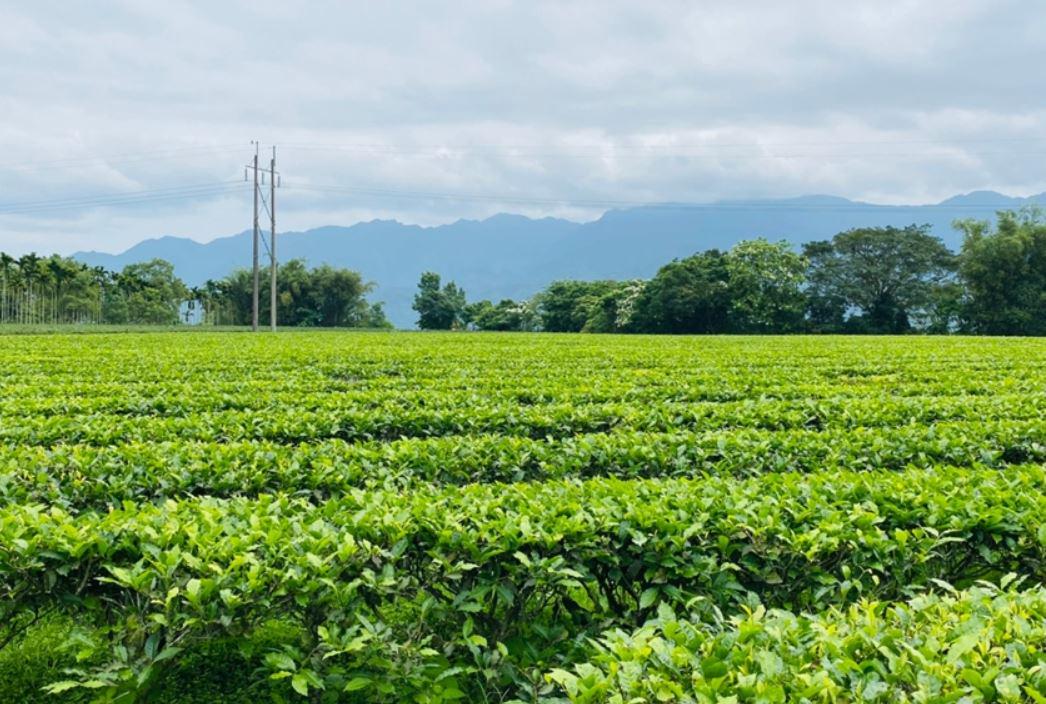
Sanxia is Taiwan's largest green tea producing area (Image source / Sanxia District Farmers' Association - Fresh Farmer Direct Sales Store)
Taiwan's green tea output is relatively small, with the main producing area concentrated in Sanxia District, New Taipei City, represented by Biluochun green tea, Longjing tea and Bachuan green tea. Biluochun is the most produced and most common type of green tea in Taiwan, and both its producing area and that of Longjing tea are Sanxia; both are also unfermented teas, giving off a fresh and natural original tea leaf aroma. Biluochun tea liquor is emerald green, while Longjing tea tends toward yellow-green. Bachuan green tea is an emerald-grade green tea, with Nantou as its producing area, made with a four-stage smoking method combined with jasmine flowers to create a unique flavor.
Black Tea
Black tea is a fully fermented tea with a fermentation degree of 80-90%. It does not undergo kill-green during production, and is made through direct withering, rolling and fermentation. Black tea is currently the tea type with the largest drinking population, and is also called the most inclusive tea, because whether milk, spices or sugar are added, it can display a balanced flavor. Although black tea originated in China, its ability to reach today's global status must be credited to Britain. In the 19th century, with the expansion of the hegemony of Britain, the "empire on which the sun never sets," it also brought its own habit of loving tea to colonial countries, thus allowing the fragrance of black tea to blossom everywhere.
If distinguished by purity, it can be divided into three types: original tea, blended tea and flavored tea. Original tea means single-origin tea, such as Keemun black tea and Assam black tea; blended tea, also called blended tea, refers to original teas from multiple producing areas mixed together, such as breakfast tea; and flavored tea is tea with fruits, flowers, spices and other flavors added, the most famous of which is "Earl Grey tea," which is made by mixing bergamot and tea leaves, and therefore has a unique citrus fruit fragrance.
(Image source / Yuchi Township Farmers' Association)
In Taiwan, besides oolong tea being world-famous, the cultivation of black tea should not be underestimated. Taiwan's black tea producing areas are mainly concentrated in Nantou, Hualien, Pinglin in New Taipei, Taichung and Chiayi. Taiwan Tea No. 18 "Hongyu" is bred from Taiwan wild tea and Myanmar large-leaf tea, with cinnamon and mint aromas; Taiwan Tea No. 21 "Hongyun" is selected and bred from Indian large-leaf and Keemun small-leaf varieties, and its tea liquor gives off pomelo blossom honey and ripe fruit aromas; Taiwan Tea No. 8 "Assam black tea" was improved from Indian Assam, has a relatively rich tea taste with a malt aroma, and is suitable for use as a flavored tea; "Honey Fragrance Black Tea" is another major feature of Taiwan, with the main tea varieties being Qingxin Oolong and Taiwan Tea No. 12 Jinxuan, etc. Because its tea leaves are bitten by the small green leafhopper, they are instead given a unique honey fragrance, and are quite well received by the market.
Blue-Green Tea
Blue-green tea, also called oolong tea, is the tea type Taiwan takes pride in. Its fermentation degree lies between green tea and black tea, having both the natural sweetness of green tea and the rich aroma of black tea. Its production process is also the most complex, requiring steps such as solar withering, indoor withering and stirring, and because the process is long and complex, different types of blue-green tea each have their own characteristics. Such well-known teas as Wenshan Baozhong, Tieguanyin, Oriental Beauty tea, Dongding Oolong tea and high-mountain tea all belong to the category of blue-green tea.
Wenshan Baozhong tea mostly uses tea trees of the Qingxin Oolong and Taiwan Tea No. 12 varieties, with producing areas mostly located in Wenshan and Nangang in Taipei City and Shenkeng, Shiding and Pinglin districts in New Taipei City. Wenshan Baozhong tea is a lightly fermented tea type, belonging to the fragrant strip-shaped Baozhong, with a clear tea liquor color and a sweet, mellow flavor that places special emphasis on aroma; Tieguanyin is most famous from Muzha Zhanghu Mountain and Shimen District in New Taipei City. Tieguanyin is both a tea tree variety and a tea-making technique, so tea made from the Tieguanyin tea tree is called "true-cluster Tieguanyin." Tieguanyin has a rich flavor, with a roasted aroma and a mellow honey taste; Oriental Beauty tea, also called Pengfeng tea or Baihao Oolong, is a heavily fermented partially fermented tea, and its unique honey fragrance likewise comes from the bites of the small green leafhopper (known as "zhuoxian"); the higher the degree of biting, the richer the honey fragrance; Dongding Oolong tea's producing area is concentrated in Lugu, Nantou, and together with Wenshan Baozhong tea it has the title of "Baozhong in the north, Dongding in the south." It is a medium partially fermented tea with a fermentation degree of 50-60%, and its special "cloth-rolling tea-making" technique makes the tea leaves hemispherical, with a smooth mouthfeel and a sweet, mellow richness, making it a highly renowned tea type in Taiwan; and high-mountain tea is tea relative to flatland and hilly tea, generally referring to tea produced from tea gardens at altitudes above 1,000 m, widely distributed including Chiayi, Nantou, Hualien and Taichung, with the main famous tea areas being "Alishan," "Shanlinxi," "Lishan" and "Dayuling." Under the uniquely favorable geographical environment, the tea leaves have a unique high-mountain charm, with a smooth and full-bodied taste, and in order to preserve this flavor, most high-mountain tea uses light roasting or even no roasting, allowing the most natural tea fragrance to linger in the memory.
Top left: Oriental Beauty tea / Top right: Wenshan Baozhong tea / Bottom left: Tieguanyin / Bottom right: Dayuling tea (Image source / Liao Changxing Tea House)
⟦NL>
Dark Tea
Dark tea is a post-fermented tea type, with a fermentation degree of 100%. Hearing "dark tea" may sound unfamiliar, but if we say "Pu'er tea," it is very famous (of course, Pu'er tea is only one kind of dark tea and cannot fully represent dark tea). After processing, the pile-fermentation time is relatively long, which also makes the tea leaves brown in form, and because of its long fermentation time, it also increases the value-preserving nature of Pu'er tea, making its value rise accordingly. Well-known dark teas besides Pu'er tea include southern dark tea, Hubei old green tea, Guangxi Liubao tea, Sichuan's West Road side tea and South Road side tea.
Hunan dark tea (Image source / Changxing Tea Shop)
White Tea
White tea undergoes neither kill-green nor rolling during processing, focusing on the two major steps of "withering" and "drying." During indoor withering, temperature and humidity are controlled, and once the aroma is released, drying can proceed, thus preserving the original appearance of the tea leaves, unlike the strips of black tea or the balls of blue-green tea. There is also a saying about white tea: "One year tea, three years medicine, seven years treasure," representing that the medicinal value behind white tea increases with time. In the past, there was even the custom of storing white tea for treating illness. White tea producing areas are mostly concentrated in Fujian, China, with small output, and the better-known types are Baihao Yinzhen, White Peony, Gongmei, Shoumei and new-process white tea, five kinds in total.
Yellow Tea
Yellow tea belongs to the lightly fermented tea type, with a process close to that of green tea, but with an additional technique of men dui wo huang (sealed piling and yellowing). After kill-green, it is covered and wrapped with cloth or paper and slightly heated, causing non-enzymatic oxidation to occur. After yellowing, the tea leaves appear yellow, and the tea liquor is also golden yellow, which also becomes the characteristic of yellow tea: "yellow leaves, yellow liquor." The better-known types include Junshan Yinzhen, Mengding Huangya and Huoshan Huangya.