Savoring Organic Farming: Rooted in Tribal Culture, Creating a Brand-New Indigenous Farming Economy
[Savoring Organic]Rooted in Tribal Culture, Creating a Brand-New Indigenous Farming Economy To promote tribal organic agriculture, the "Tribal e-Go" platform was established, teaching tribal farmers to carry out season-limited agricultural marketing and supporting the operation of the sales platform. (Image provided by
[Savoring Organic]Rooted in Tribal Culture, Creating a Brand-New Indigenous Farming Economy
To promote tribal organic agriculture, the "Tribal e-Go" platform was established, teaching tribal farmers to carry out season-limited agricultural marketing and supporting the operation of the sales platform. (Image provided by the Taiwan Indigenous Peoples College Promotion Association)
Text by Zhang Yaru Images provided by Tribal e-Go: Indigenous Tribal Joint Production and Marketing Platform Facebook fan page
In 1999, the earth-shaking 921 earthquake struck. Although it severely devastated many Taiwan indigenous tribes, it also brought tribal workers together. They cherish the connection between people and the land, unite tribal strength, practice organic agriculture, carry forward the indigenous spirit of sharing and common ownership, and build a sales platform and production-marketing model belonging to the tribes. In the future, they aim to establish a cultural and creative space for indigenous culture and organic agriculture, creating a brand-new indigenous farming economy belonging to the hometown industries.
Establishing a Sales Platform to Help Tribes Build Self-Reliant Industries
"The opportunity for our establishment had nothing to do with agriculture at all," laughed Jin Huiwen, secretary-general of the Taiwan Indigenous Peoples College Promotion Association. Originally founded to pass on and promote educational and cultural undertakings, by a twist of fate tribal farmers took the initiative to propose marketing the grapes grown by the local production-marketing group in Xinyi Township, Nantou County, and thus the "Tribal e-Go" platform was established. By pooling marketing resources, teaching tribal farmers to carry out season-limited agricultural marketing, supporting the operation of the sales platform, raising production techniques, and improving the agricultural environment, it further helps tribes rebuild and build self-reliant industries.
Stepping into Organic Agriculture, Growing and Thriving Together with the Tribes
Engaging in organic agriculture is not difficult for indigenous peoples; their farming methods have always upheld the spirit of coexisting with nature. "Doing organic is a way to help tribes rebuild and build self-reliant industries." Jin Huiwen further explained that organic agriculture can also differentiate itself from general market products, making it an industry very well suited to the tribes.
Through establishing the "Tribal e-Go" online sales platform, the association allows tribes to engage in organic agriculture with peace of mind and further build self-reliant industries. (Image provided by the Taiwan Indigenous Peoples College Promotion Association)
At the end of 2007, teacher Wu Meimao, who promotes tribal organic agriculture, approached the association, hoping they could regularly sell the tribes' organic vegetables and fruits. But seasonal and regular operations are completely different ways of doing business, and at the time Taiwan's organic market was not large, so after nearly a year of consideration, the association formally took it on. During this period, the "Regulations Governing the Certification of Organic Agricultural Products and Organic Agricultural Processed Products" happened to be passed, and the association and the tribes, who had already been working hard on the organic path, were eager to try. The association even followed certification bodies to tribes across the country for nearly half a year, understanding the details of organic certification, and even advanced the certification fees for farmers. From recording the crop production process, to the organic fertilizers and materials that could be used, reminding farmers to keep receipts for purchased materials... patiently communicating with farmers, accompanying the tribes all the way, learning and growing together with the farmers.
Jin Huiwen said that since 2017 the Agriculture and Food Agency has been reviewing and recognizing "Eco-Friendly Farming Promotion Groups," and the association became Taiwan's third eco-friendly farming promotion group. The Agriculture and Food Agency further helped hold many marketing events, giving tribal farmers who had not passed organic certification an eco-friendly farming ID, distinguishing them from conventional farming, allowing the association to reach more farmers who wanted to change their farming methods and encouraging them to move toward organic agriculture.
Jin Huiwen promotes eco-friendly farming to farmers of the Atayal tribe in Wufeng Township, Hsinchu County.
⟦NL>⟧
Uniting Tribal Strength to Practice the PGS Joint Production-Marketing Concept
Compared with general organic agriculture, where consumers and producers do not know each other and buy organic agricultural products through third-party certification, the Participatory Guarantee Systems (PGS) emphasizes the participation of multiple stakeholders, letting producers and consumers interact, set farming standards, and build relationships of trust. At first Jin Huiwen thought the PGS strategy was quite inconceivable - how could farmers possibly set standards on their own and still meet organic farming requirements? But at the time the association had limited manpower, making it hard to maintain close contact with the forty or fifty cooperating farmers, and farmers responded that certification fees were high and were unwilling to step into organic agriculture, so Jin Huiwen began to deeply understand PGS. In 2014 it ran in parallel with organic agriculture, and it took 6 to 7 years to gradually figure out a PGS model belonging to the association.
The association established regional indigenous farming cooperatives in five regions - Hsinchu, Nantou, Chiayi, Hualien and Pingtung - each developing the agricultural product characteristics of its area using the concept of PGS estates. Every month the regions gather for a PGS consensus meeting, and ordinarily they also discuss production techniques, pests and diseases, marketing channels, and the future direction of the organization through online groups.
In 2019, Jin Huiwen represented Taiwan, China to attend the international organic farmers' alliance in South Korea.
"To be honest, at first the farmers were not active." Jin Huiwen did not lose heart. After continuing for several years, through online group exchanges of agricultural information, a base for gathering and transmitting messages gradually formed, which also brought farmers in different regions closer, and they even took the initiative to speak up in the monthly meetings, raising new ideas and different approaches for joint discussion. Through the joint efforts of the association and the farmers, in 2016 Tribal e-Go even became the first region in Taiwan, China to obtain recognition for the Participatory Guarantee Systems (PGS) of the International Federation of Organic Agriculture Movements (IFOAM), registered on the IFOAM-PGS global map.
Breaking Up the Whole into Parts: Industrial Transformation Is Imperative
As the visibility of the organic industry in Taiwan, China has increased, large retailers and supermarkets such as Carrefour and PX Mart have also joined the ranks of selling organic agricultural products, making competition in the broader environment even fiercer, and the performance of many small organic stores has been relatively affected. Jin Huiwen said that Tribal e-Go's farmers cannot achieve mass production or standardized quality, and their main channel is these small organic stores. As their space to survive keeps being squeezed, how can they find a way to survive in large channels?
Jin Huiwen was the first to propose a strategy of breaking up the whole into parts, changing the original distribution mechanism that concentrated vegetable deliveries to the northern main packing site, dispersing them to four locations - New Taipei, Nantou, Hsinchu and Hualien - to reduce transport costs and loss rates, and assigning different tasks according to the consumption characteristics of each region. New Taipei, close to the greater Taipei consumer market, focuses on marketing and promotion, simply collecting goods without packing; the main packing site moved back to the Nantou headquarters, while medium-sized packing sites were set up on the outskirts of Hsinchu and Hualien. Since the distribution mechanism was changed in early 2020, it has not only effectively reduced the loss rate, but transport costs have been saved by about one third compared with the past, a quite remarkable result. "In the future we also hope to set up a base in Pingtung to serve farmers in central and southern Taiwan."
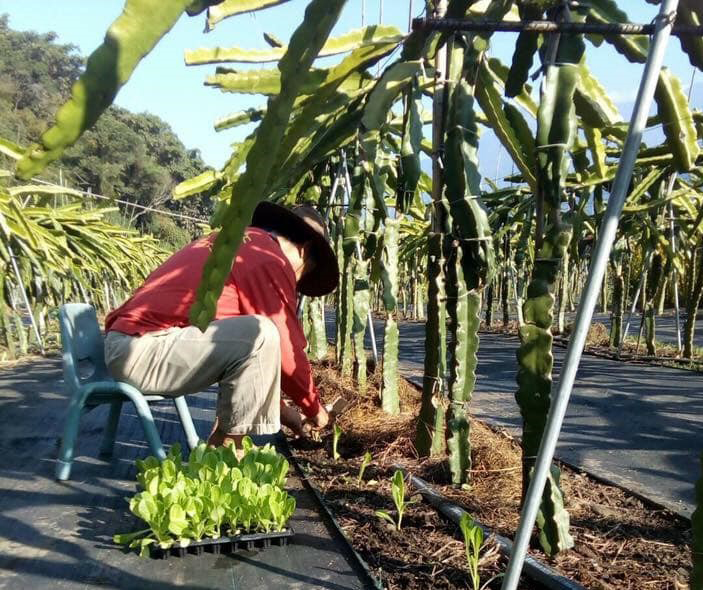
The vegetables under the dragon fruit have grown strong, ready to head to the packing site of the Nantou Regional Indigenous Farming Cooperative.
Jin Huiwen breaks up the indigenous farming cooperatives across Taiwan, China into parts, combining independent bookstores and packing sites to become diversified indigenous farming sharing spaces.
Blending Traditional Culture: The Indigenous Farming Sharing Space Is Born
To break through the past business model, the second focus of Tribal e-Go's transformation is combining online with offline. Besides the existing online platform, Tribal e-Go has set up bases in Hsinchu and Hualien, which are not merely packing sites, but combine agriculture with indigenous culture, planning indigenous farming sharing spaces in a compound business model, showcasing the rich facets of indigenous industry, culture and food.
Consumers can not only see books on indigenous culture and related issues in the store, and eat meals and drinks made from local indigenous specialty crops, but occasionally also encounter tribal farmers coming in to deliver and pack vegetables. "Agriculture is the root of culture. Why can't selling vegetables and selling books be combined?" Jin Huiwen said. She plans to plant specialty crops around the bases, such as red quinoa, ramie and pigeon pea, so that this place is not only a cultural and creative space, but more like stepping into the daily life of the tribes, passing on the value of indigenous industry, history and culture to consumers.
Hualien's unique agricultural product, the bitter eggplant, is called "tire" by the Amis people. Although its taste is similar to bitter melon, it has a sweet aftertaste.
Diverse, Sustainable Joint Management: Closely Tying Production Sites to Farmers
"We want farmers to know that Tribal e-Go is right beside them, and everyone is a part of the operation." Jin Huiwen stressed that the indigenous farming sharing spaces in each region are deliberately set up close to the production sites, such as the Hsinchu indigenous farming sharing space at the entrance of Jianshi Township, so farmers can deliver vegetables directly to Jianshi Township without mailing or home delivery, and can pack nearby. She also looks forward to increasing interaction with tribal farmers and enlivening relationships in this way. Jin Huiwen believes that farmers can see these processes on site, and thereby understand the entire cost structure and market demand, learning directly from practice while cultivating the ability to operate independently.
Jin Huiwen, secretary-general of the Taiwan Indigenous Peoples College Promotion Association.
There is no need for ornate, extravagant decoration, nor for a prime location in the city center. The indigenous farming sharing space in Jin Huiwen's heart cannot be separated from the production sites and farming friends. "As long as the philosophy is the same, you can find us no matter how remote it is." She also looks forward to more tribal youth returning home to start businesses in the future, moving toward the beautiful vision of sustainable tribal development.