Taitung Organic Sugar Apple Marketing Success: Young Farmer Li Chun-yi's Eco-Friendly Grass Cultivation
Providence University alumnus Li Chun-yi once worked as a part-time worker and supervisor at a concert organizing company, then returned to his hometown in Taitung to grow sugar apples, transforming from an urban youth into a rural farmer, overcoming skeptical looks from those around him to prove that the eco-friendly "grass cultivation" method is correct
Providence University alumnus Li Chun-yi once worked as a part-time worker and supervisor at a concert organizing company, then returned to his hometown in Taitung to grow sugar apples, transforming from an urban youth into a rural farmer, overcoming skeptical looks from those around him to prove that the eco-friendly "grass cultivation" method is correct; he also rallied like-minded young farmers and successfully marketed Taitung sugar apples overseas. His hands-on grass cultivation method earned research recognition from the Taitung District Agricultural Research and Extension Station. A business administration graduate, he said it all begins with "management" - putting his education to practical use.
Li Chun-yi graduated from Providence University, serving as department student association president and student body president in his junior and senior years respectively, and continued to pursue a graduate degree after graduation. His experience organizing events for school clubs took him from a part-time worker helping with concerts to concert coordinator, company supervisor, and even being in charge of an entire company, spending 7 years along the way.
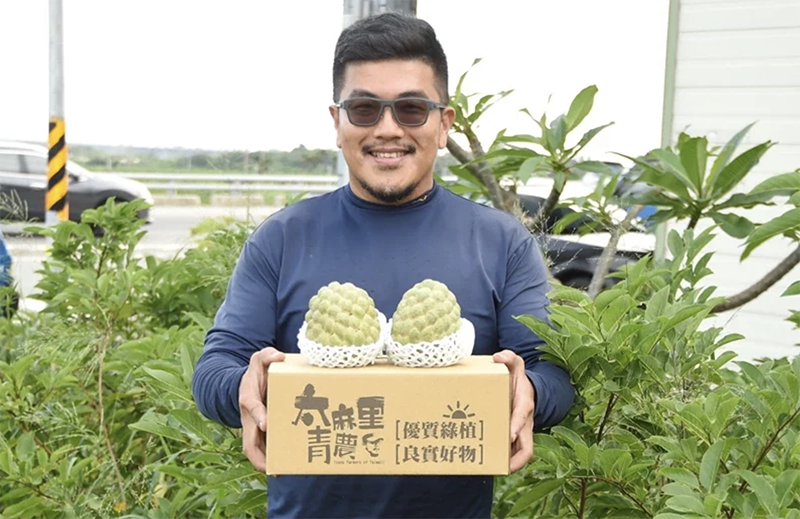
In 2009, Typhoon Morakot (the August 8 Flood Disaster) devastated the sugar apple orchard at his old home in Taitung - the lifelong effort of his grandfather and father. Of the original 6 hectares of farmland, nearly 2 hectares were lost and awaited replanting, while some land was involved in issues such as national land being expropriated. With countless matters to deal with and everything awaiting revival, Li Chun-yi saw his own responsibility in his father's weary eyes. But to go from an urban youth to a fruit farmer, he needed some buffer - so he traveled widely, looking back at the past and thinking about the future. A year of backpacking life let him "reset to zero."
⟦NL>
In 2011, Li Chun-yi returned to his hometown of Taitung, starting as his father's assistant and learning to grow sugar apples. In the second year, his father gave him a plot of land to manage. He saw that his father and fellow farmers habitually used herbicides, but herbicides cost money and labor, had a low return on investment, and would remain in the soil and affect the ecosystem. To save labor and money, he began adopting "grass cultivation." Because this would let weeds run rampant in the orchard, his father and surrounding farmers could not stand it, and he was often questioned - yet this sparked his rebellious, never-give-up personality and his desire to prove he was right.
Li Chun-yi began doing his homework, referring to domestic and international research and practices, insisting on not using herbicides, and also obtaining traceability certification and organic cultivation. Through participating in sugar apple evaluations he achieved good results, and sold at the Taipei auction market for a good price of nearly 300 yuan per kilogram, in order to win recognition.
Li Chun-yi noted that Taiwan's sugar apple varieties and production techniques lead the world, and sugar apples' antioxidant benefits are deeply loved by people in Singapore, Malaysia and elsewhere. But the Taiwan market is limited, so through cooperation with traders, he successfully exported sugar apples to Hong Kong, China, Macao, China, Canada and other places.
Li Chun-yi said that in recent years, people from Vietnam, Thailand, Malaysia and Taiwan, China have gone to China to grow sugar apples, gradually eroding the advantage. To stay ahead of others, besides growing good and large fruit, only safer cultivation methods such as pesticide-free or organic can highlight its value. Grass cultivation, he said, is about building ecological diversity and letting the ecosystem balance naturally; if an orchard has pests, it naturally has natural enemies too - pests will naturally be eliminated and will not affect the harvest.
His method drew the attention of the Taitung District Agricultural Research and Extension Station, which verified it through quantitative science, making Li Chun-yi feel it was "very meaningful." He also used product differentiation, leveraging social media and e-commerce to market sugar apples, while rallying like-minded partners to form a young farmers' production and marketing group, which won recognition as one of the Council of Agriculture's Top Ten National Production and Marketing Groups.
Li Chun-yi said that these years he has achieved some success, and it all originates from "management" - putting his education to practical use. In particular, in his university marketing course, the teacher used case discussions that allowed students to think about the reasons for a case's success or failure, training them how to think; his club experience taught him how to get things done well. He encouraged his junior schoolmates: "Training yourself to have good thinking habits is truly important."