Heirloom seeds passed down through generations, yet over 95% have already disappeared from farmland
More than ten thousand years ago, humans realized they could keep a portion of the seeds they harvested so they could replant them the following year.
Xinyu (New Discourses): The common people ate meat and drank blood, and clothed themselves in hides and fur; when it came to Shennong, he considered that the crawling insects and running beasts were difficult to use to nourish the people, so he sought things that could be eaten, tasted the fruits of the hundred herbs, examined their sour and bitter flavors, and taught the people to eat the five grains.
Until the twentieth century, crops were reproduced in this way.
Driven by commercialization and technology, this has progressed from crossbreeding to “artificial mutation,” “ploidy breeding,” “cell engineering,” and “chromosome engineering,” and on to the “genetic engineering” that is so widely debated in society today.
China's traditional folk seed breeding has become synonymous with being backward, Chinese agriculture is severely “short on chips,” and our “agricultural chips” have been strangled.
China imports about7.5 million tons of crop seeds each year, with an import value of about5 billion US dollars, making China a major seed-importing country. At present there are about6500 domestic seed companies, most with turnover below 30 million, and the domestic seed industry market is severely mired in cutthroat competition.
Domestic seeds are sold by the jin, while foreign seeds are sold by the seed.
China lags20-30 years behind other countries in the field of modern scientific and technological breeding, and at present it is still very difficult to overtake on the curve. But over-reliance on imported seeds may well carry the risk of “seed cutoff” in the future.
At this year's Two Sessions, the state emphasized that seed security must be firmly held in our own hands.
Yet nature's heritage has become a “patent” monopolized by giants
The genetic makeup of every traditional variety is unique, and this uniqueness is the result of evolved resistance to pests and diseases and adaptation to specific growing conditions and climates.
But in the current situation, the number of seed varieties we grow from north to south is very limited.
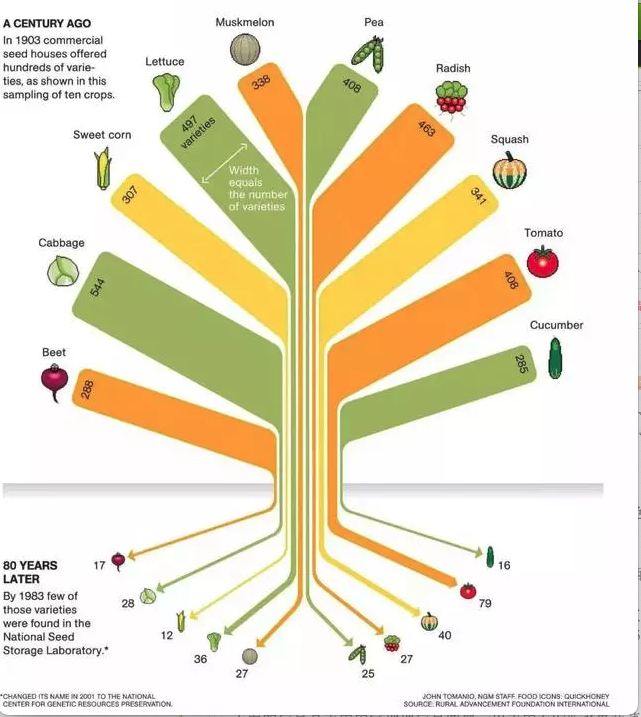
Note: In the image, the wider the color band, the more varieties of that vegetable or fruit; the bands above the horizontal line represent the categories in 1903, and the bands below the horizontal line represent the categories in 1983.
The major categories from left to right are, in order:
beet, cabbage, sweet corn, lettuce, muskmelon, pea, radish, pumpkin, tomato, cucumber.
If you had lived in 1903, you would have had more than 500 kinds of cabbage, more than 400 kinds of peas and tomatoes, and 285 kinds of cucumber to choose from.
Eighty years later, in 1983, the categories of vegetables and fruits had fallen sharply, leaving only 28 kinds of cabbage, 25 kinds of peas, 79 kinds of tomatoes and 16 kinds of cucumber.
Comparing the commercial seed bank of the early 20th century with the National Seed Storage Laboratory of 1983, researchers found that over these 80 years, 93% of the seeds had disappeared.
The information above is from a National Geographic infographic showing that in the United States 93% of fruit and vegetable varieties are nearly extinct.What is even more frightening is that the data in this chart is already more than thirty years old, and by today the problem must be even more serious (no data for China could be found).
Traditionally, from one harvest season to the next, farmers could save seed by breeding and propagating it themselves. If left undisturbed, nature would provide what you needed for the next harvest in an endless cycle.
Commercial cultivation erodes the genetic makeup of crops. As the genetic diversity of crops decreases, the most direct result is an increase in epidemics and pest infestations. Take the simplest example: the 2020 French "tomato virus." This virus precisely targeted disease-resistant varieties, while the old, previously non-resistant varieties turned out to be less sensitive to the virus.
The West has enacted laws prohibiting the sowing of unregistered edible plant varieties (behind this, of course, is the work of monopoly groups). This is truly quite thuggish; even the seeds I use to grow a bit of vegetables in my own yard need your approval, but that is what the law says.
Farmers have no choice but to buy seeds from seed monopoly companies.
Let's talk about Monsanto, because the biggest monopoly in the seed industry is it.Monsanto's development was fueled by genetically modified patents; after 1996, the United States opened up permits for GM cultivation. Monsanto seized the GM opportunity, successfully applying a biotechnology business model in agriculture, and gained strong influence in the fields of GM seeds for corn, soybeans, cotton, rapeseed and more, ushering in the global era of agricultural genetic modification. In 1998, through a series of mergers and acquisitions, it became the leader of the world seed industry in one stroke.
In 2018, Monsanto was acquired by Bayer for 63 billion US dollars, further consolidating its voice in the world seed industry and ushering in a new era of Bayer-Monsanto seed monopoly.
According to statistics, 80% of the global food market is controlled by 5 multinational corporations, including Monsanto.
What food each family can eat is already firmly controlled by these few multinational seed companies. Through monopoly control of every link -- production, planting, processing, transport, sales and so on -- they have formed an entire industrial chain linking upstream and downstream, and hold absolute sway in the agricultural product market.
China, too, has paid more than 20 years of tuition because giants monopolized nature's “patents.”
In 2000, Monsanto visited China. When it was time to part, out of courtesy and friendliness, the Chinese side gave them a wild soybean, and at the time the Chinese side could never have imagined the consequences of giving away this wild soybean.
After receiving such a gift, Monsanto's staff treasured it like a priceless jewel, and then from that single seed they extracted a “high-yield gene” and a “virus-resistant” gene. Later, Monsanto used the research results from this soybean to apply for 64 international patents.
As a result, Chinese farmers later discovered that growing Chinese soybeans themselves would actually infringe American patents. The enthusiasm of Chinese soybean farmers was cut down by more than half by the high compensation payments. China also went from being a country with 90% of the world's known wild soybean resources to the world's largest soybean importer, and now ranks behind the United States, Brazil and Argentina in production.
Similar things have also happened to species such as China's kiwifruit, Beijing roast duck and orchids.
The global seed industry is stepping up mergers and acquisitions, with the intention that the strong grow ever stronger and form a super-monopoly.
Monsanto has R&D advantages and technical barriers in the seed industry, and worldwide it has 106 seed R&D centers and a research team of more than 20,000 people. Yet the total number of R&D personnel at all of China's listed seed companies is less than one-twentieth of that.
Since the general international rule is to strengthen monopoly through capital, technology and patents and to choke off other countries' seed industries by the “neck,” China has no choice but to strive to catch up, or else it can only be strangled.
In 2017, with the involvement of China's top leader, Sinopec spent 50.4 billion US dollars and finally succeeded in acquiring one of the four agricultural seed giants -- Syngenta, seizing a place in the world's top three seed companies.
With regard to seed security, the state has proposed --implementing the strategy of storing grain in the land and storing grain in technology.
Storing grain in technology -- that is what agricultural technology companies do, and technology companies do what technology companies do; storing grain in the land is what we can do, which is to protect old seeds and protect the gene pool of agricultural products.
In the face of efficiency, the old seeds that were eliminated
Compared with foreign seeds, old seeds are indeed not high-yielding and are low in efficiency.
But the advantages of old varieties are also very obvious. Take tomatoes, for instance: today's tomatoes, apart from being high-yielding, are far behind the tomatoes we ate as children in taste, and are generally very unpalatable; their advantage is that they can be stored for a long time. All of this is the result of introducing foreign seeds, and many of China's formerly delicious, tasty native tomato varieties have already disappeared.
Besides plant seeds, China also faces severe challenges when it comes to animal “seeds.”
The Wuding chicken is the breed best suited for making Yunnan steam-pot chicken; the Pudong chicken is the breed best suited for making the most authentic Shanghai chicken-bone sauce; the Qingyuan partridge chicken is the breed best suited for making Guangdong white-cut chicken; the Luyuan chicken is the breed suited for making beggar's chicken ... all have already been included in the “National List of Livestock and Poultry Genetic Resources for Protection.”
All of them have been defeated by the white-feathered chicken, whose farming cycle requires only 45 days.
The Chenghua pig is the breed best suited for making twice-cooked pork; the Wujin pig is the breed best suited for making Yunnan Yuntui ham ... both have been listed as national rare protected breeds.
They all have black skin, and their drawbacks are that they grow relatively slowly and have a low lean-meat rate, so they were eliminated by foreign breeding pigs.
The white-skinned pigs are the breeding pigs from European and American countries that were later imported in large quantities. Their characteristics are a high lean-meat rate, a long production cycle, and so-so taste -- far inferior to China's native black-skinned pigs -- and they no longer have the original meaty aroma.
At present, the world's three major breeding-pig groups monopolize 98% of our country's breeding-pig market. Besides pigs, breeding cattle, breeding chickens, breeding ducks and so on all depend on foreign imports, and the situation currently faced is also very severe.
Old seeds are the cornerstone of world food security
Protecting old seeds is protecting the Earth's gene pool, and for us this is an inexhaustible treasure.
Old varieties are not necessarily better in taste than new varieties, but they are certainly the genetic source of good new varieties.
In 1954, cyst nematode disease dealt a devastating blow to the American soybean industry. Scientists “rummaged through boxes and cupboards” among more than 3,000 germplasm resources, and finally found a unique landrace that an American missionary had collected from China in the early 20th century -- Beijing Small Black Soybean. It was precisely by using its unique disease-resistance gene that the new soybean varieties bred in the end allowed the industry to recover. At the time, this germplasm resource from China had already been preserved in the United States for 47 years.
Yuan Longping's hybrid rice saved 400 million Chinese from starvation, and behind this indispensable achievement, the help of old varieties was also essential: a naturally occurring male-sterile rice plant was what made hybrid rice possible.
China thereby kept its say over rice seeds and was not controlled by others.
In 2013, a super typhoon struck the central Philippines. The coconut groves that farmers depended on for their livelihood were destroyed, and large areas of rice paddies were submerged by seawater. After the water receded, people unexpectedly found that although the local varieties had failed completely, there was still a small patch of green rice paddy -- the green super rice being trial-planted was standing stubbornly. This variety came from the “Green Super Rice for the Resource-Poor Areas of Africa and Asia” project led by China.
This super rice also benefited from the richness of China's old rice varieties, so that scientists could bring together high-quality rice genes and breed excellent seeds.
# heirloom# seeds# passed# down# generations# unfortunately# 95%# over# already# from# farmland# disappeared