Taiwan pineapples banned from import by mainland China: how big is the impact on Taiwan?
China Customs recently suddenly announced the suspension of imports of Taiwan pineapples (ananas), the notice stated that from March 1, 2021, the import of pineapples from the Taiwan region into the mainland would be suspended, and explained that quarantine pests had been intercepted multiple times in pineapples imported from the Taiwan region into the mainland, and that in order to prevent plant epidemic risks from the source
China Customs recently suddenly announced the suspension of imports of Taiwan pineapples (ananas), the notice stated that from March 1, 2021, the import of pineapples from the Taiwan region into the mainland would be suspended, and explained that quarantine pests had been intercepted multiple times in pineapples imported from the Taiwan region into the mainland, and that in order to prevent plant epidemic risks from the source, the import of pineapples from the Taiwan region would be suspended.
After mainland China suspended the import of pineapples from the Taiwan region, Taiwan's Council of Agriculture stated that last year it had received notifications from China that a total of 13 cases of scale insects had been found, but scale insects also exist within China, and it could not accept this unilateral decision.
So how big will the impact on Taiwan be if China bans the import of Taiwan pineapples?
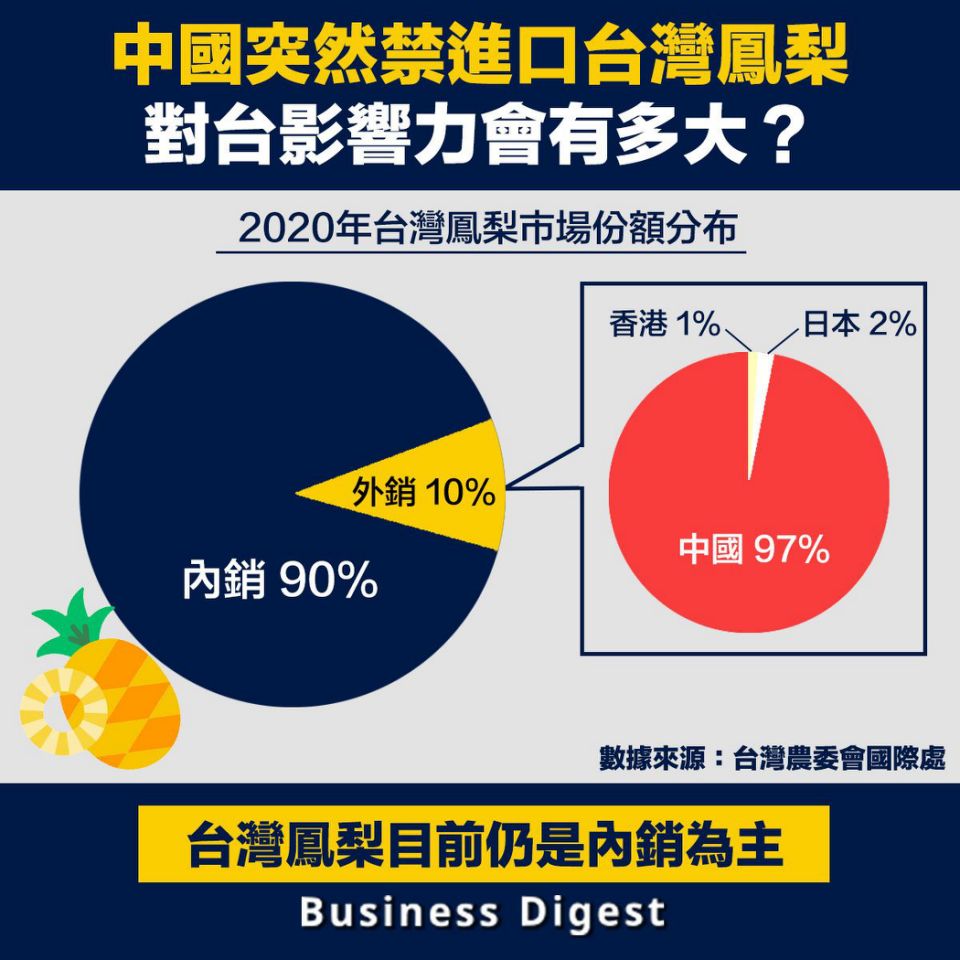
According to statistics from the International Department of Taiwan's Council of Agriculture, in 2020 Taiwan's annual pineapple production was about 430,000 metric tons, of which exports were 46,000 metric tons, accounting for 10% of annual production. Of the exports, 96.9% went to China, with about 4 metric tons sold in the past 3 years, worth about US$110 million. However, Taiwan's Council of Agriculture estimates that if the farm-gate price is stabilized over the past 2 years at an average price of NT$21.3 per kilogram, then it can make up for the value lost from this one-tenth of sales.
It is worth mentioning that Australia has also been subject to unilateral Chinese trade sanctions in recent years. Last May, China imposed an 80.5% punitive tariff on imported Australian barley, but according to the Australian Bureau of Statistics, by October 2021, barley exports were expected to surge by 64%. It turns out that after being hit by Chinese punitive tariffs, Australian barley merchants continuously opened up new markets, selling to the Middle East, Japan, South Asia and elsewhere, and it is expected that Saudi Arabia will become Australia's largest market.