Why is Hongshan red caitai so expensive and why does it need the Baotong Temple bell to be authentic?
Flowering Chinese cabbage is found everywhere, but Hongshan flowering Chinese cabbage is the best and most renowned, and the frost-kissed Hongshan flowering Chinese cabbage is the finest of all. For ordinary people, being able to eat the kind grown around Nanhu, Yezhihu and Tangxunhu is already quite good! These places were previously considered to be within reach of the Hongshan Temple bell
The flowering Chinese cabbage grown in these places I mentioned - the thickest ones I have seen were as thick as my wrist, selling to restaurants in other regions for about 50 per jin.
Other places, such as Jiangxia, grow something that is completely different - only about as thick as a finger, with a very different taste.
I once took Wuhan flowering Chinese cabbage seedlings to my hometown to plant, and indeed they could not grow to look like the ones in Wuhan.
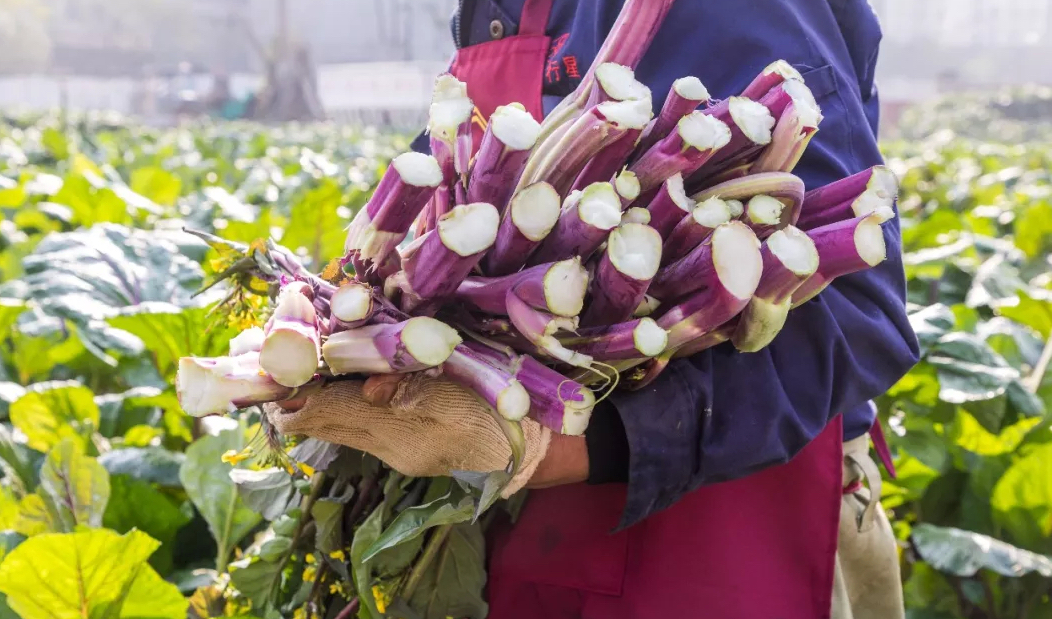
Hongshan flowering Chinese cabbage gets its name because it originates from the Hongshan District area of Wuhan City, Hubei ProvinceBecause its stems and leaves are purplish-red, Hongshan flowering Chinese cabbage was called "purple pak choi" and "rape" in ancient times, and is now commonly known as "red flowering Chinese cabbage" and "purple flowering Chinese cabbage." It gets its name because it is produced in the Hongshan area within Wuchang, and has a cultivation history of over 1,700 years. According to historical records, during the Tang Dynasty, Hongshan flowering Chinese cabbage was already very famous, being a local specialty presented as tribute to the emperor, and was once titled "Golden Hall Imperial Vegetable." "The pagoda's shadow and the bell's sound reflect the purple pak choi." Thanks to the microclimate of the "nine ridges and eighteen hollows" from Baotong Temple to Zhuodaoquan, and from Hongshan to Nanhu, along with its unique local variety, Hongshan flowering Chinese cabbage has endured for a thousand years without decline, and to this day remains a calling card of Wuhan, Hubei - a famous dish steeped in nostalgia that people cannot forget.It is as famous as Wuchang fish. Red flowering Chinese cabbage has a unique flavor whether cooked with meat or stir-fried plain, being sweet, crisp and fragrant.
In Wuhan, there is a vegetable full of legend. It is as expensive as gold, once commanding an astronomical price of 1000 yuan per jin; it captivates the soul, once making Su Dongpo visit Wuchang three times, willingly waiting an entire winter; it transcends the ages, its fame undiminished, having entered Zhongnanhai four times, and today it has even promoted the river city through its own name. Flowering Chinese cabbage is familiar to Wuhan people, but Hongshan flowering Chinese cabbage is mysterious to Wuhan people. When Hongshan flowering Chinese cabbage is mentioned, countless people wonder——
"Why is it only considered authentic if it has heard the Baotong Temple bell?" "What does Hongshan flowering Chinese cabbage actually taste like?" They are even puzzled - it is just a bunch of greens, so why is it more expensive than gold? Is it worth it?
Filled with curiosity, I came to this place of origin full of legend and mystery.
In the late 1980s, due to urban construction and large-scale building projects, the planting area of Hongshan flowering Chinese cabbage sharply declined. In 1995, the Wuhan municipal government specifically demarcated land to protect this sole plot of vegetable field capable of growing authentic Hongshan flowering Chinese cabbage.
But due to weak public awareness, this rare variety of Hongshan flowering Chinese cabbage still has not received good management and protection.
In 2004, Wuhan Chutian Hongshan Flowering Chinese Cabbage Industry Development Co., Ltd., in order to popularize knowledge about Hongshan flowering Chinese cabbage to the public, held its first auction, which finally settled at a price of 1000 per jin, while Yanyangtian, then popular in Wuhan's catering industry, purchased 100,000 yuan worth of Hongshan flowering Chinese cabbage in one go.
Today, although the yield of Hongshan flowering Chinese cabbage is not high, its output value climbs year after year.
"It is estimated that in 2018, the yield of Hongshan flowering Chinese cabbage will be around 100,000-150,000 jin, and the output value will also reach around 7 million." said Xia Xiangyong.
Since 2010, after the rise of online shopping, the main consumers of flowering Chinese cabbage also shifted from high-spending local people in Wuhan to high-spending consumers in Beijing, Shanghai, Guangzhou and other places. And the price per portion of flowering Chinese cabbage also ranged from 99 yuan per jin to 688 yuan per jin.
Hongshan is located in a hilly area, with nine ridges and eighteen hollows, and the soil is red loam and yellow loam, making it the most suitable zone for growing red flowering Chinese cabbage.
And the gray fluvo-aquic red-yellow loam of the Hongshan flowering Chinese cabbage place of origin is also called "the perfect paradise for nurturing rare flowering Chinese cabbage," which is why, among the thousands upon thousands of vegetable plots growing flowering Chinese cabbage in Hubei, only the place of origin can be called authentic.
Precisely because of this, quite a few people came up with the method of "digging up soil and transplanting" to satisfy their appetite.
First there was the laughingstock of Li Hongzhang's elder brother Li Hanzhang "sending troops to scrape up the soil," and later the joke of Japanese agricultural experts "digging up soil and taking it home," but in the end the flowering Chinese cabbage they grew all turned out bitter and hard to swallow.
Furthermore, Hongshan flowering Chinese cabbage has rather strict requirements for temperature and humidity.
If the temperature is too low, it cannot grow, and the bolting speed will be too slow; if the temperature is too high, it will grow wildly, leading to a poorer taste. Therefore, a "microclimate" with lows of 7, 8° and highs of 24, 25° is the most suitable climate for its growth.
And this plot of vegetable field facing Nanhu and backed by Baotong Temple - due to urbanization and the rise of high-rise buildings - has instead formed a natural protective barrier for Hongshan flowering Chinese cabbage, precisely the microclimate it needs.
This is why there is the mysterious legend that only flowering Chinese cabbage "blessed by Baotong Temple" is authentic Hongshan flowering Chinese cabbage.
Of course, with such a favorable climate and soil, without an experienced farmer to cultivate it, it still would not work.
In 2014, the Hongshan flowering Chinese cabbage base was recruiting local experts with over 10 years of experience growing Hongshan flowering Chinese cabbage in the area, and after several rounds of selection by the base, Zhou Jinwang, who had 18 years of rich growing experience, was hired.
From spreading seeds out to dry before sowing and leveling the field before seedling cultivation, to timing the transplanting and field management and application of cake fertilizer, no step can be done carelessly.
As a farmer with an annual income of only 6,000-7,000, at 65 years old he never imagined that those seemingly ordinary flowering Chinese cabbage could bring such a huge change to his life.
Today, even in the year with the worst weather conditions, he still earns at least 50,000, and when the weather is good, his annual income can even reach 100,000. Now, flowering Chinese cabbage has not only become a part of his life, but also affects his joys and sorrows. The better the weather, the happier he is; when the weather is bad, he is sad.
"As long as my legs and feet are still nimble, I hope to keep growing it forever!" Uncle Zhou said with a smile.
Following Uncle Zhou into the field, taking a freshly picked stalk of Hongshan flowering Chinese cabbage, the differences from ordinary flowering Chinese cabbage in shape, color and taste are immediately apparent.
Compared with ordinary flowering Chinese cabbage, which has thin stems and narrow stalks, Hongshan flowering Chinese cabbage can grow up to 70-90 cm tall, and its diameter can reach 6-9 cm, with stems thick at the bottom and thin at the top, forming a trumpet shape.
Moreover, Hongshan flowering Chinese cabbage is brightly colored, with elegant purple stems and brilliant yellow flowers. Not only is its skin dark red and purplish, but the veins of its leaves are also purple. Compared with the green leaves of ordinary flowering Chinese cabbage, it appears more noble, fitting the saying of "purple qi coming from the east."
As is well known, once flowering Chinese cabbage flowers, it must be immediately picked and sold, otherwise it easily becomes old. But the yellow flowers of Hongshan flowering Chinese cabbage grow from the seedling stage and continue growing until harvest and sale without becoming old.
An even more intuitive way to distinguish Hongshan flowering Chinese cabbage is the layer of white wax on the surface of the stem. Uncle Zhou told me this is because the fertilizer used is natural cake fertilizer.
Having said that, Uncle Zhou immediately snapped off a stalk for me to taste.
With a gentle snap, crack, the flowering Chinese cabbage broke effortlessly. The fresh raw flowering Chinese cabbage that entered the mouth was full of juice, sweet and refreshing, as if eating a fruit cucumber, with no astringent sensation at all.
At this rate, it is no exaggeration to say that I could sit there and eat an entire mu of this vegetable field……
When it comes to eating flowering Chinese cabbage, what Wuhan people love most is nothing more than plain stir-fry and stir-fry with cured meat.
Without excessive handling or seasoning, just the simplest salt can bring out the sweetness of the flowering Chinese cabbage to the fullest. The Hongshan flowering Chinese cabbage when taken out of the wok has deep purple broth, unlike ordinary flowering Chinese cabbage whose broth looks greenish.
One bite of crisp Hongshan flowering Chinese cabbage, one bite of chewy cured meat - sweetness and savory saltiness interweave and balance on the tip of the tongue, which can be called perfection.
But when it comes to the most refined way to eat Hongshan flowering Chinese cabbage, it should be cold-dressed, which is the best!
In Chi Li's novel "To the Endless Years"
Damao once asked Leng Zhichao, "What exactly is so good about Wuhan?
That it is worth sacrificing everything to stay?"
She replied: Because Wuhan's vegetables are too fragrant.
"Guangdong's bitter melon tastes too bland, Hainan's water spinach tastes too bland,
the north's radish tastes too bland, Hunan and Sichuan's chili peppers are too spicy……
But only with Hongshan flowering Chinese cabbage can it be called fragrant!"
Hongshan flowering Chinese cabbage is not only the pinnacle of taste for Wuhan people,
but also the beauty that eases our homesickness when we are far from home,
and even more so the pride of Wuhan people!