What goes best with mustard? Wasabi, mustard and horseradish are very different
When eating Japanese cuisine, especially sashimi, you'll definitely dip it in "wasabi". The stereotype says it can help kill bacteria and protect health, but some experts have spoken out saying, "You've all been fooled!" Real "wasabi" (Wasabia japonica) can indeed inhibit bacteria, but unfortunately most
When eating Japanese cuisine, especially sashimi, you'll definitely dip it in "wasabi". The stereotype says it can help kill bacteria and protect health, but some experts have spoken out saying, "You've all been fooled!" What Japanese restaurants in the market give you is not "wasabi" at all, but horseradish, which tastes very similar to mustard!
How long have you been fooled by "fake wasabi"? Wasabi, mustard and horseradish are actually very different!
▲Can't tell wasabi, mustard and horseradish apart? The Taiwan Forestry Research Institute of the Council of Agriculture specifically posted a food safety controversy clarification on its official website. (Photo / screenshot from the Council of Agriculture official website)
The Taiwan Forestry Research Institute of the Council of Agriculture also posted a food safety controversy clarification on its official website: wasabi, mustard and horseradish really are very different! Combining the institute's clarification and expert statements, wasabi (scientific name Wasabia japonica) is a plant belonging to the cruciferous family, also called "mountain horseradish", with other aliases including: wasabi (due to different translations), marsh wasabi, stream wasabi. It is a rare aromatic vegetable plant that grows in the shade of forests in high-altitude cold mountain areas at 1300~2500 m, with a very strong flavor. The part used for eating is the rhizome.
How long have you been fooled by "fake wasabi"? Wasabi, mustard and horseradish are actually very different!
▼▲This is what a real "wasabi" plantation looks like! Generally wasabi must be grown for 3 years before it can be made into a condiment for the table, and good ones take 5 years or even longer. (Photo / provided by wasabi expert Cai Zhongliang)
How long have you been fooled by "fake wasabi"? Wasabi, mustard and horseradish are actually very different!
Expert Cai Zhongliang, who has studied and grown wasabi for 31 years, currently has the largest contract-grown wasabi supply in the country. He said that the isothiocyanates contained in wasabi can themselves inhibit bacteria, and the international journal McGill (Joe Schwarcz PhD | 20 Mar 2017) further pointed out that wasabi has antimicrobial properties, among which the "6-methylsulfinylhexyl isothiocyanate" it contains has been confirmed to be an effective antimicrobial agent against bacteria such as E. coli and Staphylococcus aureus. In Japan, its extract has even been used to make preservatives for lunch bags. Cai Zhongliang said that wasabi is divided into three types: green stem, red stem and purple stem, and the purple stem wasabi has the highest medicinal value.
How long have you been fooled by "fake wasabi"? Wasabi, mustard and horseradish are actually very different!
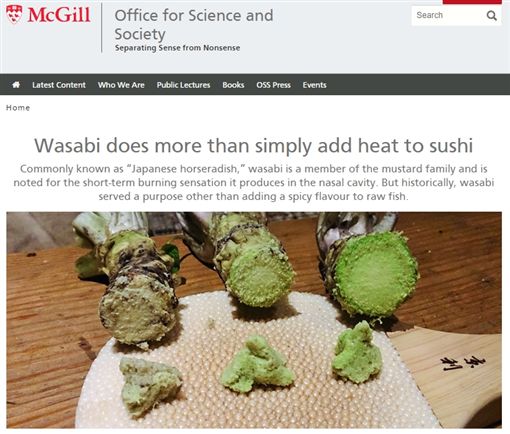
▲The international journal McGill further pointed out that "wasabi" has antimicrobial properties, among which the 6-methylsulfinylhexyl isothiocyanate it contains has been confirmed to be an effective antimicrobial agent against bacteria such as E. coli and Staphylococcus aureus. (Photo / screenshot from McGill international journal)
Real wasabi root has a certain sweetness, different from the taste of mustard and horseradish substitutes, but once dried, the sweetness and spicy aroma disappear, so real wasabi is not suitable for processing into powder products. The vast majority of so-called "wasabi" sold on the market is actually horseradish, available in paste and dry powder forms. The paste type is usually packed in toothpaste-tube-style tubes, while the powder type comes in bags and cans and can be mixed with water into a paste. Most are imitation products made from horseradish (Armoracia rusticana), a cruciferous plant similar to radish, and green food coloring.
How long have you been fooled by "fake wasabi"? Wasabi, mustard and horseradish are actually very different!
▼▲This is what real "wasabi" looks like! Top-grade wasabi of 5L size and 6 cm long sells for 15,000 yuan per kg, meaning 100 grams costs 1,500 yuan. The image below shows the branches and leaves of purple stem wasabi. (Photo / provided by wasabi expert Cai Zhongliang)
However, some paste products produced in Japan do contain real wasabi, and the packaging has wording to distinguish them, such as "わさび" (uses real wasabi), which means containing 50% or more wasabi, and "わさびり" (contains real wasabi), which means containing less than 50% wasabi. But in almost all sushi restaurants in the United States or China, and some sushi restaurants in Japan, imitation wasabi is used, because real wasabi is very expensive. Cai Zhongliang said that top-quality purple stem wasabi can reach a market price of 15,000 yuan per kg, meaning 100 grams costs 1,500 yuan.
▼▲The appearance of wasabi branches and leaves; the part we eat is the rhizome. (Photo / provided by wasabi expert Cai Zhongliang)
How long have you been fooled by "fake wasabi"? Wasabi, mustard and horseradish are actually very different!
As for mustard, the Forestry Research Institute said that in Chinese, wasabi is sometimes mistakenly called mustard, but mustard is actually produced from mustard seeds and has nothing to do with wasabi. The two also have different English names: wasabi in English is Wasabi, and mustard in English is Mustard, though both are pungent condiments. Mustard paste, also called mustard, mustard sauce or mustard relish, is a mustard-colored thick substance with a strong, distinct flavor, made from the seeds of cruciferous mustard vegetables ground and mixed with water, vinegar or alcohol, sometimes with spices or other additives to enhance aroma or color, such as adding turmeric (for color and aroma). The seeds of three types of cruciferous mustard vegetables, including white or yellow mustard seeds, brown mustard seeds also known as Indian mustard, and black mustard seeds, can all be used to make mustard. That is, mustard seeds are ground into powder, and the powder is processed and mixed into a paste, which is mustard paste, a flavoring spice.
How long have you been fooled by "fake wasabi"? Wasabi, mustard and horseradish are actually very different!
▲This is horseradish, also called "green mustard" or "Japanese mustard", usually used as the material for imitation wasabi condiment. (Photo / provided by wasabi expert Cai Zhongliang)
Horseradish (scientific name: Armoracia rusticana), also called western mountain horseradish, horse radish, mountain radish, powder wasabi, is a perennial cold-hardy root plant of the cruciferous horseradish genus. It can be used as a vegetable and has a pungent flavor that stimulates the sinuses. It is considered a substitute for wasabi and is often called "green mustard" or "Japanese mustard", because wasabi's smell or taste is similar to mustard; but in fact, the Forestry Research Institute said, wasabi and horseradish belong to different genera of plants, and are unrelated to mustard. Generally, horseradish is used not only as a condiment for dishes such as roast beef in European countries, but can also be used as the material for imitation wasabi condiment