|
The first choice among Chunlan lotus-petal flowers. With a very high cost-performance ratio. Dafugui's planting medium should not be too rich in fertilizer; getting the flower stalk to elongate requires some skill, and after full vernalization, it is easier for the stalk to grow tall at temperatures between 10-20°C! If you want to buy authentic good seedlings, you must find the right seller, and fellow enthusiasts must take note! Beginners must see the flower before buying. Don't raise it for several years, only to find when it blooms that it is a hybrid - the loss outweighs the gain! Fellow orchid growers, please look carefully at the overall pictures below; they all represent the leaf form of Dafugui. Dafugui has two leaf forms: one is relatively clumsy, with the leaf tips curling more strongly. The other is relatively elegant and slender. The formation of these two leaf forms is due to climate; after growing it yourself for a few years, they will all become the same! When Dafugui is planted deep and grown wet, the leaf form is elegant; conversely, when planted shallow and grown dry, the leaf form is clumsy. Dafugui's flowers are large and thick in substance, with a rounded central structure, flat shoulders and an arching embrace, restrained and measured, with an extremely fine base and obvious shoulders. No matter which leaf form, it differs from the coarse, clumsy leaf form of hybrids. Fellow enthusiasts should look and ask more, and remember its charm! Dafugui has a low propagation rate, and its root system is not vigorous either; the roots of plants of three generations or more are hard to keep intact. Grown in shade, the flowers open a paler yellow!
Points to observe to distinguish true from fake Dafugui (Yixiangju): 1. The color of the flower bud 2. The sandy halo of the bract 3. The base and shoulders of the outer petals and the color of the outer petals 4. The color change on the back of the outer petals 5. The color and basic shape of the lip markings 6. The spirit and charm of Dafugui (intuition)
The Chunlan "Dafugui", also known as "Zhengtonghe" and "Tuanhe". The Ningbo Cixi orchid farmer Bao Yuanchun found it in the Changlong Mountains of Cixi, and it was selected in 1909 at a flower kiln in Shanghai, and was obtained separately by Zheng Tongmei of Shuanglin, Huzhou, and Wu Chunbai of Hangzhou. Whether "Zhengtonghe" and "Dafugui" are the same variety or two varieties has been widely debated. As current facts prove, they are simply different flower forms of the same variety! On the market there are many hybrids passed off as Dafugui, such as: Datunyuan
Characteristics: compact plant type, leaves arching and drooping, leaf blades twisted with flared tips. Leaves 5-9 in number, thick and glutinous in texture, dark green in color and glossy. The leaf surface is a shallow "V" shape, with longitudinal ridges (xinglong), and fine marginal serrations. The tips of the basal and lower leaves form a hood or hold dew, the nasal ridge is broad, and the leaf tips are blunt. Leaf length 25-30 cm, width 1-1.5 cm; in flower art, the three outer petals are broad and large, the side petals 3.5 cm long and 1.6 cm wide, the main petal 1.8 cm wide. The base is finely contracted with good shoulders, opening in an arching embrace. The main petal is slightly hooded, and the flower's diameter is 3.5-4 cm. The shoulders are flat or slightly drooping. The petal substance is thick and glutinous. The short, rounded hold petals (pengxin) are 2 cm long and 1.2 cm wide, embracing the column. The large round lip curls back after being open for a long time. The flower color is dark green, occasionally with faint red lines distributed in the middle of the petals. New shoots are purplish-red, short and round like a peach. Flower bud: the bract shell is dark green and heavy, yet still shows a mix of blue, purple, green and red. The veins are sparse and run to the top, the sandy halo is good, the color is fine, and it sheds its shell well.
Flower stalk: when fully open, the flower stalk is about 10 cm, 0.5-0.7 cm thick. The small sheath is a mixture of several colors, still dark, but the purplish-red is pronounced. The texture is thick and glutinous, and the veins are coarse, sparse and run to the top.
Appreciation: the petal color is dark green, turning jade-green after being open a long time. The three outer petals have a fine base and good shoulders, and the petal tips form a hood with a sense of sharply contracting to a point. The whole flower gives a sense of weightiness, possibly because the large round lip is so plump when first opened that it pushes the hold petals apart and reveals the nasal ridge. The three outer petals have a good arching embrace and their form does not change after being open a long time, and the large round lip droops and curls back. Regarding the microscopic appreciation of the lip tip, it is actually not entirely the same as recorded in ancient manuals; "Lanhui Xiaoshi" records it as a large Liuhai lip. Regardless of whether the lip is like a full moon when first opened or curls back after being open a long time, after corrective appreciation it is still a perfect arc like the edge of the moon. Therefore, calling it a large round lip is more accurate. The lip surface may show a "U", "two verticals", or scattered spots. The overall impression is dignified and opulent. Fragrant, a classic variety of Chunlan lotus-petal type. 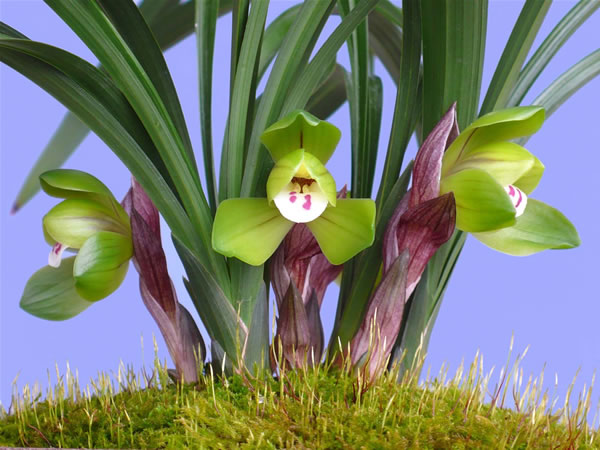
"Zhengtonghe" new shoots are eggplant-purple, while "Dafugui" new shoots are pale purplish-red. The leaf form of both is semi-circular broad leaves; "Zhengtonghe" leaf tips are more bluntly rounded, and the side leaves of old plants are slightly twisted. The leaf width is broad at about 1.2 to 1.8 cm, leaf length 20-25 cm, and the largest plant can reach 32 cm, with about 5 leaves per plant. The leaf stalk is usually stout, and the leaf sheath tightly wraps the leaf stalk without loosening; in large plants the leaf stalk can also be tight, slender and long. The leaf margin curls slightly inward all around, the leaf surface grooves are shallow and have longitudinal ridges, and the marginal serrations are extremely fine. The leaf color is deep green and glossy, and the leaf substance is thick and glutinous. Although the leaf blades are broad, the veins are especially fine. The leaf form is broad and elegant. Skilled orchid growers often grow vigorous plants with many leaves but a plant shape that is not tall; "Zhengtonghe" can be grown to 7 to 8 leaves per plant, 18 to 20 cm long, with leaves and flowers matching each other even better, making the best plant.
"Zhengtonghe" flower buds are red-purple, with deep purple veins, and the bract is broad, large, round and short. "Dafugui" flower buds are water-red, with water-green sandy cloud at the pointed tip, and purplish-red veins. The flower core shape of both is very round and neat, resembling the head of a wooden fish mallet. Looking at the bract from the ovary, "Zhengtonghe" appears red-purple, with a rich mix of purple-red and green sandy cloud; "Dafugui" has bright purplish-red sandy cloud. Both are what is commonly called "lotus-colored bract shell", with a green base and pale pink flower stalk; the stalk is not tall, only about 10 cm, and "Zhengtonghe" has an even shorter flower stalk, only 6 to 8 cm. The three outer petals are broad and large, with an extremely fine base and greatly flared shoulders; the sepals are especially short and round, with tightly rolled edges, and both sides of the petal tips curl tightly inward. The petals are especially thick and glutinous, with a straight shoulder ("one-character shoulder"). "Zhengtonghe" has slightly drooping shoulders. The three petals are broad, grand and well proportioned; the hold petals are short, round, broad and large, embracing the column, a standard mussel-shell hold, with a large, broad round lip and red spots distinctly in a "U" shape. "Zhengtonghe" flower color is emerald green, while "Dafugui" flower color is pale emerald green with a slight yellowish tone; the flower form is magnificent and the flower quality is upright, with the grand air of wealth and nobility. In large plants it can bloom two flowers, two flowers on one stalk, extraordinarily spectacular. It is truly the best variety of Chunlan lotus-petal type, loved by all who see it. During cultivation, the leaf surface is prone to black spot disease; if management can be differentiated during care, it will grow well. Many years of verification show that it is actually the same variety, just differing due to environment and cultivation! Dafugui has been controversial since it first appeared, and the reason lies in the fact that the traits of this flower in various respects are greatly affected by the environment. When flowering-period management is on the shady side and the flower bud receives less light, Dafugui's flower color tends toward yellow, while if the bud receives more light during the bud stage, the flower color generally appears relatively more emerald green. Likewise, Dafugui's bract color will also change accordingly. Buds under weaker light or emerging later have less chlorophyll, so the bract color is relatively fresh and tender, appearing bright magenta or bright red, and mature buds show a little tender green at the tip of the bract; conversely, buds under stronger light and emerging earlier have a darker bract color, and once a deeper green base color is mixed into the red, the color becomes darker and muddier, appearing purplish-red or dark purple, with the green at the bract tip obvious. In addition, buds of Dafugui produced in the south tend to be greener in color with less red, and sometimes even pure green buds appear. Dafugui's lip markings are also always full of controversy, also because Dafugui's lip markings are stable yet variable. The most common lip marking of Dafugui is the type 11; occasionally the lower parts of the 11 connect, forming a ingot shape or U shape, and sometimes the curling of the lip creates the illusion that the bottom of the 11 is connected. Pure Dafugui sometimes also shows missing lip markings, in which case the lip markings appear incomplete. As for the thickness of the lip markings, Dafugui varies: sometimes it is an extremely fine 11 of uniform length, and sometimes a thicker 11 with the two red bars differing in length; this appears in flowers of different years and is not a fixed characteristic, nor is it caused by hybridization. Dafugui's lip is relatively thick in texture, and with proper management it can remain uncurled or slightly curled for about 10 days, but Dafugui is ultimately a curling-lip variety, which differs from plum-petal types; one should not force it too much, and still less use this as a distinction between pure and hybrid. Because in recent years many offspring of Dafugui have appeared and become mixed in with Dafugui, the controversy over Dafugui's variety has become ever fiercer. Among these, many offspring can be clearly distinguished, but a few are difficult to distinguish with the naked eye based on a single flowering; caution is still needed when introducing plants.
The leaf form of pure Dafugui also varies slightly due to management and growth vigor and other reasons, and can be roughly divided into two types: one is broad, large, thick and arching-drooping leaves with obvious longitudinal ridges on the leaf surface; the other has narrower leaves, a taller leaf stance, and less obvious longitudinal ridges on the leaf surface, and this type of plant is relatively more delicate. But these two leaf forms are not a distinction between pure and hybrid; after dividing the same source of Dafugui, differences in growth vigor will create similar distinctions. Generally, Dafugui with strong growth vigor tends toward the first leaf type, while that with slightly weaker growth vigor tends toward the second. In addition, tissue-cultured Dafugui, because its growth vigor is very strong after virus elimination, also has a relatively taller, larger and thicker leaf form. Some individuals long propagated naturally by division, because their growth vigor weakens, will show more of the second leaf type, but after reviving they can still change to the thick leaf form.
In the more than 100 years since Dafugui appeared, new lotus-petal varieties have emerged in succession; however, lotus-petal varieties similar to Dafugui's style are extremely few. Among new lotus-petal varieties, most are of the type with upright leaves forming a hood; such lotus-petal varieties have relatively small flower forms, and the overall outer petals also appear rounder, neater, shorter and broader, unlike Dafugui which has a relatively long base and unlike Dafugui which has obvious shoulders at the petal tips. By comparison, such lotus-petal varieties have an extra measure of refinement and roundness, while Dafugui has an extra measure of breadth and bearing. This makes Dafugui appear very unconventional and special among today's many lotus-petal varieties, and amid the rivalry in beauty of so many lotus-petal varieties, Dafugui always displays its own particular dignity and grandeur. Compared with the many other existing lotus-petal varieties, Dafugui's petal base is slightly longer, and it is precisely this slightly longer petal base that gives Dafugui its unique air of composure. Some of today's new lotus-petal varieties have short, round petals, especially the hold petals, which are even shorter and broader; however, because the hold petals are short, the originally normal nasal tip appears somewhat too large. Although many lotus-petal varieties have hold petals that arch and embrace very well, tightly wrapping the slightly large nasal tip, this gives a feeling of crampedness, as if the tightly embraced nasal tip is about to burst forth, producing instead a feeling of not being able to contain it, and appearing insufficient in bearing. On the contrary, Dafugui's hold petals are round and moist at the head, but the base of the hold is slightly longer, so the nasal tip appears smaller, slightly concealed by the two large mussel-shell hold petals. Although such hold petals do not have as great an arc as some lotus-petal varieties, they can exactly cover the nasal tip and appear effortless; even when the hold is not tight, because the nose is deeply hidden within, it does not make one feel at all that the nose is exposed, always giving a feeling of containing all things and of calm magnanimity. In addition, Dafugui's slightly longer outer-petal base and obvious shoulders also make Dafugui look more relaxed yet controlled.
The name Dafugui fully embodies the essence of this flower: magnificent and splendid flower color, graceful and noble bearing. This is by no means a trait possessed by the nouveau riche and ostentatious, but rather more like displaying the broad, extraordinary bearing possessed by those great households with deep foundations. |