Home › Orchids › Article

Introduction to the characteristics of the Nanguo Shuixian (Cymbidium sinense 'Nanguo Shuixian') variety
Orchids 0 views
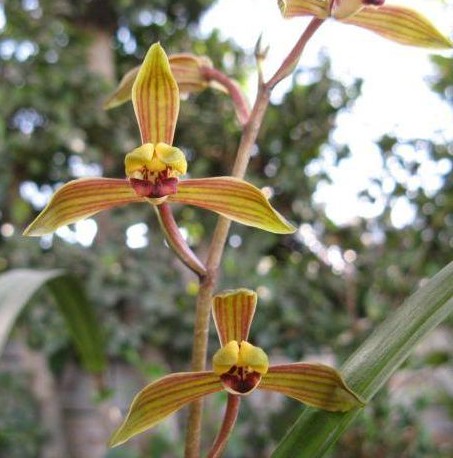
The flowers of Nanguo Shuixian belong to the multi-flowered type of Cymbidium sinense (Chinese orchid), with a delicate fragrance. The flowers are relatively large, spreading to nearly 4 to 5 cm in diameter. The two lateral sepals mostly form a straight-line shoulder with raised corners. The inflorescence is well-arranged and scattered, with bright, rosy coloring. The petal edges have a ring of golden-yellow variegation, set against a burgundy base tone. It is truly beautiful. Most notably, the tip of the lip has a large...
Nanguo Shuixian was introduced and discovered in 1993 by the veteran Chaoshan orchid grower Chen Shaomin. According to reports, this variety originated in Guangxi as a wild-collected plant. When introduced, it was a single pot with seven growths in total. After rejuvenation, it bloomed and was named Nanguo Shuixian and published on the cover of the 1998 issue of "Lan" magazine. This was the first public appearance of Nanguo Shuixian.

    The flowers of Nanguo Shuixian belong to the multi-flowered type of Cymbidium sinense. Strong plants generally produce more than 15 flowers; last year I had a record high of 22 blooms. Like the multi-flowered Cymbidium faberi, it is very fragrant, with large flowers held above the foliage, quite spectacular. The flowers are relatively large, spreading to nearly 4 to 5 cm in diameter. The two lateral sepals mostly form a straight-line shoulder with raised corners. The inflorescence is well-arranged and scattered, with bright, rosy coloring. The petal edges have a ring of golden-yellow variegation, set against a burgundy base tone. It is truly beautiful. Most notably, the tip of the lip has a large red patch dotted in the center, making the entire flower more harmonious, elegant and poised, full of charm. Even more rare is that Nanguo Shuixian, regardless of whether the plant is strong or weak, has very stable flower quality. It is the best true-form Shuixian petal type among all the Shuixian petal types discovered so far in Cymbidium sinense. Since its discovery, it has won numerous honors, such as the gold award at the 2009 National Exhibition in Wenjiang, Sichuan, and the special gold award at the orchid exhibition for the 10th anniversary of Macao's return to China.

Distinguishing Nanguo Shuixian by leaf shape and leaf buds

Nanguo Shuixian is a peerless beauty among orchids. Not only are its flowers beautiful, but its plant form is also quite elegant and refined. The leaves are semi-arching with smooth tips, and the leaf texture is glutinous, thick, emerald green with a waxy sheen. The midrib is relatively flat. The sheath is hard, slender, and clear and moist. The pseudobulb is oval-shaped. When the buds of Nanguo Shuixian first sprout, they are very small, white and thin, very easy to identify. Unlike other Cymbidium sinense varieties where a large pseudobulb means a large bud, only after about one month of growth do they swell into large triangular buds.

Management requirements for Nanguo Shuixian

Since Nanguo Shuixian is one of the Cymbidium sinense lines, like other Cymbidium sinense varieties, it has a relatively large pseudobulb and a well-developed root system. In daily management, it requires more nutrient supply than other orchid types to become stronger and produce larger and brighter flowers. If conditions permit, use some decomposed cake fertilizer placed on top to supply nutrients slowly, and add some chemical fertilizer as a supplement so it can grow vigorously. I use a mix of wild millet leaves, saluogen, fired clay, and Jinshizhi (a type of orchid potting medium) in a 4:6 ratio as a semi-hard, semi-soft potting mix, which retains fertilizer and water quite well.

Other

Currently on the market there are still many diseased plants of Nanguo Shuixian carrying BLS (Black Leaf Streak), as well as some fake varieties passing off as the real thing. Orchid enthusiasts are advised to be especially careful when acquiring this variety, so as not to be deceived and suffer losses.

Related Articles