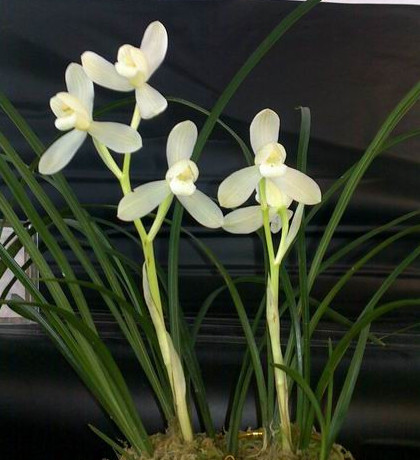
Introduction to the characteristics of the Yonghuaisu Cymbidium lianpan variety
Large lotus petal; the flower color is white with green veins, a large round tongue, and the center of the tongue is pure white; the flower shape is dignified and elegant, making it a premium variety among the white lianpan cymbidiums. It belongs to the plain-centered lotus-petal type of Cymbidium lianpan. The leaves are thick in texture, oily green, with bright veins, drooping leaves, leaf length 40-50 cm, leaf width 0.8-1.1 cm, each plant has 5-7 leaves, and the leaf buds emerge white and glutinous with no off-colors. Flowering period...
Large lotus petal; the flower color is white with green veins, a large round tongue, and the center of the tongue is pure white; the flower shape is dignified and elegant, making it a premium variety among the white lianpan cymbidiums. It belongs to the plain-centered lotus-petal type of Cymbidium lianpan. The leaves are thick in texture, oily green, with bright veins, drooping leaves, leaf length 40-50 cm, leaf width 0.8-1.1 cm, each plant has 5-7 leaves, and the leaf buds emerge white and glutinous with no off-colors. The flowering period is January-February, with 2-3 flowers per scape, a distant and delicate fragrance; the petals are of the plum-type lotus-petal form, the main and secondary petals are thick in texture, white and glutinous, with rounded tips slightly cupped, and green veins faintly visible in the middle of the petals; the clasping petals are mussel-shell shaped, and the large ruyi tongue is broad, round, plain and clean. The whole flower is dignified, pure and white as jade, possessing the beauty of a noble lady. It is not only pure in color, clear in charm, and calm in spirit, but also refreshing to the heart. It is truly an excellent plain-flowered lotus-petal variety of Cymbidium lianpan.
Yonghuaisu is a standard plum-type lotus-petal white-flowered lianpan plain variety, originally produced on Fenghuang Mountain in Laowo, Liuku, Nujiang Prefecture, Yunnan Province. It was selected, bred, and cultivated by Mr. Wang Yonghuai, a famous orchid grower in Dali Prefecture, and after years of domestication, its traits have stabilized. This variety has a beautiful leaf shape; the leaves are 2 to 3 times thicker than ordinary Cymbidium lianpan leaves, and the serrations on the leaf edges are deep, so it can be identified from far away. Leaf length 40 cm-50 cm, leaf width about 0.9-1 cm, and the leaf stalk separates 1 cm above the bulb. It blooms in early spring, with a flowering period of about 50 days, and 2-3 flowers per scape. It is a large-flowered plum-type lotus-petal plain variety; the three outer petals are thick in texture, white and glutinous, with rounded tips. The inner petals are Guanyin petals, and the large ruyi tongue is plain and clean. The shape of the entire flower is full of strength, magnificent and noble, icy-pure and elegant, and delightful, making it a superior grade among plain flowers. Its fragrance is pleasant and refreshing. Seen from a distance, the flowers and leaves set each other off, showing a regal demeanor, like a living work of art among a myriad of flowers.
On January 20, 1994, Mr. Wang Yonghuai, a famous orchid grower in Dali Prefecture, purchased this flower in Liuku, Nujiang Prefecture. It was initially a seedling shoot, and it bloomed for the first time in 1998. In 1999, due to cultivation-related issues, Yonghuaisu developed root rot and dying shoots, and Mr. Wang Yonghuai once again saved it from the brink of death. In the spring of 2003, these few Yonghuaisu plants bloomed again, and their flowers were extraordinarily elegant and beautiful. After that, the flowers of Yonghuaisu bloomed more beautifully year after year. Because of its robust leaf form, beautiful flower appearance, charming flower color, and unique charm, Yonghuaisu can achieve the elevated appreciation realm of enjoying both flowers and leaves together in the evaluation process of orchid growers, and it has attracted the attention of the orchid circles at home and abroad.
Yonghuaisu is originally produced on Fenghuang Mountain in Laowo, Liuku, Nujiang Prefecture, Yunnan Province. It was collected on January 20, 1994, and was selected, bred, and cultivated by Mr. Wang Yonghuai, a famous orchid grower in Dali Prefecture; after years of domestication, its traits have stabilized.
Mr. Wang said that the discovery of this flower was purely the reward for a kind heart!
In 1994, when he was on a business trip to Liuku, he met an old farmer from the mountains at the entrance of an inn, who was displaying a pot of lianpan plain orchid, with three shoots in flower, and another single-shoot dragon-root orchid. Because the old man had bought flowers from Mr. Wang before, he called him by name and asked him to take a look, saying that he had already been there for a day and had not sold them, and that he still needed money to buy some daily necessities to take home, so he asked Mr. Wang to buy them for him. Mr. Wang saw that the three lianpan plain shoots were planted in a broken large enamel bowl; it was an ordinary lianpan plain orchid, already with serious tip burn, and beside it was a small dragon-root seedling that also looked like a lianpan plain orchid. When he asked the old farmer the price, the old farmer said ten yuan per shoot. Mr. Wang felt that the orchid's quality was not good and not worth that price, but the old farmer was not having an easy time either, so he bought these few orchid shoots for forty yuan.
The old farmer's home was in a small mountain village 13 km from Laowo Township. After the flowers bloomed, Mr. Wang went again to look for the old farmer at that time, hoping to find the siblings of Yonghuaisu locally, because a single orchid seed pod contains tens of thousands of seeds. But unfortunately, he did not find that anyone else had dug up and planted any, and then Mr. Wang asked the old farmer to lead the way to the place where Yonghuaisu had been found, but unfortunately it had already become an airport!
Afterward, Mr. Wang carefully tended these few orchids just like his other orchids. They bloomed for the first time in 1999, and when they bloomed they immediately caused a sensation. Later they continued to bloom, but the flower quality was not as good as the first blooming, so they were not put on display. In 2004, the flower quality was better, so they were brought out for exhibition again, and the pictures were included in many orchid books. During the cultivation process, seedling death occurred many times, and the quantity never increased much; at present there are only more than twenty shoots. When asked about the exact number of shoots, he looked up and thought for a moment, then said there were 24 heads (24 heads, that is, 24 pseudobulbs, counting emerged buds together with old shoots, and some cannot be considered standard shoots, such as overly old shoots and newly opened large buds). When asked whether he had ever sold any, he said he had never sold any, and now there are only his more than twenty shoots in the whole world.