Introduction to the Laofengqiao (Fengqiao Mei) Cymbidium faberi variety
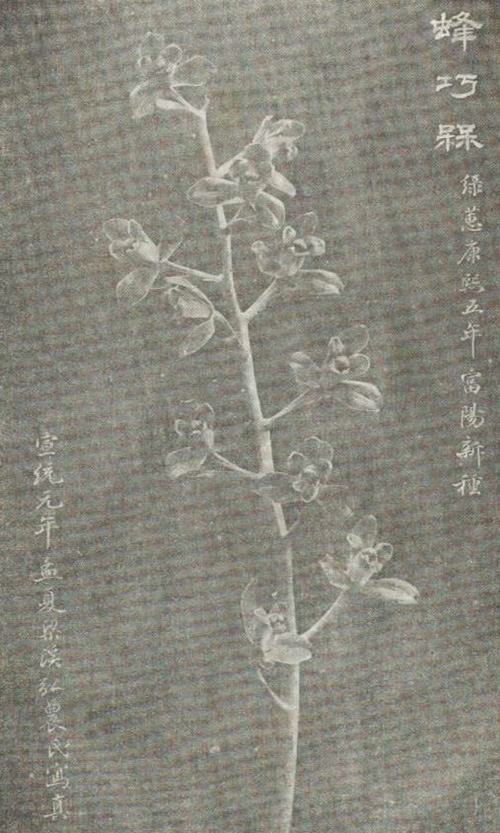
The Cymbidium faberi 'Fengqiao' belongs to the red-shell, green-flowered plum petal type, and is hailed by the orchid world as a treasure among Cymbidium faberi. In history it enjoyed extremely great prestige, and the person who gave it the name 'Fengqiao' was none other than the then Emperor Kangxi. How could a supreme emperor give a name to a few small grasses? This must be traced back to the causes of a certain affair.
It is said that in the mid-Kangxi period of the Qing Dynasty (1691-1701), the wealthy merchants and gentry of the Jiangsu-Zhejiang region were very enthusiastic about cultivating orchids. In terms of owning varieties, they pursued "new" and "rare," and there existed a mentality of taking "being the sole champion" as an honor. Every spring, orchid traders from Shaoxing, Yuyao, Fenghua and other places always had to go into the deep mountains to dig and buy "luoshan lan" (newly collected wild orchids) from local orchid farmers, usually packing ten thousand orchid buds together with their accompanying orchid plants into a burlap sack as one bundle. After loading a dozen or several dozen sacks, they would set off for Shanghai, Nanjing, Wuxi and other places, selling them at a price of three to two taels of silver per sack. To the wealthy merchants and gentry, this price was of course negligible, but if a fine or precious variety could be picked out from a single sack, then the price would be hard to say. From the saying circulating at the time, "nine-segment plum petal, over ten thousand foreign dollars," one can fully see how high the value of plum-petal Cymbidium faberi flowers was at that time! As for judging orchid varieties, looking at the morphological characteristics of the leaves and buds can only be considered half the story; if one wants to be completely clear, one must look at the flowers. In order to make budded orchid plants bloom early, they of course had to go through a special method - "forcing flowers." First, one or several seven-shi vats had to be prepared, then the orchid plants were taken out of the burlap sacks, cleaned and arranged neatly handful by handful, the orchid roots dipped in clear water, and the roots placed against the vat wall while the leaf clusters faced the center of the vat, arranged in a neat, orderly ring. After one layer was arranged, a second layer, third layer... Once stacked to a certain height, a vat lid made of tied rice straw was placed on top, and after six or seven days, the orchid plants were taken out, and the orchid buds could be seen to have elongated and opened into flowers. In this way, careful and unhurried selection could be made according to flower shape and flower color.
It is said that at that time, in a place called Zhujiajiao in Qingqing County, a water town on the outskirts of Shanghai, there was a wealthy Fang family that ran a cloth shop. The family was very rich, and the shop owner loved orchids as his life. Every spring, as soon as the orchid-selling boats arrived, he would surely buy several burlap sacks to take home and select flowers from them, but what he encountered was always only "ordinary flowers," and it was already considered quite good to get a second- or third-rate flower. In the first month of spring, Zhujiajiao held a temple fair every year, with bustling crowds and great excitement. This cloth shop owner Fang selected orchids at home for several consecutive days. When tired, he would go out for a walk to stretch his limbs. When he strolled to the entrance of the Earth God Temple, he saw a fortune-teller beckoning to him, who grabbed him and read his fortune, telling him that his "Yintang" showed a red glow and that he would have good luck this year... After hearing some pleasant words, Shopkeeper Fang paid a few bits of silver and turned to leave. Just after stepping over the threshold a few steps, he was called back again. The fortune-teller said: "Sir, although you will have gains this year, in dealing with people and matters you should be lenient where you can be lenient and tolerant where you can be tolerant, because there is a small black mole between your eyebrows, so you are prone to being secretly plotted against and losing wealth. It is best to be careful and cautious."
It was near noon. Shopkeeper Fang left the Earth God Temple, crossed the great stone bridge and entered his shop. The fortune-teller's words had long been thrown away on the road. He sat down again on a small stool and continued selecting orchids with full concentration. His family urged him to eat, but he said: "I'm not hungry, you eat first." Dong dong dong... the clock struck twelve. His family urged him to eat again, but he said: "I'll eat after I finish sorting this pile, no hurry."... "Oh!" He suddenly cried out excitedly. He was seen holding a clump of long-leaved Cymbidium faberi grass, and when he parted the leaves with his hand, a flower scape with tender green bracts and a slender stem was revealed. Several flowers on the lower part had already opened. He widened his eyes and examined them one by one in detail: the petals were tightly edged, cupped, narrowly based, and the tongue was square-notched. A good flower, a good flower! Shopkeeper Fang was as delighted as if he had obtained a treasure, and even more joyful. He immediately set aside the other orchid grasses, carefully trimmed away the rotten roots and withered leaves from this plant, and cautiously planted it in an exquisite Yixing purple clay pot. Because this flower had already been forced open for several days, once planted in soil it seemed especially full of vitality and spirited.
Zhujiajiao was not very large, and news that someone had obtained a good flower could be said not to last the night. For a time, visitors came in and out continuously to see the flower. Among them was a pawnshop owner surnamed Jin, a famously wealthy man in Qingpu, who was also an "orchid fanatic" who loved orchids as his life. Although his home already had many fine and precious varieties, today when he saw this Cymbidium faberi with its pale green, slightly yellow plum-shaped outer three petals, although it had cat-ear-shaped concave petals, when viewed as a whole flower it instead revealed a lively and dashing temperament. He could not help but feel somewhat astonished, secretly praising it: there could be such a good flower in the world! Compared with what he himself cultivated, he truly felt a sense of being far inferior. He finally could not restrain his desire to obtain this flower and spoke up to ask Shopkeeper Fang to sell it. After being flatly refused by the cloth shop owner Fang, he again asked relatives and friends to intercede, expressing willingness to pay a huge sum to buy half, but still met with rejection. Because of this, the pawnshop owner surnamed Jin was actually bedridden for several days, unable to think of food or drink by day, unable to close his eyes by night, tossing and turning all night, and finally hit upon a plan: if he could not be a gentleman, then he would have to be a petty man. Without stopping halfway, he paid a high price to invite the then famous thief Wang Yifei. Two days later, the deed was done. The pawnshop owner surnamed Jin was of course elated, and hurriedly cut off the flower scape and mixed this Cymbidium faberi grass into his own pots of Cymbidium faberi. As the saying goes: "There is no wall through which the wind cannot pass." The news that the cloth shop owner Fang's orchids had been stolen quickly caused a sensation throughout Zhujiajiao and Qingpu County. The yamen sent "horse-paced constables" to investigate clues and try to solve the case. During the investigation, they learned that the pawnshop owner Jin had tried every possible means to obtain this flower and was the most suspicious, but after secretly inspecting the orchids cultivated in Jin's home, no clues were found. Lacking evidence, the case could only remain unsolved for the time being. The new Cymbidium faberi cultivated by Shopkeeper Fang had of course been stolen, leaving him both heartbroken and furious, but there was nothing he could do. In the end he fell ill in bed and did not recover for several months.