What is Zhengxiao He Cymbidium faberi like? An introduction to its variety characteristics
Petal type: Cymbidium faberi, lotus-petal characteristics: the three outer petals have long stalks, flared corners and contracted bases, mussel-shell-held petals, and a Liuhai tongue, green in color. The main and secondary three petals are all broad lotus petals in the center, thick in texture, light green with level shoulders, and the petal tips are pointed, which is the main characteristic. The large round tongue is thick and short, forming an inverted heart shape, with very distinctive red spots, and the ovary is a beautiful purplish red...
Petal type: Cymbidium faberi, lotus petal
Characteristics: the three outer petals have long stalks, flared corners and contracted bases, mussel-shell-held petals, and a Liuhai tongue, green in color.
The main and secondary three petals are all broad lotus petals in the center, thick in texture, light green with level shoulders, and the petal tips are pointed, which is the main characteristic. The large round tongue is thick and short, forming an inverted heart shape, with very distinctive red spots, and the ovary is a beautiful purplish red; the flower stalk is thick and tinged with red, and the thick leaves have a blue base and are richly glossy; it has a medium-fine upright-leaf habit and is easy to propagate.
It first appeared in the Japanese "Lan Hui Ming Jian"; its place of origin and breeding history are unknown. The flower shape closely resembles "Dingxiao He".
The leaf posture is obliquely upright, with the outer leaves half-drooping; the leaves are medium-narrow, the leaf tips long, and the leaf surface forms a "V" shape; the leaf texture is thick and hard, and the leaf color is deep green and glossy. It is about 40-50 cm long and only 0.8 cm wide.
The new shoots are emerald green, with bright red streaks at the tips.
The flower buds are reddish green; the flower scape is about 50 cm tall, with a pinkish-purple scape color and red flower stalks, and it bears few flowers, only 5-7.
The three outer petals have contracted bases. The flared corners form a lotus shape, and the petal tips have a distinct sharp point; the sharp point drifts slightly, the shoulders are level, and the petals are held and then open; the mussel-shell-held petals clasp the column, and the form is upright.
The large round Liuhai tongue is thick, with red spots centered and radiating outward; around the red spots there is green moss, and the edges of the tongue are white, making it very round and vivid.
The flowers are emerald green and pretty, and together with the red flower stalks and the beautiful tongue, they give a feeling of beauty and elegance; it is truly a rare treasure among Cymbidium faberi flowers. In recent years it has been introduced from Japan, but the quantity is not large.
Although this variety resembles "Dingxiao He", the biggest differences lie in the held petals and the tongue. "Dingxiao He" has golden-yellow shallow cupped level held petals and a forked tongue, while "Zhengxiao He" has mussel-shell-held petals, green color and a Liuhai tongue, making it a small-form lotus petal. "Dingxiao He", by contrast, is a lotus-form golden-held narcissus.
Alias: Dingxiao He (to be verified)
School: Red, Lotus Immortal
Grade: Upper-middle grade
Status: Representative of the lotus-form petal type in Cymbidium faberi
History: Selected during the Xianfeng period of the Qing Dynasty by the orchid grower Ding of the Jiangsu-Zhejiang region.
Leaf material: The leaf posture is obliquely upright, the leaf surface forms a "V" shape, the leaf texture is thick and hard, and the leaf color is deep green and glossy. It is about 40-55 cm long and only 0.8-1 cm wide. The new shoots are emerald green, and the shoot tips have bright red streaks.
Flower appearance: The flower scape is pinkish purple, the flower stalks are red, and each scape bears 5-7 flowers, with the flowers held above the leaves. The three outer petals have contracted bases and flared corners in a lotus shape, and the petal tips have a distinct sharp point; the sharp point drifts slightly, the shoulders are level, and the petals are held and then open. Mussel-shell-held petals, a large round Liuhai tongue marked with vivid large red blotches, and a slight notch at the tongue tip.
Comment: The petals of Zhengxiao He are emerald green and pretty, contrasting strongly with the red flower stalks and the vivid flower tongue, leaving a deep impression. Taiwan, China's orchid circles have judged it as "this species has a harmonious beauty of flower and leaf, and also an atmosphere of a different species, so it is a rare species", which can be said to hit the mark.
Who counts the matters before and after death[1],
Still less a single lonely secluded grass.[2]
Ask not what is said on the Three-Life Stone,
Now does the little lotus know me or not?
In orchid writings of the past, only Dingxiao He appeared, and there was no Zhengxiao He. After the 1970s, large numbers of famous orchids from Japan, Taiwan, China and other places gradually flowed back, and the name "Zhengxiao He" suddenly appeared in orchid registers, while "Dingxiao He" instead faded into obscurity.
The debate over Zhengxiao He and Dingxiao He was also once a topic that orchid enthusiasts were keen on. There are very many such "legacy issues" in orchid circles, such as Jiyuan and Laoshiyuan, Dafugui and Zhengdong He, Yuanzi and Nanyang Mei, Liumei and Loumei, Qinghua Mei and Panlu, Diecui and Dayipin, Xiuzi and Duanhui Mei... There is only one root cause for these problems, and that is the era gap in orchid culture.
The topic of cultural gaps can actually be extended further, involving history, politics, society, humanities and many other aspects. So-called orchid culture is merely a small slice of the larger cultural system, and can be used as a miniature to analyze, discuss and study. But within the limited space of this small book, the author intends to stop here and not belabor the point.
Therefore, regarding Dingxiao He and Zhengxiao He, this piece will likewise no longer offer an exhaustive "tracing to the root" exposition. One reason is as stated above, and another is that I do not possess the evidence or ability to solve this mystery. I only know that they are almost the only surviving lotus-type Cymbidium faberi flowers among the old famous varieties of Cymbidium faberi that are named after "lotus". As the saying goes, "A thousand plum blossoms are easy to select, but one lotus is hard to find", and for Cymbidium faberi it seems even more so. To date, we have almost never seen or been able to name a famous Cymbidium faberi lotus variety that fully meets the traditional "lotus petal" standard.
So emotionally speaking, my mind is conflicted: I hope that today's Zhengxiao He is the Dingxiao He recorded in orchid books, so that a traditional classic variety may be continued; and I also hope that Zhengxiao He is not Dingxiao He, so that the Cymbidium faberi register gains yet another famous "lotus" variety.
Hope is not the same as reality. The only fact is this: Dingxiao He, together with those traditional famous orchids of the same period, flowed to Japan, and after many years, a Cymbidium faberi plant called Zhengxiao He returned to China. Some say that the so-called "Zhengxiao He" is a homophone of "Dingxiao He", so they are the same thing, only the Japanese called it wrongly. I am willing to accept this conjecture, but it remains only a conjecture. After all, all the past will never come again.
It is like a dream: Zhengxiao He knocked on the door and came in, and no one knows his past life; Dingxiao He pushed open a door and went out, and no one knows his present life.
[1] The allusion to the "Three-Life Stone" refers to the anecdote of the Tang hermit Li Yuan and the monk Yuanze. The poem says: "On the Three-Life Stone the old refined soul, enjoy the moon and chant the wind, say no more. Ashamed that the lover comes from afar to visit, though this body differs, the nature long endures. Matters before and after the body are vast and dim, wishing to speak of karmic ties, yet fearing heartbreak. The mountains and rivers of Wu and Yue have all been searched, yet back turn the misty oars up to Qutang." Both Zhengxiao He and the Three-Life Stone come from Wu and Yue.
[2] Kuangnai: moreover, furthermore.
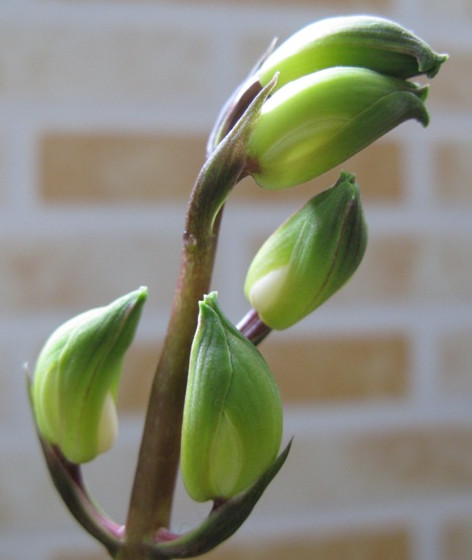
Zhengxiao He has a characteristic that distinguishes it from other old varieties of Cymbidium faberi. Under normal circumstances, the midrib at the leaf tip of a new shoot of Zhengxiao He shows faint dark red streaks, which is relatively unique among traditional varieties.