Song Mei
Song Mei, also known as Song Jinxuan Mei, is a traditional famous cultivar of Chinese orchid and the representative variety of the plum-petal flower. It is the top choice among Cymbidium goeringii. This flower was selected by Song Jinxuan of Shaoxing during the Qianlong period of the Qing Dynasty (1736-1795), and its name was formed by combining Song Jinxuan's surname with the plum petal of the flower. Its flower shape is dignified and generous, and it is listed as the first of the four great famous varieties of Cymbidium goeringii.....
The price of Cymbidium goeringii Song Mei is about 20-100 yuan per plant; those grown by orchid nurseries are cheaper, while balcony plants grown by individuals are more expensive! Song Mei is an orchid variety that can be called perfect in fragrance, leaf form, and flower form. If you only want to grow one pot of orchid, then choose Song Mei without hesitation!
To this day, new flowers emerge endlessly. Yet which variety can compare with this hundred-yuan Song Mei? Cultivating orchids is about pursuing good blooming quality; it is not something finished and done once you obtain the variety. To achieve a pleasing and nearly perfect orchid bloom is not something that can be accomplished overnight. A Song Mei with two flowers on one stem is rarely seen, and 'Heding Hong' is even harder to see. On the road of orchid cultivation, people like us still have many things to do. Let the mind quiet down and the person settle down. Orchid cultivation begins with Song Mei.
Song Mei, also known as Song Jinxuan Mei, is a traditional famous cultivar of Chinese orchid and the representative variety of the plum-petal flower. It is the top choice among Cymbidium goeringii. This flower was selected by Song Jinxuan of Shaoxing during the Qianlong period of the Qing Dynasty (1736-1795), and its name was formed by combining Song Jinxuan's surname with the plum petal of the flower. Its flower shape is dignified and generous, and it is listed as the first of the four great famous varieties of Cymbidium goeringii. Song Mei and the Cymbidium goeringii Long Zi are together called the "Two Jades of National Orchids." After more than two hundred years of history, although famous orchids have emerged repeatedly, none of the plum-petal flowers has surpassed it, and it belongs to the classic model of plum-petal flowers.
Song Mei leaves are arch-shaped, generally 25cm-30cm long and 0.5cm-1.5cm wide, with bluntly pointed leaf tips. The leaf texture is medium-thick, the leaf color is dark green with good gloss, the midrib is firm and stiff with great elasticity, the leaf posture is semi-drooping, and the leaf margins have fine teeth. Each plant has about 5 leaves.
Petal type: Due to differences caused by cultivation and bud mutation, plum-petal flowers can bloom as lotus-type narcissus and plum-type narcissus. The three outer petals are especially tight and round, just like plum blossom petals, with tight edges resembling a white border. The color is green, and the two inner petals form a pouch, shaped like a silkworm moth, hence called silkworm-moth pincers. The lip petal is short and round, slightly facing upward. The tip of the lip forms a slight pouch, just like a child's bangs, hence called bangs lip, and the lip has irregular red spots. The bract leaves are pale red. When the orchid plant is strong, it often blooms double flowers. The flower scape is tall, the leaves are dark green, semi-drooping, with blunt leaf tips, relatively wide leaf blades, and glossy leaf surfaces. The beauty of the leaf posture is hard to describe, and it is an outstanding famous variety among the plum-petal Cymbidium goeringii. Together with Wan Zi, Long Zi, and Ji Yuan, it is listed among the "Four Great Heavenly Kings" of Cymbidium goeringii, and is promoted as the first of the "Four Great Heavenly Kings."
The three outer petals sometimes bloom as lotus-form narcissus or plum-form narcissus. When the orchid plant is robust, it easily produces double buds and twin flowers. The main petal is upright and perfectly round, the side petals are level-shouldered, the center is round and neat, and the flower appearance is very proper. The flower scape is tall and sometimes can rise above the leaves. The bract leaves have two to three sheath shells, and the flower stalk has two kinds, white and white with slight red, also caused by bud mutation. Because the time when Song Mei was discovered coincided with the perfection of the theory of Chinese orchid petal forms, Song Mei was used as the model to determine the definition of plum petals and stipulate the conditions that plum-petal flowers should possess. Song Mei is the typical and representative plum-petal flower. Whether in flower appearance or spirit and charm, for hundreds of years, among no matter which category of orchid, no plum-petal flower has been able to surpass Song Mei.
Some people in the orchid world divide "Song Mei" by leaf shape into "long-leaf Song Mei," "short-leaf Song Mei," "upright-leaf Song Mei," "curled-leaf Song Mei," "broad-leaf Song Mei," "fine-leaf Song Mei," and so on. In fact, these "changes" are merely caused by external factors such as cultivation management and environment, and cannot be called "mutations." At present, the only true natural "bud mutation" of "Song Mei" is the example of "Golden-edge Song Mei" in Chen Xuexiang's nursery. Through "directional cultivation," one line of the "golden edge" has become very stable, but it still has not bloomed, so it is unknown whether there will be changes in floral art. The author has also introduced and grown all the above-mentioned leaf-form types of "Song Mei," among which some have leaves nearly 50 cm long, some have relatively upright leaves, and some have leaves more than 1.5 cm wide. However, these "Song Mei" from different sources gradually become consistent under the same growing conditions, and I believe that after another one or two years of cultivation they will be indistinguishable. Although the different changes in leaf shape of "Song Mei" cannot be regarded as "mutated" varieties, they can let us understand its source and the original cultivation conditions and methods, and can be used to guide our purchasing intentions. Through observing these different leaf-form "Song Mei," we can find that no matter how the leaf shape changes, its basic characteristics will not change.
1) "Song Mei" leaf posture: The leaf posture of "Song Mei" is generally the typical arching-drooping type, and there is also a relatively more upright semi-drooping type. But whether arching-drooping or semi-drooping, its curvature is very smooth and full of strength, without stiffness or weakness.
2) "Song Mei" leaf length and leaf width: The leaf length of "Song Mei" is generally about 30 cm, but with differences in the strength of the plant, the leaf length will change relatively. The author has grown "long-leaf Song Mei" with leaves up to 50 cm long. The leaf width of "Song Mei" is generally about 1.2 cm. Like leaf length, leaf width cannot be determined either. That is to say, the leaf length and leaf width of "Song Mei" cannot be used as standards for determining the variety, but we should know that no matter how it changes, it is merely an enlarged or reduced version of the "usual leaf."
3) "Song Mei" leaf texture and leaf character: The leaf texture of "Song Mei" is fine and soft, with moderate thickness. Its leaf character combines hardness and softness and is extremely elastic. However, it should be noted that the leaf texture of "Song Mei" grown naturally and forced in a greenhouse will change to a certain extent.
4) "Song Mei" leaf color and gloss: The leaf color of "Song Mei" is generally dark green, and the leaf surface has especially strong gloss. However, in addition to its varietal characteristics, the leaf color of "Song Mei" is also related to differences in leaf structure and contained chlorophyll caused by cultivation methods and environmental lighting, so the depth of "Song Mei" leaf color cannot be used as a standard for determining the variety either.
5) Details of "Song Mei" leaf stalk, leaf tip, leaf surface, etc.: The leaf stalk of "Song Mei" is tightly contracted, the leaf width is medium-broad, the leaf tip is bluntly pointed, the leaf surface has longitudinal wrinkles, and the bottom leaves are boat-shaped. These characteristics are fixed and unchanging.
6) Overall plant type of "Song Mei": Looking at the overall plant type of "Song Mei," the leaves of each plant are neatly arranged, either high-drooping or low-drooping, with smooth rounded curvature and elegant charm.
Song Mei, the first of the Four Great Heavenly Kings of Cymbidium goeringii, is the typical representative of plum-petal flowers. From ancient times to the present, great orchid cultivators have highly praised it, and modern orchid writings introduce it in detail. "Lan Hui Tong Xin Lu": "The five petals have tight edges, extremely broad and thick, with pointed tips. Bangs lip, level shoulders, white scape, slightly purple below the shell, the upper three bracts all green, a noble variety." Song Mei was discovered during the Qianlong period, and for more than two hundred years, no existing plum-petal variety has been able to surpass Song Mei. Chinese orchid culture incorporates the connotations of Confucianism, Buddhism, and Daoism. Song Mei has three outer petals that are tight and round, green in color and soft in texture, with a prominent white border and tight edge, a fine base, a round head with a pointed tip, level shoulders, silkworm-moth pincers, and a bangs lip. The center and outer ring are round, tight, and proper, and the flower is level with or above the leaves. The flower bud is short and round, bulging in the middle, hollow at the top, with pale red bract leaves turning green layer by layer, and purple veins reaching the top. The flower color is emerald green and delicate and beautiful, and the flower shape remains unchanged for a long time after opening. Its subtle fragrance is rich, and its elegant spirit is unique, exactly like a personified representative, containing the essence of Chinese orchid culture and embodying people's pursuit of completeness, purity, and ideals.
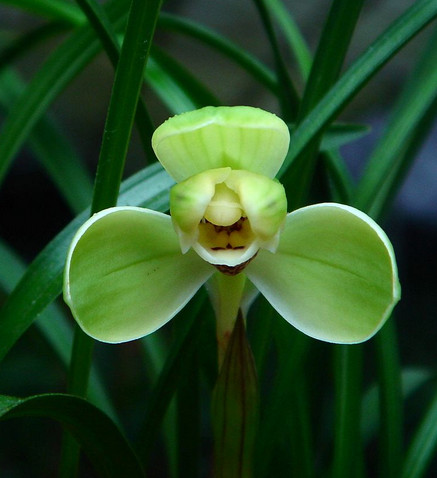
Hybrid Song Mei, with an especially strong shadow of its "parents," looks quite pleasing in its small appearance, and its fragrance is also pure. Apart from the flower color being a bit muddier, there are otherwise no major flaws.
3D work of Song Mei