Variety Characteristics and Appreciation of the Longzi Chunlan (Dragon Character Spring Orchid)
Chunlan (Cymbidium goeringii), narcissus-petal type, a traditional famous variety. Discovered during the Jiaqing reign of the Qing Dynasty at Gaomiao Mountain in Yuyao, also known as Yaoyise and Yuyao First Immortal. Together with Xishen Mei (supreme divine plum-form narcissus) and Wangzi (narcissus petal), it is one of the representative varieties of this category. The three outer sepals are round and broad with pointed tips, tightly edged, thick in texture, light green with a slight yellow tinge, with a translucent quality.....
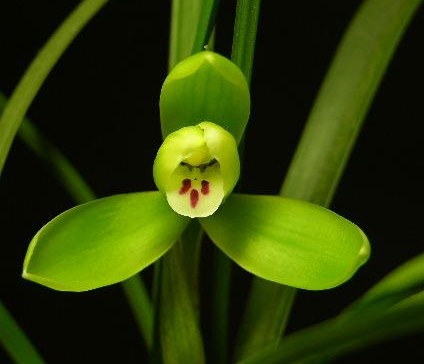
Longzi is a prolific bloomer and grower, Chunlan (Cymbidium goeringii), narcissus-petal type, a traditional famous variety.Discovered during the Jiaqing reign of the Qing Dynasty at Gaomiao Mountain in Yuyao, also known as Yaoyise and Yuyao First Immortal. Together with Xishen and Wangzi, it is one of the representative varieties of this category.The leaf posture is a mix of slanting-upright and mid-arching; the outer leaves are mid-arching, the central leaves are slanting-upright, the petioles are slender and long, the leaf tips are pure and pointed, the leaf color is green and glossy, and the flower buds are pale aqueous green. Deep purple veining. The tight edging is excellent, the pouch is deep, and the three sepals arch and embrace as they open. Guanyin-held heart, large spread round tongue. The inverted-triangle-shaped red dots are very distinct, the flower form is large, and it is a typical narcissus-petal type.The leaf posture is a mix of slanting-upright and slanting-arching growth; the basal leaves are very distinctive, resembling a boat shape; the outer leaves slant and arch, the central leaves slant and stand upright; the petioles are extremely slender and long, commonly called "incense-stick legs"; the middle of the leaf rapidly widens, commonly called "mantis belly"; the leaf tips are bluntly pointed, commonly called "eel tail". Leaf length is 30-40 cm, but some leaves grow to 50 cm, with a width of 1-1.5 cm; the leaf posture is majestic, and the leaf color is emerald green and glossy. New shoots are green with purple veins and a purple-sand blush. The flower buds are pale green with purple veins and a light purple-sand blush; the higher up, the more intense the green coloration of the bud sheaths, and the sheath closest to the flower is entirely green with a white edge. The three outer sepals resemble the shape of lotus petals, with excellent tight edging, and the three sepals arch and embrace as they spread. Deep pouch, soft Guanyin-held petals, large spread round tongue, with red dots in a pattern of one long and two short, vividly colored. At its largest, the flower form can reach 7 cm. The flower color is emerald green with a semi-translucent quality; when the flower first opens, the white edges look like frost. The flower stalk is tall, with the flower held above the leaves. Together with "Song Mei," it is called by the orchid world the Twin Jades of Chinese Orchids. This flower is widely circulated and is a typical representative of the lotus-form narcissus type. The propagation rate is moderate, and it is easy to grow, yet growing it really well is not easy. It has relatively strong stress resistance, blooms easily, and often three or four plants are enough to produce flowers; its bone strength is excellent, and it does not lose shape even after being open for a long time. The flower stalk is green with red dots at the nodes, and the price is not high, making it one of the top choices for orchid growers.
The three outer sepals are round and broad with pointed tips, tightly edged, thick in texture, light green with a slight yellow tinge, with a translucent quality. Guanyin-held petals, large spread tongue, with three bright red dots on the tongue in an inverted-triangle arrangement, the five petals separated at the base; the flower appearance is full and beautiful, the flower scape is slender and long, 15-20 cm tall, and can rise above the leaves; the flower form is large, about 7 cm in diameter. The bud leaves are rose red, the new shoots are green with purple, the leaves are deep red and glossy, the leaf stem is slender, the middle is broad, the leaf tip is pointed, 30-40 m long, with a tube of 1-1.4 cm; the central leaves have incense-stick legs, the lower leaves have a mantis belly, that is, the petioles are slender and long, the leaf belly is broad, the leaf posture is highly variable, and the plant is tall and robust. Its growth is strong and vigorous, easy to plant, easy to sprout, and it has a strong flowering nature. Among the "Four Great Heavenly Kings," "Four Great Famous Varieties," and "Four Great Families" of Chunlan, it is the variety with the most brilliant flower color and the largest flower, and together with Song Mei it is called the "Twin Jades of Chinese Orchids."
The "Record of Famous Chinese Orchid Varieties -- Chunlan Volume" says, "The sepal petals and the held petals are huge; the sepal petals are round and broad, slightly pointed at the front, relatively thick in texture, with tight edging. Guanyin-held petals, thin inside and forming a pouch shape. Large spread tongue; when the flower first opens it is semi-drooping, and after full bloom it gradually curls backward. It belongs to the large-flower category; the perianth is yellowish light emerald green with a translucent quality, with level shoulders or slightly drooping shoulders. The leaves are deep green, medium-long (20-30 cm) and relatively wide, glossy; the base is slender and the middle is broad, the leaf tips are slightly rounded, and the leaf posture is extremely variable, with some drooping, some reversing, and some standing upright, free and unconstrained."
"A Brief History of Orchids and Huilan": "Large lotus form, tight edging, Guanyin pouch separated at the base with held petals, large spread tongue, slender long stalk, level shoulders. It appeared during the Jiaqing period at Gaomiao Mountain in Yuyao, hence also called Yaoyise." A black-and-white photograph is preserved, inscribed with the words "Longzi, also known as Yaoyise." Before "A Brief History of Orchids and Huilan," both "A Conspectus of Orchids and Huilan" and "A Brief Account of Orchid Sayings" recorded it, with the difference that "A Conspectus of Orchids and Huilan" considered it to have a "large spread square tongue," while "A Brief Account of Orchid Sayings" called it "Longzi Xian."
During the Qing Dynasty, Xu Jilou praised it in verse in "A Conspectus of Orchids and Huilan":On Gaomiao Mountain's peak, green rises to the sky, a thousand rocks and dragon veins arch before it.Spiritual roots gather emerald green, vying for spring's charm; this is Yuyao's First Immortal.As the most brilliant among Chinese Chunlan, Longzi, with its large and brilliant flowers, ranks first among Chunlan narcissus types.
Longzi, with its elegant color and refined bearing, should be praised as the most "brilliant," a term that ought to be paired with "clear," that is, "clear brilliance" and "clear beauty," so as to recreate Longzi's "clear brilliance" that is moving and "clear beauty" that is refined, like "a lotus emerging from clear water, naturally without adornment."