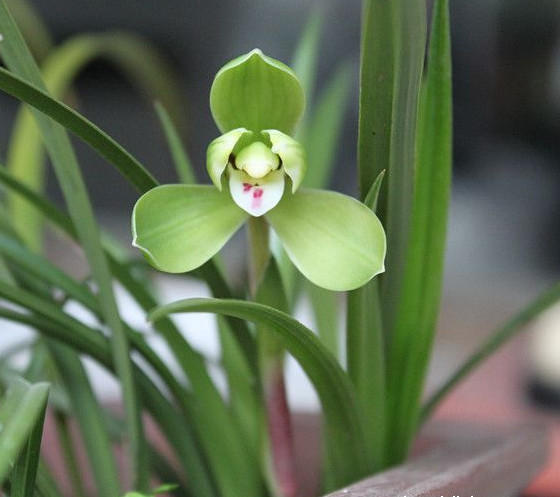
Introduction to the 'Twenty-Seven Mei' Chunlan Variety and Key Appreciation Points
In 1978, it was selected by Sun Nianqi, an elderly orchid grower from Jiashantou Village, Shaoxing, Zhejiang, from Mount Dayinling in Lizhu, and named 'Nianqi Mei', also called 'Erqi Mei' by some. The new shoots are bright red, and the newly emerged leaves have heavy white tips. Leaves are 30 cm long, 0.8-1 cm wide, with blunt leaf tips, thick and substantial leaf texture, and V-shaped leaf grooves on the surface. The leaf posture is semi-pendant, with some twisted leaves...
'Nianqi'[niàn qī]. In 1978, it was selected by Sun Nianqi, an elderly orchid grower from Jiashantou Village, Shaoxing, Zhejiang, from Mount Dayinling in Lizhu, and named 'Nianqi Mei', also called 'Erqi Mei' by some. The new shoots are bright red, and the newly emerged leaves have heavy white tips. Leaves are 30 cm long, 0.8-1 cm wide, with blunt leaf tips, thick and substantial leaf texture, and V-shaped leaf grooves on the surface. The leaf posture is semi-pendant, with some twisted leaves. The scape is upright, reaching up to 15 cm tall, and the bracts are purplish-red tinged with green. The three outer sepals are rounded at the tip and tapered at the base, with pointed tips and thick texture. Soft silkworm-moth petals, and a Liu Hai tongue. Level shoulders, and the flower is emerald green. The flower form is well-proportioned. The bract leaves are pale purplish-red, the scape is tall, and the leaves are semi-upright. The three outer sepals appear broad and wide, with the main sepal forming an upper-covering shape, majestic in bearing. The two lateral sepals taper at the base and widen at the corners, forming a level shoulder. The petals are of the soft silkworm-moth type, round, smooth and glossy, with the five petals distinctly separated. The lip is a large round tongue, with red patches on the tongue surface, and the flower color is tender green and semi-transparent. The flowering period is exceptionally long, remaining unchanged for over 30 days in bloom, but unfortunately it does not propagate quickly.
Selected in 1980 by Zhu Nianqi of Tangdi.The three outer sepals are rounded at the tip and tapered at the base, with pointed tips and thick texture. Soft silkworm-moth petals, and a Liu Hai tongue. Level shoulders, and the flower is emerald green. The flower form is well-proportioned. The bract leaves are pale purplish-red, the scape is tall, and the leaves are semi-upright.Advantages 1. Free-flowering. 2. It blooms reliably year after year; although there are differences in nutrient levels and flower size, the flower form does not change much, unlike Song Mei, Wan Zi, and Lao Shiyuan, whose flower forms vary so greatly. 3. The color is tender yellow-green, very clean, with no stray colors on the three sepals.
Disadvantages 1. After two days in bloom, the shoulders tend to drop slightly. 2. The flower scape is not tall enough, inferior to Song Mei.