Detailed introduction to the Cymbidium goeringii cultivar Guanyao Mei
New shoots are purple-green. The leaves are broad, thick in texture, with deep leaf grooves, forming a "V" shape, about 1.1-1.3 cm wide and about 25-28 cm long, with high basal sheaths, sharply pointed leaf tips, and pale leaf color that is emerald green with a glossy sheen. The leaves are moderate in stiffness and softness, arching and drooping elegantly, quite beautiful and charming. The bracts are pale green with dark green mottling and also dark purple-red...
Basic characteristics of Guanyao's plant type: leaf veins are particularly prominent, somewhat similar to Cymbidium faberi, and the leaf tips are tail-waving in shape. The leaf form is not attractive, it is lazy to bloom, but the fragrance and flower form are good! Some unscrupulous sellers pass off Guanyao as Jiyuan! Typical differences between Guanyao and Jiyuan: Guanyao flowers have slightly drooping shoulders, green flower stalks, asymmetric central column, and tail-waving leaves! Looking at the shoots emerging from the soil, Jiyuan is green with red tips, while Guanyao is purple. Guanyao Mei costs about 5 yuan per seedling, while Jiyuan costs about 10!
In the spring of the 6th year of the Republic of China (1916), the famous Huzhou orchid grower Mr. Yao Zuotian selected and bred it, naming it Guanyao Mei, with its origin in the mountains of Huzhou. New shoots are purple-green. The leaves are broad, thick in texture, with deep leaf grooves, forming a "V" shape, about 1.1-1.3 cm wide and about 25-28 cm long, with high basal sheaths, sharply pointed leaf tips, and pale leaf color that is emerald green with a glossy sheen. The leaves are moderate in stiffness and softness, arching and drooping elegantly, quite beautiful and charming. The bracts are pale green with dark green mottling and also dark purple-red vein lines. The front parts of the 3 sepals are round and broad, with small points at the petal tips; the main petal has slightly tightened edges and a shallow pocket, while the two side petals have no pocket. When the flower first opens, the petal base is narrow and short, gradually lengthening; the two lateral sepals are flat and soft, with a smooth and glossy surface, and a slight white halo at the pocket tip. The two column petals mostly overlap together, tightly wrapping the column inside. The ru yi tongue is upright, straight and extended, short and hard, not curling backward, hidden within the column petals and attached to the column, dotted with red spots, with an antique and elegant form. Guanyao Mei has slender flower scapes, pale blue-green, with red halos at the scape nodes. The flowers are medium-sized, about 4.5-5 cm in diameter, with a well-proportioned and beautiful flower appearance. Because the leaves arch and droop, the flower scapes appear long and tall, and the flowers held above the leaf canopy are especially free and spirited. Guanyao Mei is easy to propagate but not easy to bloom; generally it requires more than ten clumps of grass to bloom. The flower quality is extremely beautiful, but it is rarely appreciated in bloom. It is one of the first-generation relatively widespread famous and rare varieties among China's Cymbidium goeringii, deeply loved by orchid growers.
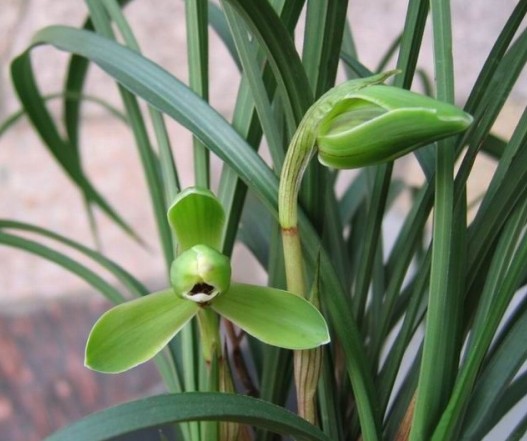
"Guanyao Mei" leaves are 1-1.2 cm wide, with broad edge leaves and narrow middle leaves, leaf length 25-35 cm. The edge leaves have a large arching droop, while the middle leaves slant and droop, with some leaf tips slightly twisted. The leaf surface is slightly glossy; old leaves are not very glossy, dark deep green, with sharp leaf tips. The leaf groove is deeper at the lower end of the leaf and flatter near the leaf tip. The leaf margin serration is slightly coarse and dense, the leaf surface has longitudinal ridges, and the secondary veins on the leaf surface are obvious. The main vein on the leaf underside protrudes, and the lateral veins are obvious, appearing yellow-white. Near the leaf base, the main vein on the leaf underside is especially broad and prominent. The leaves have great elasticity, and the leaf finger ring is high and obvious. New shoots have a green base with purple-red vein lines, and the leaf sheaths are long and pointed; upon emerging from the soil, green base with purple-red veins is visible, with obvious contrast. New seedlings are strongly upright, pale green, with high and pointed basal sheaths. Its leaf base contraction and release are not very obvious, and a single strong seedling basically has more than five leaves. The plant shape is slanting and draped, graceful in form. Although the main and secondary veins appear to have characteristics of foreign-origin grass, judging from flower color and fragrance it should be Jiangsu-Zhejiang grass. The flower scape is round and slender, green in color, with the uppermost node emerald green without mixed colors, and red halos at the stalk nodes. The scape is about 12 cm tall. The flower buds have a green base dotted with purple-red vein mottling; the lower part of the sheath is light purple, gradually turning deep green toward the upper part, with broad and obvious purple veins. The outer three petals show white edges when the bud is visible, are emerald green, round-headed with contracted base, tightly edged, flat-shouldered, with glossy soft silkworm-moth column petals, and a large ru yi tongue with an obvious large red patch at the tip. The opening form of "Guanyao Mei" is somewhat similar to "Wanzi", but afterward the three petals gradually lengthen and the tongue petal droops; of course the sepals, column petals, and tongue cannot compare with "Wanzi". Moreover, the column petals of "Guanyao Mei" often clasp tightly together, making the central structure appear narrow and small. A well-opened "Guanyao Mei" should be said to be very beautiful. In "Lan Hua Pu" there is a black-and-white photo of "Guanyao Mei"; although it is not in color, the opening form is very upright, and without careful looking it is easy to mistake it for a black-and-white photo of "Taiyuan Mei". It is said that when Wang Shuping cultivated and bloomed "Guanyao Mei" back then, he was overjoyed. Not only did the whole family celebrate, he also reported the good news to relatives and friends, and invited a photographer to take pictures as materials to distribute to friends in the orchid world. This shows how good the flower quality of "Guanyao Mei" is.
Although "Guanyao Mei" is a good flower, it is also a famously stingy bloomer. It was once heard that Wang Shuping grew this flower for fifty years and saw it bloom only three times, but this is merely legend, nothing more than emphasizing the flower-stinginess of "Guanyao Mei". It is usually said that this variety with 5 or 6 seedlings cannot bloom, and generally only 7-8 strong seedlings will produce flowers. In fact, if "Guanyao Mei" is a strong, large plant, 3-5 seedlings can also bloom. So-called strong plants refer to three generations connected in one clump, with each generation having leaves as strong as the others. Strength and weakness cannot be determined by how many leaves a single plant has; one must also look at whether the roots are vigorous or weak. Unfortunately, because of frequent division, such strong plants are now hard to find. As long as the roots are vigorous and the leaves healthy, with proper water control in June and July each year, increased light, and several sprays of phosphorus-potassium fertilizer, flower buds will certainly be seen. Although the quality of "Guanyao Mei" opening is related to the nutritional status of the mother plant when forming buds, it also depends on the grower's management at blooming time. Usually, when the bud is visible, it is not easy to expose it to sun; increasing the temperature difference, keeping the pot dry, and maintaining suitable humidity around the orchid plant can produce a good opening.
Ms. Rongrong has a poem titled "Guanyao Mei":
"Everyone says I am a lazy-blooming seedling, yet I am solitary and proud, named Guanyao.
If heaven has feeling and you have intent, with quiet beauty and distinctive charm, facing each morning."