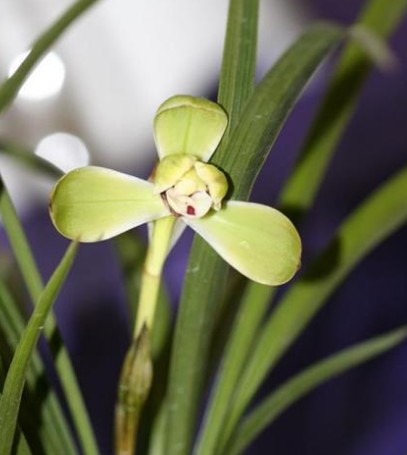
Fangzi Chunlan (Cymbidium goeringii) Variety Introduction and Appreciation Points
Selected around 1920 by the Fang family of Ningbo. Leaf posture semi-arching, leaf texture thick, leaf tips bluntly pointed. Leaf color deep green, slightly glossy. Bract sheaths reddish-purple-green. The three outer petals have rounded heads, long feet with flared corners, and petal tips tightly clasped inward. Level shoulder, petals with faint green stripes. Silkworm-moth hold (pollen masses), with obvious white edges at the tips of the holds, ru-yi tongue. Flower color green.
Since its appearance, "Fangzi" has appeared in many orchid books. The black-and-white photo left in "A Brief History of Orchids and Hui Orchids" may be the most beautiful and most correct flowering form recorded in Fangzi's early period; later, Shen father and son's "Orchids" and Obara Eijiro's "Kinds of Orchids and Their Cultivation" both have photos of similar flower quality. It can be seen that Fangzi was already circulating in orchid circles at that time. As for many other books, especially the color photos in many domestic orchid books published after the Cultural Revolution, almost without exception they use the flowering photo of "Yipin" as "Fangzi"; the resulting consequence is that orchid swindlers pass off "Yipin" as "Fangzi" and sell it to orchid enthusiasts at high prices, and even if the enthusiast discovers they have been cheated, they cannot hold the swindler responsible, because the "Fangzi" photo in the book is exactly like that. I know of at least 2 such cases. So, what kind of flowering form is the real "Fangzi", and how does it differ from "Yipin"? Below, centering on these 2 varieties, a comprehensive comparison is made with pictures.
Speaking of the currently domestically recognized "Fangzi", it should be around 1994, when Xie Yichuang, president of the Yuyao Orchid Association, obtained it from Zhu Shuiting of Shaoxing, and it reflowered many times afterward. The currently recognized and circulated flowering photo is the reflowering photo in Yuyao. Huajing also, after seeing the reflowering photo, obtained the variety in 2010 through the introduction of teacher Yu Bojun.
The frontal photo reflects "Fangzi"'s silkworm-moth hold, ru-yi tongue, and full central column, which is very different from "Yipin". The three petals are short and broad, with a slender contracted base, and the overall impression is a full and grand flower shape, which should belong to the plum-petal type rather than the narcissus-petal type. Viewed from the front, the three petals are clean in color, and the top node of the flower stem turns green.
The flower shape of "Yipin" is obviously different from "Fangzi". However, Ding Yongkang of Wuxi, in the article "The Theory of National Orchid Petal Types" (see "Chinese Orchids" '95, Issue 1), emphasized: Fangzi's "three outer petals have no red veins, Yipin has red veins". The author instead believes: Yipin's three outer petals and holds all have veins, but they are by no means "red veins", and should be "green veins". Ding also specially provided a color photo of "Fangzi" to confirm that Fangzi is a narcissus petal and differs from Yipin (mainly in the presence or absence of "red veins"). We carefully observed the color photo provided by Ding and repeatedly analyzed it, and saw that each of the three outer petals had seven veins, and were round-headed with long feet, ear-picking holds, and a small round tongue - these features are exactly identical to "Yipin", yet utterly different from "Fangzi". According to "A Brief History of Orchids and Hui Orchids" on Fangzi: "The three outer petals are short and broad, separated segments, silkworm-moth hold (pollen masses), ru-yi tongue, level shoulder, green color, long stem." Wu Enyuan confidently listed "Fangzi" among the plum petals. On this, Shen Yuanru, Wu Yingxiang, Wu Kaiyuan and others had no objection at all, and also unanimously confirmed Fangzi as a plum petal. Even according to Mr. Ding's "plum-petal theory": holding that plum petals "manifest as holds relatively thick and solid, tongue not developed, most tongues short and small and relatively hard." Even then, "Fangzi" should absolutely be classified in the plum-petal ranks.