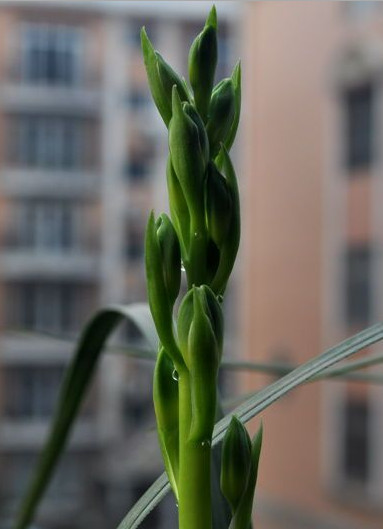
What cultivar is Dayipin Huilan (Cymbidium faberi)? Characteristics introduction
Petal type: Green-shell large lotus-form narcissus petal. Because of its outstanding bearing, it was named Dayipin. Discovered in the mountains of Fuyang, Zhejiang. According to "Lanyan Shulue", it was selected by Hu Shaomei of Jiashan, Zhejiang during the Qianlong era of the Qing Dynasty; according to "Lanhui Tongxin Lu", it was selected by Hu Shaomei in the early Jiaqing years. Characteristics: five petals in separate segments, color emerald green...
Petal type: Green-shell large lotus-form narcissus petal. Because of its outstanding bearing, it was named Dayipin. The flowers of Dayipin change shape quickly, but the overall presence remains unchanged, and from a distance it looks very grand!
Fragrance: The fragrance of Dayipin is of the delicate type; on the first day of blooming the scent is faint, and by the second day it is fine. The fragrance spreads over a wide range, coming and going, and smells very pleasant! (On sunny days the fragrance will be very strong, filling the whole room.)
History: Discovered in the mountains of Fuyang, Zhejiang. According to "Lanyan Shulue", it was selected by Hu Shaomei of Jiashan, Zhejiang during the Qianlong era of the Qing Dynasty; according to "Lanhui Tongxin Lu", it was selected by Hu Shaomei in the early Jiaqing years. It is said that in the Qianlong years or the early Jiaqing years, it was produced in the mountains of Fuyang, Zhejiang, and selected by Hu Shaomei of Jiashan. Dayipin leaves: leaf length 40-50CM, width 1-1.5CM, leaf color emerald green, new leaves glossy, leaf surface flat, leaf margin serrations clear. Leaf posture semi-pendant, the plant is robust and relatively easy to grow. The flower scape is slender, round and upright, and the flower stalk rises above the leaves, called dengcao stalk, also known as flowers above the leaves, and is hailed as the most graceful of all huilan.
Characteristics: five petals in separate segments, color emerald green, petals upright and of glutinous texture, large soft silkworm-moth pollinia, large ruyi tongue, the flower center shaped like a small sanbing; it is acclaimed as the crown of lotus-form narcissus petals among huilan, listed first among the traditional eight old varieties of huilan, and regarded among huilan flowers as the representative of the scholar-official. When in bloom, if the pot is too wet the petals tend to curl back and slightly droop at the shoulders, and after being open a long time they easily lose shape.
Flowers: flower stalk pale green. Flower buds emerald green, with excellent watery sand halo, head shape round and neat, bracts tightly wrapped. Each scape bears 8-12 flowers, flower shape large; before the flower opens it is of the large flat-cut head shape, that is, the tip of the bud is as if cut flat with a knife; the two lateral sepals extend flat, reaching 7CM in diameter; the three outer petals are of lotus form, the lip is a large ruyi tongue, with contracted base and flared corners; the flower is a clear bright yellow-green, the petals glutinous and moist, flying shoulders, soft silkworm-moth pollinia, smooth and round, green moss large liuhai tongue, adorned with pale red dots; it is the typical variety of lotus-form narcissus among green huilan, hailed as the crown of lotus-form narcissus and first among the eight old varieties of huilan. It once made a great name for itself at the Suzhou flower show; at that time the rich merchant Zhou Yiting was willing to buy it for three thousand gold, but because many others were competing for it, the deal did not go through. The next year it was purchased by Zhou Yiting. In the orchid manuals of that time there was a special section discussing lotus-form flowers: "Lotus form refers to that among narcissus; the base is finely contracted, the petal head is broad with a slight point, somewhat longer than plum petals, and it is important that the edges be tight and the flesh thick. The pollinia soft and smooth. The large tongue slightly curled; only one like 'Dayipin' is a true lotus form." When 'Dayipin' first opens, it is imposing and majestic, noble and broad, truly possessing the scholar-official bearing that Huang Shangu spoke of.
Appreciating a fine flower also requires attention to certain methods; for example, when 'Dayipin' is blooming, the pot should be dry. If it opens wet, the middle and rear parts of the three outer petals tend to curl back, and one must adjust them by hand before they set their shape; the pot should be kept slightly dry, otherwise the flower shape will change and show slightly drooping shoulders. No one is perfect, and no flower is entirely beautiful; with reasonable care, the shortcomings can be made less apparent. 'Dayipin' can indeed be called the crown of lotus-form narcissus among green huilan. This variety has spread widely and is still deeply loved by orchid enthusiasts today.
There are quite a few forms in which Dayipin opens, but they can basically be divided into 3 types:
1. When it opens with soft pollinia, this is the common form; the tongue shape tends more toward a small round tongue, and after being open a long time both the outer petals and the tongue curl back.
2. When it opens with semi-hard pollinia, the tongue shape becomes a large ruyi tongue.
3. When it opens with hard pollinia, the tongue shape is a small ruyi tongue, the outer petals do not curl back, and the flower holds up even better than when opening with semi-hard pollinia.
In fact, most huilan plum-narcissus varieties share this characteristic: when the pollinia are hard the tongue tends to be small, and when the pollinia are soft the tongue becomes larger.