Introduction to the Jiepei Cymbidium faberi Variety and Analysis of Its Main Characteristics
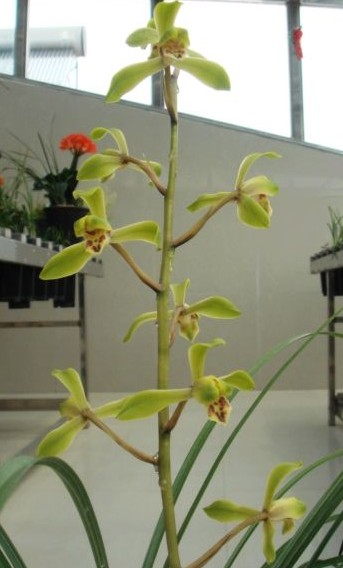
Jingjiang Jiepei is the finest under heaven
Yuxiu Orchid Garden, Jingjiang City, Jiangsu Province Lu Mingxiang
Jiepei, a famous Cymbidium faberi flower. This orchid was selected in the early years of the Republic of China by an orchid lover surnamed Zhang from Shanghai. The term "Jiepei" comes from the Tang dynasty poet Yang Shen's lyric "Ode to the Orchid": "Fragrance fills the sleeves, as if meeting Jiepei, the river immortal scattering worldly ties." Hence the name. Jiepei has a leaf posture that slants and drapes in an arch shape, with medium-fine narrow leaves, the leaf cross-section shaped like a "v", the leaf tips slightly pointed and long, the leaf color deep green, especially glossy, about 40--50 cm long. The Jiepei flower bud is tight, round and upright, the shell color clearly turning from red to green. The Jiepei flower scape is slender, reaching about 45 cm tall, the stalk color emerald green, the small flower stalks bright purplish-red, each scape bearing 7--11 flowers. When the Jiepei flower bud first opens, the three outer sepals are small and narrow; within 2--3 days the sepal width gradually increases and broadens, the three outer sepals have long feet, contracted bases and flared angles, tight edges and thick texture, and the two lateral sepals are level-shouldered. Jiepei has a divided white-jade cup, with the column visible on the back of the cupped heart, the tongue base not exposed, a large ruyi tongue, and a distinct hooked tip at the front end. Because the Jiepei small flower stalks are purplish-red and the petals form a white-jade cupped heart, it has the fine reputation of "red hairpin and green jade." Its flower color is pure green, its flower posture vigorous and upright, its flower quality upright, its reproductive capacity strong, its growth vigorous, it easily produces flowers, and its fragrance is rich. It is a fine Cymbidium faberi variety loved by all who see it. The people of Jingjiang have a long and legendary history of growing Jiepei, and it is a long story. In the early years of the Republic of China, Liu Rongqiu, the owner of a money house in Jingjiang, exchanged several varieties including Jiepei from the Rong family of Wuxi at the price of "one dan of rice per seedling." Unfortunately, during the War of Resistance they were plundered clean by the Japanese devils. Fortunately, Liu Xinzhi (then instructor at the Jingjiang County sports field, later a physical education teacher at Jingjiang County Middle School), the son of the owner of the Yuheng distillery in Jingjiang, had introduced several pots of orchids including Jiepei from Liu Rongqiu before the outbreak of the War of Resistance. In 1937 Jingjiang was occupied by the Japanese devils; when Liu Xinzhi fled as a refugee he took nothing except a few pots of his beloved orchids, and after the victory of the War of Resistance he returned to Jingjiang and continued to cultivate them, placing them in the People's Park greenhouse each winter to overwinter. In 1965 Liu Luping, director of the People's Park, obtained four pots of famous orchids including Jiepei from Liu Xinzhi on several occasions, treasured them like a precious jewel, cultivated them with care, and made orchids a key focus of development in the park. During the Cultural Revolution orchids became "fragrant flowers and poisonous weeds" and were listed by the Red Guards as targets for destruction; the park hid the orchids here and there, and only thus was Jiepei Mei preserved. After decades of development, the number of Jiepei Mei in Jingjiang People's Park increased greatly, and today there are nearly ten thousand seedlings. It is recorded in the Jiangsu Provincial Gazetteer - Scenic Gardens Gazetteer: "Liu Luping, director of Jingjiang People's Park, established a special orchid garden and collected famous varieties, ... among which the possession of Jiepei Mei ranks first in the country. In May 1987, Jingjiang Jiepei first participated in the China Flower Expo held in Beijing and won a quality exhibit award." At the same time Jiepei Mei also spread widely among orchid lovers in Jingjiang, and the folk collection quantity also ranks first in the country. Those with larger quantities, such as Liu Luping, had several thousand seedlings, while ordinary ones had several hundred seedlings. It can be said that in Jingjiang every orchid grower must possess several pots of Jiepei. Among the thousands of pots of Jiepei in Jingjiang, there are also some with peculiar forms that are quite eye-catching. For example, what Jingjiang orchid lovers call "large-flowered Jiepei" has leaves over 1 cm wide, shallower leaf grooves shaped like a "u", a higher leaf frame, and a leaf cluster more imposing than Jiepei; the flower bud has a quicksilver-red shell, with the upper part not tight and hollow to more than 1 cm; its flower is larger than ordinary Jiepei, yet the flower shape is similar to Jiepei, and the column is also visible on the back of the cupped heart. Another example is what Jingjiang orchid lovers call "drooping-leaf Jiepei," whose leaf width is also relatively broad at about 1 cm, with a ring-drooping leaf posture, shallow leaf grooves, and the upper part of the flower bud also hollow to more than 1 cm; the flower stalk is blackish-purple when it first emerges and turns green relatively late; its flower is also larger than ordinary Jiepei, yet the flower shape is likewise similar, and the column is visible on the back of the cupped heart. At the 2000 Hangzhou Orchid Exhibition, Liu Luping of our city (vice chairman of the Jiangsu Provincial Orchid Association) submitted four pots of Jiepei, three of which won awards. It is said that there was considerable controversy during the judging; most judges held that among these four pots only one was Jiepei, and the other three boxes were all not Jiepei. The year before last I became acquainted with an orchid lover from out of town. When I went to his home to see his orchids, he pointed to a pot of Cymbidium faberi and said to me: "This is what I managed to introduce from a certain place, your Jingjiang Jiepei Mei." I was very surprised. Was this not our Jingjiang "large-leaf Jiepei"? How had it become a "rare treasure" that everyone sought after in other places? At the end of the year before last, a famous orchid-growing master from out of town specifically asked me for Jingjiang's "drooping-leaf Jiepei" and was willing to exchange another pot of a relatively famous rare variety for it. At first I was greatly puzzled, but later I learned that this "drooping-leaf Jiepei" was cultivated in their area as another famous variety. Last autumn, drawn by its fame, we visited a famous orchid master in southern Jiangsu and told him that many of the variety photographs in the several orchid books he had compiled were all Jingjiang Jiepei. This aroused his interest, and afterwards he made a special trip to Jingjiang to introduce a pot of "large-flowered Jiepei" to take back for study. Not long after, he called to say: this pot of orchid is "xx Xin Mei." ...... It is understood that after these Jiepei were introduced and passed around in other places, they were given as many as five or six different flower names, and one after another became supreme grade or rare treasures. Who would have thought that the "Jiepei" spreading from Jingjiang to other places would thus multiply in value so greatly! Could it be that they were originally not Jiepei, but famous varieties buried for many years? Could it be that what the boss Liu introduced back then also included other varieties mixed in, which were collectively called Jiepei? Could it be that they are new varieties differentiated and mutated from Jiepei? What varieties are they actually? For the people of Jingjiang, who have grown Jiepei for nearly a hundred years, this has unexpectedly become an unsolved mystery. Precisely because of this, the orchid growers of Jingjiang cherish these variant "Jiepei" very much, and even their selling price is somewhat higher than ordinary Jiepei. Nowadays, because there are so many seekers, most are reluctant to sell, making them a mysterious variety that can be admired but not obtained. Beautiful indeed is Jingjiang Jiepei! Its history, legendary and long; its quantity, first in the country; its grade, sought after by all; its mystery, inviting study. No wonder Jingjiang orchid lovers proudly say: Jingjiang Jiepei is the finest under heaven!