What kind of orchid is Yutu Lianbanlan? An introduction to its variety characteristics
Yutu, also known as Yutu Caidie, was collected in 1990 by mountain villagers in Weixi County, Diqing Tibetan Autonomous Prefecture, Yunnan, and later spread to Kunming. At that time, the home of Ji Laoliu (Ji Jiaxiang), a veteran orchid enthusiast in Kunming, was burglarized, and the loss was said to be around 600,000 yuan. The next day, Mr. Ji went to the orchid market to see whether anyone had brought his stolen flowers there to sell...
Yutu, also known as Yutu Caidie, was collected in 1990 by mountain villagers in Weixi County, Diqing Tibetan Autonomous Prefecture, Yunnan, and later spread to Kunming. At that time, the home of Ji Laoliu (Ji Jiaxiang), a veteran orchid enthusiast in Kunming, was burglarized, and the loss was said to be around 600,000 yuan. The next day, Mr. Ji went to the orchid market to see whether anyone had brought his stolen flowers there to sell the stolen goods. In the end, he did not see his stolen orchids, but he did find someone hawking 3 plants of a brilliantly colored Lianbanlan butterfly flower. He looked it over again and again and could not put it down. After bargaining, he bought it at the high price of 18,000 yuan. After Mr. Ji grew it for two years and the number of plants increased to 10, he resold each plant to the orchid grower Mr. Zhu for 6,000 yuan. Mr. Zhu saw that its column petals curved upward like rabbit ears and that the butterfly markings on them were brightly colored and gorgeous, so he named it Yutu Caidie. It was sent to the 3rd China (Shenzhen) Orchid Expo and won a gold award.
At this point, Mr. Ji was again so deeply attached to this flower that he exchanged 4 plants of Golden Yellow Su with Mr. Zhu to get back two old Yutu pseudobulbs for breeding. When Mr. Zhu had grown Yutu to seventy or eighty plants, he was too busy with work to manage them properly, and in addition, excessive fertilizer caused all the plants to die. Fortunately, the two old pseudobulbs in Mr. Ji's hands slowly multiplied. It was also thanks to this exchange that this rare fine variety among Lianbanlan orchids was preserved and passed on!
Yutu is a fine-leaf Lianbanlan, with a plant height of about 15-35CM and a leaf width of about 0.5CM, with 6-9 leaves. The leaf margins have fine serrations, the lateral veins are obvious, and the leaves are semi-erect with a graceful leaf shape. In the early stage when young shoots emerge from the soil, the shoot tips are dark red, with crystal, hooked downward at the head, and protruding at the tip. When they open and become mature plants, they gradually turn from dark red to green. Yutu has a high flowering rate. After the flower buds emerge from the soil, the bud tips are also like the shoot tips, with red crystal. The flowers stand above the leaves, with 2-4 flowers per scape, and a flowering period of about 40 days. The perianth is yellow-white, with obvious red veins in the center of the main petal. The two column petals curve upward, symmetrical and neat, like rabbit ears, hence the name Yutu. The column petals have a relatively high degree of butterfly transformation, with large red markings and intense color, setting off the base color of the petals in light and dark tones with striking contrast.
Yutu also has another important ornamental point, namely leaf butterfly. Although the probability is not high, at less than about 10% of the total, it mostly appears on the central leaves of plants with strong vigor, robust shoots, and multiple clustered plants. When the butterfly first appears, it is red markings on a white background. After a few months, the red markings turn brown or black, but under a magnifying glass they still appear deep purplish red. If the degree of butterfly transformation is relatively deep, after a period of time the leaf that has produced the butterfly will "mush out," that is, the butterfly-transformed part of the leaf texture becomes dry, turns yellow, and may even wither.
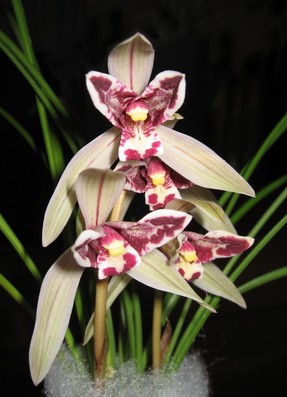
As far as the bearing of the orchid flower is concerned, Yutu is second to none. The leaf shape is semi-erect, the leaf posture is elegant, and both the newly emerged leaf shoots and flower shoots carry crystal.
Yutu's column petals have undergone butterfly transformation very well, with brilliant color. The two column petals stand upright and full of spirit like rabbit ears, not falling backward. The flowers are large, and the flower color is very brilliant, much more vivid than the best Taoyuan Die and Guan Die among Chun Jian orchids. Appreciated as a whole plant, it is just like: "Undisturbed by favor or disgrace, leisurely watch the flowers bloom and fall before the courtyard. Indifferent to staying or leaving, casually follow the clouds rolling and unfolding beyond the sky!"
Yutu is a double-art grass, with butterfly transformation on the middle leaves. Leaf art can be sought, but butterfly transformation in the grass is truly hard to obtain. Although it is not that every plant undergoes butterfly transformation, but rather that among three or four plants, or five or six plants, one plant's middle leaf will undergo butterfly transformation, similar to Taoyuan Die, it is still rare.
The only regret is that Yutu flowers easily "open adrift," that is, the butterfly transformation phenomenon disappears and the degree of butterfly transformation becomes lower. Therefore, in the orchid world there are terms such as Yutu, "domestic rabbit," "big rabbit," "second rabbit," "wild rabbit," and "jumping rabbit." In fact, this is mainly caused by external planting factors. If what you bought is indeed the genuine article, and it opens adrift in the first year, you can grow it for another two years and see how it flowers again.