Introduction to the Characteristics of the Daxuesu Lianbanlan Variety
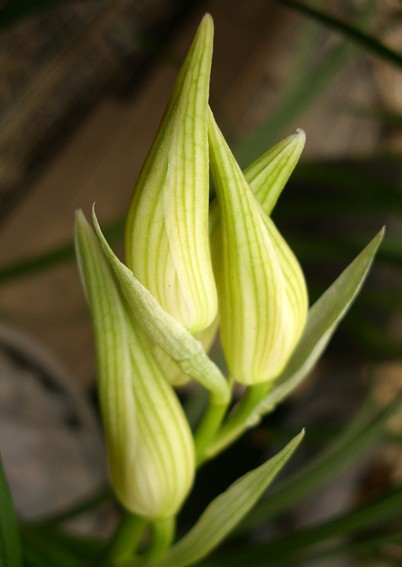
The traditional famous flower Yunnan Daxuesu is an outstanding variety among Chinese orchids, and a pearl among the Yunnan Lianbanlan orchids, and an excellent representative variety of Lianbanlan. It combines the strengths of Lianbanlan, displaying the "fragrance of Chunlan, elegance of Huilan, charm of Molan, spirit of Hanlan" that Lianbanlan possesses, and showing the unique and typical grand yet elegant demeanor of Lianbanlan. It is a rare orchid plant bestowed upon humanity by nature; its emerald green medium-wide leaves and sword-shaped upright blades are soft yet firm, graceful and elegant! In recent years, it has remained popular, introduced to all parts of the country and to Hong Kong, China, Macao, China, Taiwan, China, Japan, South Korea, Thailand, Singapore, Canada, and other countries. It is deeply loved by the vast number of orchid enthusiasts, mainly for seven major reasons:
First, because of its "long history of cultivation." With rich accumulated orchid culture and history, people are especially fond of it, and it has naturally become a traditional famous flower.
Second, its "elegant floral character" has high ornamental value. As an out-of-town orchid lover named "Mozi" praised in his article "The Yunnan Daxuesu I Know," "Appreciating Daxuesu focuses on viewing its whole and savoring its charm. Its leaves bend and droop to the rim of the pot, like green jade belts, forming one beautiful arc after another, with curves that are quite graceful, natural, and free. Its flower stalks rise tall above the foliage, and the pure white flowers appear especially clear, elegant, and plain; from afar they look like white gulls soaring in the sky, and just like a flock of white butterflies playing among the green grass. Viewed as a whole, it is graceful and luxurious, transcendent and refined, and with waves of subtle fragrance drifting over, you cannot help but be intoxicated by it"!
Third, because it is "plain-colored." This conforms to the traditional Chinese aesthetic of beauty: plain is elegant, while gaudy is showy; plain is pure and natural, with ice-like flesh and jade-like bones; plain is simple and unadorned, with a character surpassing plum and orchid; plain is noble and quietly elegant, with a lofty mind and broad spirit.
Fourth, because it is a "good flower that knows the season." The flower buds form in the cold winter and bloom at New Year's Day and Spring Festival, symbolizing auspicious blooming, prosperity, everything going as wished, and happiness and well-being.
Fifth, its "amazing award-winning record and extraordinary performance." It almost always performs outstandingly in every orchid exhibition, able to outshine the crowd and win awards; its many championships and trophies have established its noble status.
Sixth, its "moderate price is favorable for introduction." The transaction price and trading volume of Daxuesu were once a weather vane for observing the Yunnan orchid market. After experiencing multiple rises and falls, its price has fallen back and stabilized. Especially when investing in "sky-high-priced orchids" and "high-end orchids" carries great risk, choosing Daxuesu as an initial investment upon entering the orchid market is undoubtedly a wise move. The current medium-to-low price is even more favorable for orchid enthusiasts everywhere to introduce and develop it.
Seventh, "the variety is excellent and has strong stress resistance." Its cultivation adaptability covers a wide range of regions, suitable for cultivation and development in different areas. Whether in the colder Harbin or the southern Hainan Island, people are introducing it. .......Who could not love such a good flower?
Regarding the strains of Daxuesu, based on my years of experience growing Daxuesu and my understanding of it, I believe the most accurate and most authoritative view is that there are only two major strains, namely Weishan Yuandan Lan and the true Yunnan Daxuesu. At present, no new wild species has been discovered; even if there is one whose leaf type or flower is similar to it, it can only belong to Lianban Su. Lijiang Shigu Daxuesu and Heqing Daxuesu are in fact the same orchid plant. As for the discovery of Daxuesu, the earliest was during the Tea Horse Road period, by Mr. Wu of Hualong Village, Heqing. He was a famous physician (traditional Chinese medicine doctor) and was given it by a mountain villager during his travels as a healer. It later spread, and was passed on to Shigu, Lijiang. His descendant is now the former bureau chief of my work unit. There are many other legends about Daxuesu; some are purely fabricated, and the claim that Daxuesu has five or six varieties is even less accepted. Lijiang and Heqing are linked by mountains and rivers; with great publicity, the fame is naturally great, but one cannot name this Su and that Su after place names. (In Heqing alone, some people also call Daxuesu "Hualong Su," "Songyuan Su," "Heqing Daxuesu," "Heqing Dasuxin," "Caiyuan Su," etc., according to the growing region.) Of course, when Daxuesu is grown in one place for a long time, changes will occur in leaf type, leaf height, leaf width, and so on; that is natural. Even in the same place, the flowers each person grows are different. The main differences between Weishan Yuandan Lan and Yunnan Daxuesu are that it has relatively fewer leaves, the middle of the leaf is fish-belly shaped, and the leaf stalk is thin, but the flower is whiter.