Introduction to the Characteristics of the Jiangnan New Best Cymbidium faberi Variety
Characteristics:
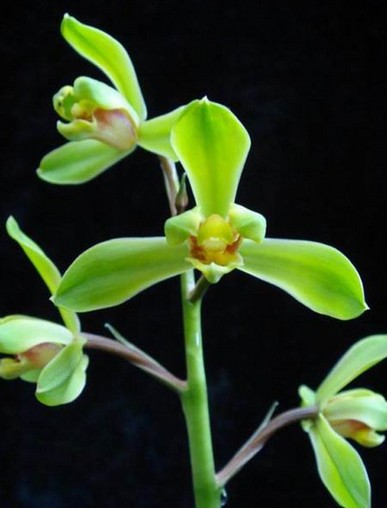
Leaf texture thin, the longest leaf can reach 70cm, leaf posture obliquely drooping, new shoots green with a purple blush, foot sheaths low. Few-leaved nature, generally even strong plants have only 6 or 7 leaves; easy-flowering nature, a 5-leaf plant can bloom. This flower has a slender scape, rising well above the leaves, with sparsely spaced flowers. Flower shape resembles the Old Best. The three outer petals have round tips, long feet and contracted bases, separated petals with semi-hard hoods slightly closed, a dragon-swallowing tongue, level shoulders, and pure green flower color - the purest color-transforming among the traditional red-to-green Cymbidium faberi varieties; its charm and complexion are excellent, and it is listed as one of the New Eight Varieties of Cymbidium faberi.
Looking at its overall floral quality, saying it resembles the Old Best feels slightly forced. The New Best has superior temperament, appearing even more elegant and graceful.
Jiangnan New Best has leaves 40-60cm long, leaf width 0.8-1cm, leaf posture semi-drooping, edge leaves arching and drooping, leaf tips slender, leaf color emerald green, leaf surface richly glossy, leaf texture soft and smooth. The flower sheath has a white base, green belly and red tip, a typical red-to-green sheath. There are two types of shape: "magpie beak" and "pointed beak."
The flower stalk is slender and round, the pedicels light purple, bearing 6-12 flowers.
The three outer petals have tight edges, contracted bases and rounded tips; the petals are separated, semi-hard soft petals, and the front end of each petal has a notch, shaped like a thumb (side view). Commonly called fist-holding petals or ring petals (the Yuan character variety also has this kind of petal).
The tongue petal is a large dragon-swallowing tongue, slightly drooping with the base not exposed, and the red spots on the tongue surface are evenly distributed and brightly colored.
Medium height, thick and round, with very good symmetry, perfectly round. The flower holds its form extremely well.
Petal texture thick and glutinous, petal color pale emerald green, seeming to have a sense of transparency.
The flowers also open in a sparse and graceful arrangement, full of charm.
This variety's extremely strong resistance to adverse conditions is its advantage; it has fewer leaves than usual, but its notable trait is that a large plant with only 5 leaves can still bear flowers.