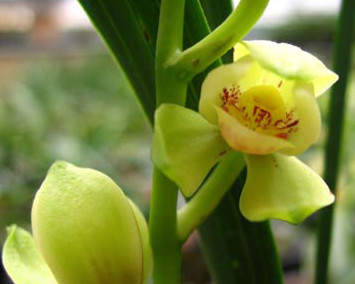
Cymbidium ensifolium 'Four Seasons Cuiyu He' (Liyu He) - variety characteristics introduction
Flower name: Four Seasons Cuiyu He (Liyu He) Content: Collected in 2002 from Fujian, the flower has a contracted base / flared angles / thick and lustrous petals / vivid color, the tongue does not hang down, a rare true-standard lotus-petal type among newly collected varieties, currently very few in stock.
Flower name: Four Seasons Cuiyu He (Liyu He)
Content: Collected in 2002 from Fujian, the flower has a contracted base / flared angles / thick and lustrous petals / vivid color, the tongue does not hang down, a rare true-standard lotus-petal type among newly collected varieties, currently very few in stock.
Cuiyu He was discovered in 2002 in Yongfu Town, Zhangping City, Fujian Province. The town has a long history of orchid growing and has produced many fine flowers; the famous Yongfu Su, Daye Tie (Fuzhou He), Daye Longyan Su and others were all discovered by local orchid farmers. That winter, at Mr. Lu Yihe's home, I happened to see a photograph; the flower in the photo had been taken when it had been fully open for more than ten days, so the flower was somewhat faded, but its color was remarkably jade-green. What particularly drew attention was the number of flowers - goodness, there were as many as thirteen - and what was even more amazing was that although it was nearly withered, the large Ruyi tongue still had not dropped. Through Mr. Lu's introduction, I visited a fellow townsman of his, an orchid farmer, to see this orchid. According to him, in the 1990s his eldest son had gone to the Wuyi Mountains in western Fujian to buy a truckload of wild-collected orchids, and found a group whose leaves were especially tall, upright and imposing, so he thought it was the upright-leaf lotus-petal plain-color type - Daye Tie - and picked it out to plant. Later it suffered severe frost, leaving only a few damaged heads and weakened seedlings, which he tended carefully until it flowered and he took the photo. I then sincerely obtained the old farmer's consent and transferred it, buying several dozen heads (seedlings) back to Shantou. However, because this orchid had been grown locally in ground beds with pure humus soil, its roots were very thick and fat and stretched out horizontally (not the straight roots of pot-grown plants now), so during the digging process the junctions between roots and pseudobulbs all broke. After returning to Shantou I switched to small plastic pots with fired clay hard material, and the losses were severe - nearly half died or were damaged. Only the following year did they barely establish themselves and produce weak seedlings, so even now there are not many strong seedlings, and this is how that came about.
Cuiyu He has a tall and vigorous plant habit. Although its wild nature has been tamed, its leaves are still very distinctive: leaves 30-35cm long, with raised stalks and slender bases, dark green leaf color, leaf shape like a snake's belly with a sharply tapered tip and sub-glossy surface, large and bulging round pseudobulbs, and many thick strong roots, making it very easy to identify (there is currently a line of Four Seasons varieties whose leaf material resembles Cuiyu He, and some unscrupulous people use it to pass off as Cuiyu He; those introducing it should pay close attention to distinguish it to avoid being cheated)
Cuiyu He belongs to the multi-flowered type. I suspect it is related to western Fujian cymbidium (huilan), because cymbidium blooms in mid-spring, and by then the early-flowering sub-orchid family of Four Seasons is also coming into flower. In its color and multi-flowered character (generally when a mother-and-son shoot blooms there are 8-9 or more flowers), it shares the multi-flowered nature of cymbidium. Its floral fragrance type is also close, so I am somewhat suspicious, and it remains for experts to study.
Besides its flower color being very jade-green and lustrous, Cuiyu He's petals are also very thick, substantial and rounded, so the flower holds exceptionally well; from opening to withering it does not lose shape. The Ruyi tongue turns upward and does not hang down, making it one of the few new varieties among true-standard lotus-petal Four Seasons orchids whose tongue does not drop. Moreover, the outer three petals are in a 2:1 ratio, with incurved hooded edges clasping together, the inner petals slightly open, covering the Ruyi tongue, forming a nearly round central structure, just right. The flower size is similar to that of He Wang, a medium-to-large flower type, and the fragrance is extremely clear and delicate.
Cuiyu He's shoot-producing rate is about 100%, and it can produce 3 rounds of shoots in two years; however, from the sprouting of a small shoot to the growth of evergreen leaves takes more than a month. After the leaves emerge it grows very fast, then slows again when forming the pseudobulb (because its pseudobulbs are relatively large and can only store energy slowly). Generally, a well-formed pseudobulb, if grown well, can still produce shoots after 5-6 years.
Because Cuiyu He has large heads and thick roots, its routine management requires more nutrient supply than other orchid types to make it stronger and its flowers larger and brighter. If conditions permit, place some fully decomposed cake fertilizer on the surface to supply nutrients slowly, and add some chemical fertilizer as a supplement, and it will grow vigorously.