Introduction to the Jianlan 'Yushen Dagong' variety, also known as Sanming Yushen
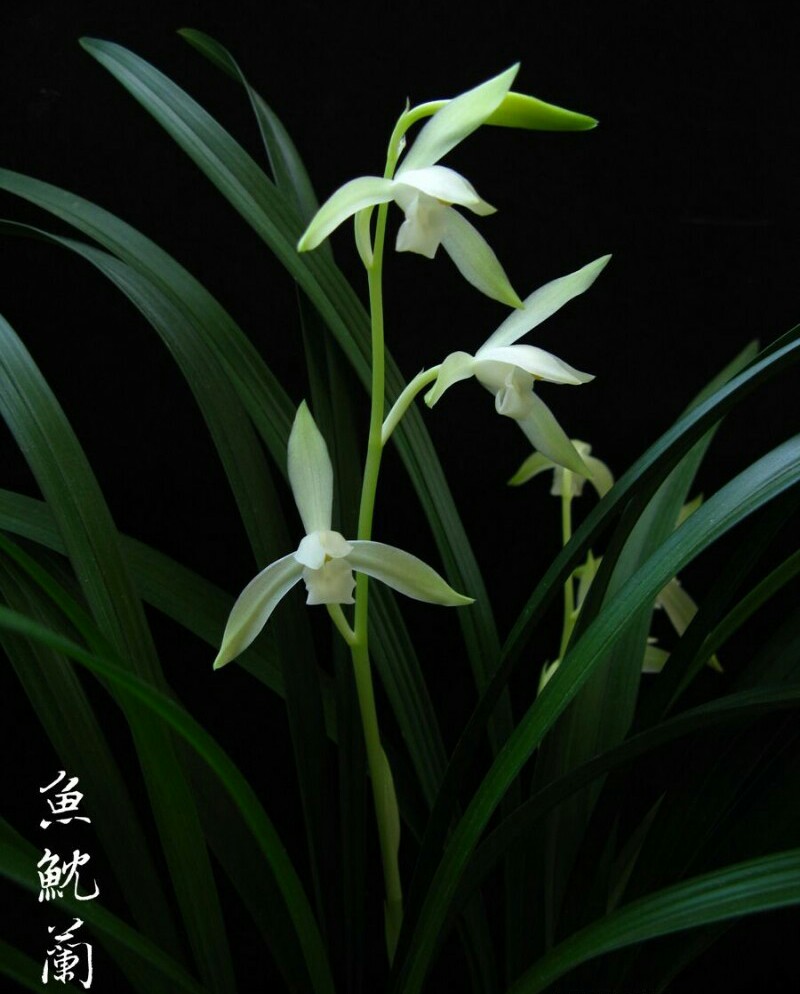
[Brief introduction]: Its petals have a more oily, fleshy texture. Because its petals have a translucent jade-like texture like a fish's skull, it got its name. Orchid works through the ages have all highly praised it.
Leaf width 40-50cm long, lustrous, leaf tip blunt-pointed forming a double-groove-like arrow groove, semi-erect leaf, leaf surface flat, pseudobulb oblong spherical. The flower scape, from emerging from the soil to the small bud stage, is slender and upright, colored greenish-white, bearing 6-8 flowers, flowers large with broad thick petals, the whole flower pure white with the petal tips slightly tinged with a green halo. The flowers are level with or above the foliage. The delicate fragrance is clear, distant and pleasant. In 1996 it won the gold award at the Shandong International Confucius Culture Festival Orchid Exhibition, and in 2000 the bronze award at the 10th China (Hangzhou) Spring Orchid Expo.
[Introduction]: In the vast Jianlan family, Yushen Su, also known as Yuzhen Su and Yushen Su, can be called outstanding among them. According to the Jinzhang Lanpu (Jinzhang Orchid Manual) written by Zhao Shigeng of the Song Dynasty: "...Yushen Lan (Yuzhen Lan), also known as Zhao Hua and Yushen. The flower segments are clear as yushen, sink in water without shadow, the leaves are strong and green, this is a wonder beyond the white-flower class." It possesses many innate beauties:
1. Majestic leaf posture. It presents an erect or semi-erect leaf form; its gracefully upright elegant posture endows people with a sense of noble purity and vigorous vitality.
2. Deep green leaf color. When just sprouting, its tender green gives people a sense of brightness; when the leaves mature, its deep green is deeper and more beautiful than any other Jianlan under the same conditions, granting people a feeling of leisure and comfort.
3. Tough and thick leaf texture. Touching its leaves with the hand, they are full and soft; matched with its leaf posture, one can perceive the connotation of softness within firmness.
4. Broad leaf tips. Other Jianlan all taper to a point toward the tip from the middle, whereas Yushen is broad, round and substantial in its upper-middle part, just like green command arrows pointing straight to the sky, radiating an upward vitality and a momentum of striving to compete.
5. Sturdy leaf bases. Compared with other varieties with thin bases and scattered leaves, it appears especially sturdy and upright, better displaying its charm of unity, steadiness and solidity.
6. Very many leaves. Growing four or five leaves on the same growth point is common, and there can be as many as six to seven; combined with its majestic orchid posture, it can grant people the joy of prosperity and flourishing.
7. Flower buds white and tender, lovely. When grown to two to four cun, they are just like a plain-clad maiden strolling in a gracefully upright green bamboo grove, giving people infinite elegance, quiet and warmth.
8. Flower color milky white and crystal bright. Its flower color is especially pure white, and the edges are also adorned with a pleasing tender green, slightly transparent; when in full bloom, place it in a basin of water and one can know its transparency is very high, plain and elegant, pleasing; its jade countenance and crystal heart, pure and lovely.
9. Petals rich, thick and broad. Compared with other plain-heart (suxin) varieties, it is 1.5-2 times wider, and the top is round and full, the middle fat and broad, presenting a graceful and luxurious posture, giving people a sense of rich and substantial beauty.
10. Beautiful yet not delicate and weak. Because the leaves are erect, light exposure is excellent, and it is not easy to collect dust and debris, so it keeps itself clean and is not prone to disease; because its leaves are many and thick and its growth point solid, it is good at storing nutrients in autumn and winter and releasing buds in spring and summer, so its reproduction rate is extremely high. It is common for each plant to grow two or three shoots per year, and as many as six shoots at the high end; in hotter climates it even sends up two seasons of shoots each year. When blooming, the fragrance assails the nostrils; with one flower in a room, the whole house is filled with fragrance.
In short, the quality of its leaves, the beauty of its flowers, and the pleasantness of its fragrance are unmatched by other Jianlan suxin (plain-heart) varieties; moreover, with its strong disease resistance and high reproduction rate, it is easy to get along with and be close to people; it truly deserves to be a rarity in the Jianlan family.
The Yushen Dagong circulated locally in Sanming, from its plant form, flower form, fragrance, thin flower segments, good transparency, and flowering period as long as half a month and other characteristics, my view is consistent with the original poster's: the Yushen Dagong circulated locally in Sanming matches quite well with the Yushen Dagong described in Zhao Shigeng's Jinzhang Lanpu of the Song Dynasty. Sanming Yushen's petal texture is translucent, glutinous, with pure fragrance, long flowering period, and it does not deform after being open a long time, with 7-12 flowers; whether it is the Yushen Su of the Song Dynasty remains to be verified.
The earliest record of Yushen Lan is Zhao Shigeng's Jinzhang Lanpu of the Song Dynasty: "Yushen Lan, twelve sepals, flower segments clear and limpid, just like yushen; pick it and sink it in water, no shadow can be pointed to. The leaves are rather strong and green; this is a wonder of the white orchids." Just this one line "sink it in water, no shadow can be pointed to" has stirred up no end of controversy. I think the records of that time should be viewed historically. Historically, Chinese people's understanding of orchids went through a process; Qu Yuan planted orchids and cultivated hui, nine gardens and a hundred mu, but all were "green stems and purple sepals," which by today's standards would be ordinary flowers. I remember once seeing a Song Dynasty gongbi orchid painting, which probably depicted a famous variety of that time; the bamboo-leaf-shaped petals were white, and the lip and column had color, which by today's standards would not count for much. So placed in that era, a variety like Yushen Lan with such appearance and such fragrance would have seemed unmatched among all orchids. The record exaggerated a little, but if placed more than 900 years ago, imagine a pile of dusky-colored flowers with such a semi-transparent pure suxin flower appearing among them, how sensational it would have been, and with what language would one record it? The so-called "wonder beyond the class" means it was so good that it could not even be classified; so viewed this way, "sink it in water, no shadow can be pointed to" is not hard to understand.
So what exactly is shen? What relationship does it have with the transparent texture of the petals? Zhou Lianggong of the Ming Dynasty, in Min Xiao Ji, somehow understood the meaning of "shen" as fish roe: "the flower color is tender green and limpid, extremely like fish roe; cast it into water, it merges with the water, and the flower color cannot be distinguished." Probably because of dialect, the Kangxi Dictionary also made this mistake, and even now some people strain to support this theory, even saying that the leaves of Yushen Lan have grain-like fish roe on them! Others say "shen" is a small fish; when a small fish has just hatched, its body is transparent. Actually these are all somewhat forced interpretations that fail to distinguish the characters. A quick look makes it clear that "yushen" is the skull of the yellow croaker (shi shou yu), which can be made into implements, window ornaments, lampshades, and can also decorate hats. There are many records in Song Dynasty literature. The Song Dynasty poet Zhang Xian's ci poem "Yushu Houting Hua - Shangyuan": "The precious bed's fragrance is heavy, awakening from spring sleep; the shen window makes dawn hard to discern." This refers to curtains made with yushen. Meng Yuanlao of the Song Dynasty, in Dongjing Menghua Lu - Various Sundries for Sale: "repairing futou hats, mending and washing shen-horn hat ornaments" refers to hats decorated with yushen. Zhou Mi of the Song Dynasty, in Wulin Jiushi - Lanterns: "Besides these there are shen lanterns, carved with gold amber and tortoiseshell to adorn them." That is to say, in the Song Dynasty, yushen was a high-grade ornament. Regarding these, one can refer to a blog post, "Yushen Is the Supreme Fine Article for Ancient Women's Adornment."
Using something like yushen, with its pure white and soft color and its translucent texture when held to the light, to describe an orchid seems incomprehensible today, just as many years later people will not understand why people today, instead of saying white, must say "apple white" -- it is just for the sake of looking high-end, grand and classy, isn't it.
So even if Yushen Lan was not as miraculous as the historical records say, did it actually go extinct or not? This question can be viewed from two aspects. First, the tribute economy of the past was in essence a special way in ancient times of promoting the commodity economy; the royal family purchased the best things on the market as tribute, which drove production in the corresponding local fields. As the saying goes, when those above have a liking, those below will surely exceed it. Just as Wang Shimao of the Ming Dynasty recorded in Min Bu Shu about Fujian Yushen: "Orchids are named for Jian, and the four prefectures of Fu and Xing are especially flourishing; every household, great or small, transmits and plants them... Most regard Yushen (Yushen) as the best, and those that bloom in all four seasons are treasured." It can be seen that up to the mid-Ming Dynasty, Yushen was a commodity flower existing in large quantities. Fujian has historically also been a place relatively less affected by war, so to say it suddenly went extinct would probably be hard to believe.
But with the development of new flowers, it is possible for historical famous varieties to fall into neglect, and this is also inevitable in the development of orchid varieties. Neglected it may be, but did it go extinct or not? If the Yushen Lan that reappeared at the 1990s Kunming Garden Expo was the only one, then it would be hard to say. At that time experts appraised and said this flower and the Yushen Dagong preserved at the Du Fu Thatched Cottage in Chengdu are the same variety; I think this fits. This is the same as the textual research of cultural relics: a single piece of evidence is hard to rely on, but if there can be a distant echo from a thousand li away, then the reliability is greatly strengthened.
(Patch: The Yushen Dagong circulated locally in Sanming and the one Liancheng sent for exhibition are not the same line of flower. Sanming local orchid enthusiasts and Rao Chunrong even argued over this issue. From multiple source photos and orchid enthusiasts' descriptions, the two are not the same variety. From Zhao Shigeng's records, the three characteristics are: flower segments clear and limpid, leaves rather strong and green, tip slightly curved -- that is, petals semi-transparent, i.e. thin; plant form strong with leaf tips holding dew, i.e. plant form slanting and curved but not bowing and drooping; leaf color deep green. But the characteristics introduced on the Liancheng company's official website are: petals thick and tender green, plant form upright. Thick petals cannot be transparent. The Liancheng company itself knows this, and deliberately added a line "has transparency," but if it is thick, how can it be transparent? (See post 44.) These three characteristics do not match, so it can basically be judged that what Liancheng sent for exhibition is not Yushen Dagong. Rather, the Sanming Yushen circulated among the people matches all three characteristics: flower segments thin, good transparency -- I have tested it myself, and through a sheet of writing paper it is clearly visible, just like ice-type jadeite (flower segments clear and limpid); plant form with measured opening and closing, leaf bases rising high, leaf middle upright and neat (leaves rather strong and green); leaf tips elegant with held dew (tip slightly curved), appearing very reserved; the heart leaf of a 5-leaf seedling is certain to have a yin-yang tip (this characteristic has also been noticed by orchid enthusiasts). From when the flower opened on September 3 to now September 14, it still gives off fragrance without cease, with a clear and cool fragrance. The Riyue Bao blooming at the same time, compared with it, is not on the same level at all. In addition, it was found that the bract on the flower stalk is still crystal clear and not withered to this day, while the Riyue Bao blooming at the same time had bracts that began to change color and wither when the flower opened. Also, after asking Fujian orchid merchant friends, this flower is also very hard to find locally, so few are put up for auction. The line I grow myself is marked "authentic Sanming Yushen," and by comparison it should not be the line that won the award in Liancheng. This patch breaks the logic of the paragraph above, but I still believe that a commodity orchid that served as tribute for several hundred years would not suddenly go extinct and lose its strain in Fujian, which was undisturbed by war. Second, the physical object does not lie, and the flower speaks for itself; who is right and who is wrong, who is high and who is low, will naturally become clear by comparison. It is not something that can be blurred over by having a few experts appraise it and issue a gold award.)