What is Bai Mo Mo Lan? Variety Characteristics and Care Methods
Miscellaneous Discussion on Identifying the Orchid Cymbidium sinense Varieties Bai Mo and Mo Lan
In order to help orchid lovers understand the name "Bai Mo Lan", the Guangzhou Orchid Research Society's method for identifying several "Bai Mo Lan" varieties is introduced as follows:
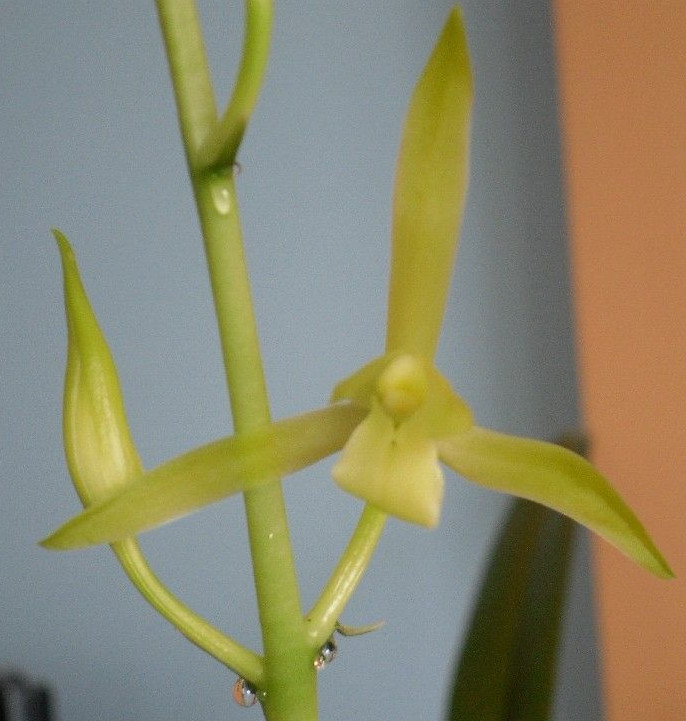
"Bai Mo Lan" is a precious mutated variety of Mo Lan. The pseudobulb is elliptical, the roots are thick and long, and the leaves grow in clusters of 4-5, sword-shaped, entire-edged, and glossy. The flower stem is very tall, upright, and often rises above the leaves; each stem bears 7-20 or more flowers. The bracts are small, and the base has water pores. The sepals are narrowly lanceolate and pale white; the petals are shorter and broader, extending forward, positioned above the column. The lip is indistinctly three-lobed, with the tip drooping and curling backward, pale white. It blooms at the beginning of the year, so it is also called Bai Hua Bao Sui Lan.
"Bai Mo Lan" has a cultivation history of several hundred years. Passed down to the present, there are no fewer than a dozen or more varieties. Its leaf color is lustrous and smooth, its form is elegant, its fragrance is quiet and far-reaching, and it has strong disease resistance, making it a favorite cultivated by the urban and rural people of our county. "Bai Mo Lan" is generally divided into two strains: "Qi Jian" and "Ruan Jian".
(1) The Qi Jian Bai Mo strain. The characteristics of this strain are: the leaf clusters grow upright, the opening angle is small, the texture is thick and leathery, glossy, the leaf color is slightly yellow, and the leaves do not droop. Its traditional varieties include:
(1) Xian Dian Bai Mo: During the late Qing Dynasty, it was discovered under the banyan tree in front of the Guang Cheng Zi Great Immortal Temple on Dezheng North Road in Guangzhou. It was a family heirloom variety cultivated by Shen Kaofen, former head teacher of the former Guangya Academy. The leaves are narrower than Liu Ye Bai Zhou, with the tips slightly curved and drooping. The bracts and leaf bundles are tightly attached, commonly known as "Jia Jin". The flowers are white, with the He De Wang white-green, and each inflorescence bears 16-23 flowers. Extremely fragrant.
(2) Liu Ye Bai Mo: Also called "Yun Quan Xian Guan Bai Mo Su" or "Ou Jia Mo". It was originally cultivated by a silk merchant surnamed Ou in Daliang, and was later treasured by the Yun Quan Xian Guan on Xiqiao Mountain. It spread through the Nanhai and Shunde areas, and was most numerous in Daliang and Chencun. Its characteristics are: the leaves spread out, the leaf waist is relatively broad, willow-leaf-shaped, and the bracts and leaf bundles are relatively loosely spaced, that is, "Jia San". The flowers are yellow-white, and each inflorescence bears 18-20 flowers.
(3) Li Jia Bai Mo: Cultivated by a tea merchant surnamed Li in Foshan. Later, because he went blind, it was also called "Foshan Mang Gong Mo". This variety is similar in form to Liu Ye Bai Mo. The distinguishing points are: the tips of its bracts curve inward like claw hooks, the flowers are yellow-white, and each inflorescence bears 15-18 flowers.
(4) Jiang Nan Qi Jian Bai Mo: Originally produced in Luofu Mountain, Boluo. Its leaves are the longest among the "Qi Jian", reaching up to 70 cm. What distinguishes it from the above three is: the leaf opening is narrow, the leaf surface is uneven, the midrib is relatively deep, the texture is relatively thin and hard, and the bracts are tightly upright, so it is called "Qi Jia". The flowers are tinged with yellow.
(5) Zao Hua Jiang Nan Bai Mo: Also called Jiang Nan Da Feng Wei Su. The leaf color is green, without gloss, the texture is thick and hard, the tips droop, and the leaf ends are broad. After drooping, the tips curve slightly upward, like a phoenix tail. The flowers are blue-white, and the flowering period is early, blooming before Xiao Jia.
(6) Duan Jian Bai Mo: The leaves are generally about 40 cm long. Each shoot has 2-3 leaves, at most no more than 4. The flowers are small and white, and each inflorescence bears 5-10 flowers. It is a variant of Guangdong Xiao Mo.
(7) Yu Ban Bai Mo: The leaves resemble those of Liu Ye Bai Mo. The distinguishing point is: the leaf tips are slightly slanted and twisted, so it is also called "Niu Zui Lu". The flower sepals are pale jade green.
(8) Chi Geng Bai Mo: The leaf texture is thick, the leaf waist droops, and the leaf tip has a pot-shaped concave part like a spoon, hence the name. It was passed down in the Nanhai and Shunde areas in ancient times.
(9) Yin Si Bai Mo: The leaves have intermittent white filamentous stripes, and the flowers are yellow-white. It was bred from a mutation of Xian Dian Bai Mo.
(10) Ya Jian Bai Mo: The leaf color is dark green and lusterless, the leaves grow upright, the texture is thin and hard, the margins are slightly serrated, the leaf tips droop slightly and are slightly twisted, and there are sharp thorns on the midrib on the back of the tip.
(2) The Ruan Jian Bai Mai strain: Its characteristics are that the leaf clusters do not grow upright, the opening angle is greater than 120 degrees, the leaf texture is thin, lusterless and rough, the veins are obvious, the leaves are broad, 4-5 cm wide, the leaves droop, and the tips are sharply acute. Its traditional varieties include:
(1) Ta Lou Ruan Jian Bai Mo: The leaves are extremely soft, drooping deeply outward over the pot surface, the bracts all open, there are basically no upright leaves, the flower stem is yellow-green, and each inflorescence bears 8-12 flowers.
(2) Pu Tong Ruan Jian Bai Mo: It has an upright leaf posture, the leaf cluster opening is within a 120-degree angle, the leaf texture is thin, and the vein grooves are clearly imprinted, reaching to the leaf tip. The flower sepals are blue, the petals are white, and each inflorescence bears 18-20 flowers.
(3) Ruan Ying Jian Bai Mo: What differs from the above two is that the leaves have longitudinal wrinkled folds, and the leaves are soft-upright and hard, easily bent back.
(4) Lu Mo Su: The leaf color is dark green, the leaf posture is upright, and the middle part bends downward and droops. The flower sepals, petals, and column are all green, hence it is called Lu Mo Su.
(5) Lu Yun: The leaves resemble those of Lu Mo Su. The distinguishing points are that the leaf veins are obvious and there are nodes, especially obvious at the tips. The flower stem is dark green, and the perianth is in multiples of 6, chrysanthemum-shaped. It is a premium variety of the Ruan Jian strain.
This is the first type of name, and the one most commonly referred to: Mo Lan Su Xin.