Detailed introduction to the characteristics of the Cymbidium sinense variety Baiyu Sujin
This variety originated from the Agricultural Science Institute of Lunjiao Town, Shunde City. It is a mutated variety of Baosui Baimo. When discovered, there were only two plants, which were cultivated over many years. Its orchid leaves not only grow brilliant yellow-white striped patterns, but its flower buds, flower scapes, and flowers are also unique among plain-flower varieties of the same type. The entire plant's flower scapes and flower shape also display green, yellow, and white stripes,...
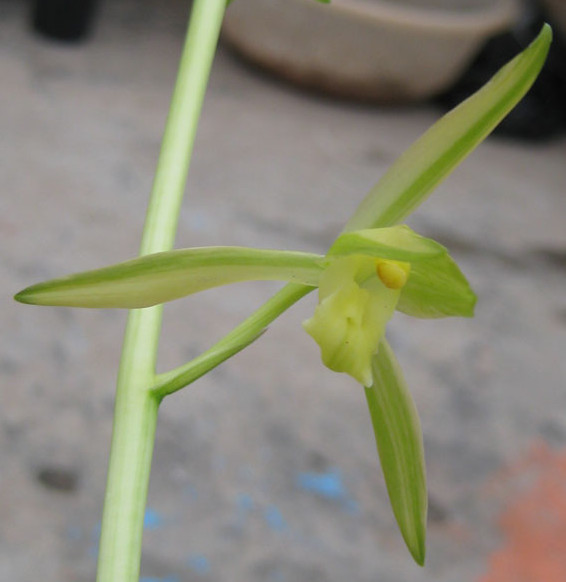
This variety originated from the Agricultural Science Institute of Lunjiao Town, Shunde City. It is a mutated variety of Baosui Baimo. When discovered, there were only two plants, which were cultivated over many years. Its orchid leaves not only grow brilliant yellow-white striped patterns, but its flower buds, flower scapes, and flowers are also unique among plain-flower varieties of the same type. The entire plant's flower scapes and flower shape also display green, yellow, and white stripes. It is a rare plain-flower variety. For details, see the three photographs on page 168 of the book Chinese Cymbidium sinense. The number of this variety developed to date is not adequate. There are two reasons: first, new shoots with high variegation appear during cultivation; second, green-leaf plants appear, which has a certain impact on propagation. Based on these circumstances, the author offers orchid friends his humble views from recent years on cultivating "Baiyu Sujin" to prevent the occurrence of high variegation.
1. When first planting this variety, purchase it with successive generations, and observe the variegation tendency of the mother plant as a reference for the new variegation tendency of the next generation.
2. When purchasing a single plant, it is best if it has new shoots. Observe whether the leaf sheaths of the new shoots show white-green stripes. The more there are, the brighter and more beautiful the leaf variegation of the next generation will be. Do not buy those of a single solid color, because they easily produce extreme variegation.
3. If buying a weak plant, it must have successive generations and many snow-white roots.
If plants tending toward variegation and green-leaf plants are found, how should they be handled?
1. For single-plant cultivation, try as much as possible to do it after the 10th lunar month and before the 12th lunar month. Shoots that grow through Spring Festival can strive for autumn growth the following year. If, when a new shoot has grown 2-3 cm tall, the leaf sheaths are found to have only a little green and the rest all yellow, attention should be paid during the shoot's growth process, and it is best to remove it. When new shoots grow again, there is no impact on the growth of new plants the following year. Therefore, striving every year to divide plants after the 10th lunar month and before the 12th lunar month is an excellent measure.
2. For daily light, refer to the process of cultivating Jinhua Shan. Strong light easily produces high variegation, and attention should be paid every summer. Fertilization should mainly be nitrogen, with a small amount of potassium fertilizer applied after the 9th lunar month to help the orchid pseudobulbs grow thick and strong.
3. In grass-plant cultivation, the orchid pseudobulbs should not be exposed above the soil surface. The more sunlight it sees, the brighter the variegation tendency, and the more easily high-variegation plants are produced. This is the opposite of cultivating the plain-flower Yinhua variety. For the plain-flower Nanhai Yinhua, the orchid pseudobulbs should be exposed above the pot, with a small amount of nitrogen fertilizer applied and more sunlight.
Zhang Ju, Advisor of the Shunde National Orchid Association