What are the characteristics of the Chinese orchid Songchun? A complete guide for you
Songchun, an orchid variety with relatively scarce germplasm resources, is increasingly loved by more orchid enthusiasts because it combines the grandeur of Huilan, the slender elegance of Chunjian, and the rich fragrance of Chunlan. However, due to scarce resources and delayed promotion, some new orchid enthusiasts are not very familiar with this variety. I just saw a post on the forum where an orchid enthusiast asked...
Songchun, an orchid variety with relatively scarce germplasm resources, is increasingly loved by more orchid enthusiasts because it combines the grandeur of Huilan, the slender elegance of Chunjian, and the rich fragrance of Chunlan. However, due to scarce resources and delayed promotion, some new orchid enthusiasts are not very familiar with this variety. An orchid enthusiast asked about the difference between Songchun and Huilan (called Bamao Lan in my area). Let me try to explain, offering a modest spur to induce others to come forward with valuable contributions:
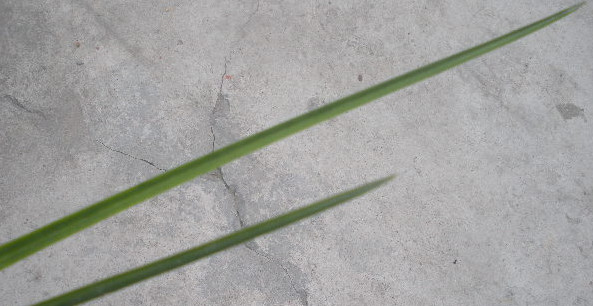
1. Songchun leaves are softer in texture than Huilan leaves, gradually tapering from the middle upward without a sharp tip, like a rice-field eel's tail, commonly known as "rice-field eel tail"; Huilan leaves are harder in texture, with obvious fine serrations along the leaf margins.
Songchun leaves: (Note: cultivated Songchun plants are somewhat shorter than freshly collected wild plants)
2. Songchun leaf bases are wide, with a ring, and the leaves are numerous. A mature plant generally has 8-15 leaves, with the bases neatly clasped together, arranged in a fan-shaped row, commonly known as "goose-feather bases"; Huilan mature plants have leaf bases that gradually spread apart and no longer clasp tightly together.
Songchun leaf base:
3. Songchun roots are uniform in thickness, branched, and somewhat thinner and longer than Huilan roots; Huilan roots are thicker and shorter, thick near the base, tapering toward the root tip, and unbranched.
Songchun roots: (Note: home-grown Songchun roots are somewhat thicker and shorter than freshly collected wild plants)
4. Songchun leaf buds and flower buds are often very plain and pure, yet the flowers are extremely rarely plain!
5. The last point is the most important~~Huilan leaves have obvious or not-so-obvious white or yellow veins (among beginners in non-production areas, some even mistake them for striped variegation), while Songchun leaves are clean and elegant in color, without them.
Songchun, also known as Chunlulan, Lulan, Songchungui, and Bamao Lan, was classified by Wu Yingxiang in the book "Chinese Orchids" as a variety of Huihua, rar.szechuanicum (Y.S.Wu et S.C.Chen) Y.S.Wu et S.C.Chen. Chen Xinqi and Ji Zhanhe's "Complete Book of Chinese Orchids" also classifies it as a variety of Huihua. Wu Yingxiang and Chen Xinqi first discovered it in Sichuan. Some scholars also believe that Songchun is an independent native population and should not be classified as a variety of Huihua.
Songchun is mainly distributed in some subalpine zones of Yunnan, Guizhou, and Sichuan in the southwest, growing at altitudes of 800-2000 m under evergreen shrub forests from the mid-slope to the summit of rocky mountains, often mixed with Huihua, Tongye Chunlan, and others (on very few mountains only Songchun grows). It prefers shady and humid conditions. Songchun has relatively many leaves, generally 8-16, clustered, nearly in two rows, with leaf bases arranged in a straight line, thinly leathery, with leaf posture mostly arching and drooping, fine teeth along the leaf margins, grooves on the leaf surface, and relatively flat leaf tips. Songchun plants generally need to go through two growth cycles to complete their growth.
Songchun gets its name because its flowering period is in March-April. Its flower scape is slightly curved, 30-50 cm tall, with 5-9 flowers. Because of the difference in flower number, there are distinctions such as five-flower Songchun, seven-flower Songchun, and nine-flower Songchun. The flower diameter is about 6 cm, the flower color is yellow-green, and it has a delicate fragrance. The bracts are almost as long as the ovary plus stalk. The sepals are mostly lanceolate, the petals are shorter and wider than the sepals, extending forward, and the lip is not obviously three-lobed. The mid-lobe has green papillate hairs and purple-red spots.
Songchun shell color is mostly white-green, but many with white bright green veins or green shells with green veins are not plain-centered varieties (this shows that finding a plain Songchun is not so easy). Beginners easily misidentify them, and buying the top flower is the safest approach.
Because Songchun is mainly distributed in the Yunnan, Guizhou, and Sichuan region of the southwest, and also in the dense forests of tall rocky mountains where few people go, it was not recognized for a long time. Most orchid enthusiasts do not know enough about Songchun, and many people think Songchun flower quality is inferior to Huihua. In fact, this is a prejudice, a prejudice arising from a lack of understanding of Songchun. With the promotion of the orchid craze in recent years, Songchun, once "raised in the depths of the boudoir unknown to others," has also been brought out of the mountains and become a new favorite in the orchid world. In 2001, at the 11th National Orchid Exhibition (Guiyang), Mr. An Qichang of Zhijin, Guizhou, with his "Songchun Qihua" and Mr. Xiao Zhengcong of Pengzhou, Sichuan, with his "Songchun Hongbaoshi," both won gold awards. Since then, "each generation produces its own talents," and new and excellent Songchun discoveries have continued to emerge every year. Varieties such as petal-type flowers, colored flowers, bicolor flowers, plain centers, butterfly flowers, strange flowers, crystal, and linear variegation, and other ornamental qualities found in other orchid types (both flower artistry and leaf artistry), have all appeared.
Songchun has a high cultivation survival rate and a high propagation rate. Wild Songchun plants with four or five shoots are everywhere, and single solitary shoots are rarely seen. The plants are robust and vigorous, the leaves are arranged neatly and uniformly, and the leaf posture is elegant and graceful, combining the robustness of Huilan and the ethereal beauty of Chunlan. If the leaves have spots, stripes, or other linear variegation, because the plant is tall and the leaves are numerous, it appears broad and showy. Moreover, when Songchun leaves have variegation, the flowers are also likely to carry variegation, and the evolution of linear variegation is relatively good, with great potential for further change.