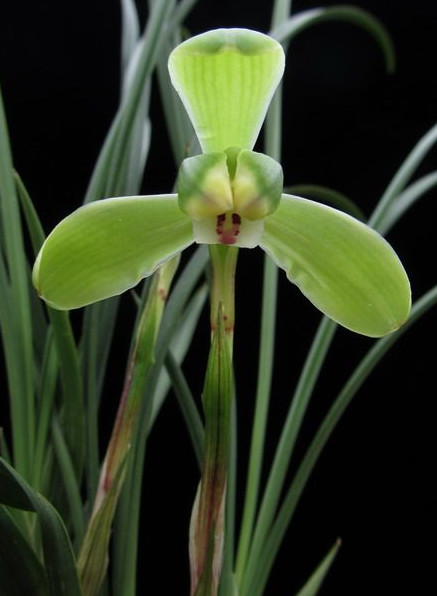
Cultivation methods and precautions for Anmei Chunlan
1) After three years of observation, the saying that An is difficult to grow does not seem to be entirely unfounded, but it is not as frightening as imagined: this grass has slightly weaker disease resistance than ordinary famous Chunlan varieties, and is also more sensitive to fungicides than other Chunlan (applying conventional fungicides at normal doses will not cause An to show obvious disease spots, but its growth rate and recovery speed will slow down noticeably)...
"Selected and bred in the early Republic of China by the Shaoxing orchid grower Niu Yang'an. The three sepals have round heads, fine roots, and tight edges; soft silkworm-moth palps, with the front ends of the palps white; a large Liu Hai tongue. The flower's elegance is fully comparable to Song Mei and Xi Shen. The leaves are light green, the foot sheaths are relatively low, and the leaf shape is rather stiff. The grass is extremely difficult to grow and easily scorches at the tips."
——Mo Lei, Jin Zhenchuang, Zheng Liming, eds., Newly Compiled Jiangsu-Zhejiang Orchids and Huilan
1) After three years of observation, the saying that An is difficult to grow does not seem to be entirely unfounded, but it is not as frightening as imagined: this grass has slightly weaker disease resistance than ordinary famous Chunlan varieties, and is also more sensitive to fungicides than other Chunlan (applying conventional fungicides at normal doses will not cause An to show obvious disease spots, but its growth rate and recovery speed will slow down noticeably). This is the first point. Compared with other Chunlan, An has noticeably stricter requirements for fertilizer, water, and temperature (correspondingly, it is not particularly particular about other external conditions such as light). Therefore, An grass has an obvious characteristic: the grass condition is uneven in size and irregular. This is the second point. In the eyes of professionals, this grass does not meet the conditions of an excellent horticultural variety, but this grass seems quite satisfied with my "care," so its seedling production and recovery are instead noticeably higher than many famous varieties.
2) Flowering characteristics of An: after this grass produces strong growth, it flowers very easily, and the flower buds tend to concentrate on the strongest seedling in a clump. Large seedlings with more than six leaves generally have about three flower buds; this flower also tends to set buds earlier. In addition, relatively speaking, the outer bracts of this flower are rather small (the adhering shell is normal, with strong green color). Based on feeling, the probability of this flower producing good open form in the north is higher than in the south. Because the observed sample base is too small, this cannot yet be taken as a final conclusion.
3) The grass type of An: writing about this issue always makes me a little uneasy, because I remember that when I first started growing orchids, I very much hoped that some book or authority could explain thoroughly and unmistakably the grass type, leaf texture, leaf serrations, and other characteristics of a certain grass, so that among many orchid grasses I could recognize it at a glance. Later, I gradually felt that thinking and doing this was more or less too idealistic, just like a stock trader wanting to make a fortune solely by technical indicators: it cannot be said to be baseless, but it is absolutely unreliable. Of course, after spending a long time in this circle, I have indeed met several skilled people who are very accurate about some grasses at a glance. If you could really extract the secret from them, it would be somewhat similar to what the Crocodile God of the South Sea said to Duan Yu: "You are very much like me! You are very much like me!" If he does not publicly reveal the answer, no one would know that what he said was similar was only the back of the skull. So I now generally rarely talk about this, to avoid misleading others and myself. But since Wendao has already described An, I have no choice but to add a little with my meager skill as a superficial observer, so that beginner orchid friends can have a slightly more comprehensive understanding of this grass. My personal view is that the overall grass type of An is relatively close to He Shen among common varieties. It is just that the leaf bases are tighter, the waist is straighter, the leaf color is deeper green, the leaf texture is thicker and more glutinous, the leaf grooves are deeper and longer, and the widening of the leaf belly of a single leaf (especially the bottom leaves) is less obvious (this may be the reason it resembles Xi Shen - my guess, not necessarily the "back of the skull," so it does not count). Overall, He Shen's leaf posture is rather stubborn, while An appears strong. I can roughly add only this much. Fortunately, Brother Wendao is diligent and took many clear pictures (see "Yang'an Mei Buds, Grass, Flowers"). I hope skilled and perceptive experts will offer much guidance and additions.