An Introduction to the Characteristics of the Cymbidium tortisepalum Variety Zhaoshi Mei
History: Zhaoshi Mei was discovered by teacher Zhao Qin in Dengchuan, Eryuan County. When it was registered in the "China Orchid Famous Variety List," the definition of plum-petal (mei ban) was not yet very clear, and understanding of plum-petal flowers was not yet unified. It was simply felt that the petal shape closely resembled the petals of plum blossoms, so teacher Zhao Qin registered it under the surname "Zhao" as "Zhaoshi Mei"...
History: Zhaoshi Mei was discovered by teacher Zhao Qin in Dengchuan, Eryuan County. When it was registered in the "China Orchid Famous Variety List," the definition of plum-petal (mei ban) was not yet very clear, and understanding of plum-petal flowers was not yet unified. It was simply felt that the petal shape closely resembled the petals of plum blossoms, so teacher Zhao Qin registered it under the surname "Zhao" as "Zhaoshi Mei." Gradually people developed a new understanding of plum-petal flowers and established a rigid definition: the column petals (peng ban) must be hard column petals, that is, the column petals must be emulsified flowers to count as a true-standard plum petal. Therefore, by today's standards, Zhaoshi Mei can only be considered a "lotus petal" (he ban). Whether it is called Zhaoshi Mei or Zhaoshi He, this flower is indeed a good flower, with a very beautiful leaf shape and extremely graceful petal form.
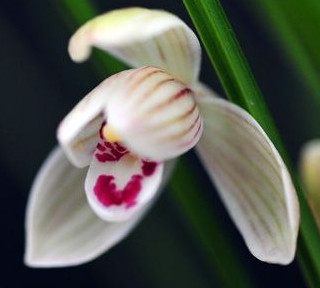
Characteristics: This variety has a plant height of 25-30 cm; after domesticated cultivation, the height is under 20 cm. Leaf width is 0.8 to 1 cm, with 6-9 leaves. The leaf texture is relatively hard, the veins are transparent, and the leaves are large and curled, with many crystal spots on the leaves; white line art and yellow line art appear from time to time. Each scape bears 2-4 flowers, lotus petal (he ban), the flowers stand above the leaves. The outer petals of this speckled-shell flower are round and broad, with a narrowed base and flared corners, tight edges, and a slightly protruding point at the tip. The mussel-shell column petals (peng ban) close together, the lip is round and curls backward, with two rows of red markings on it. The flower color is pinkish white, the veins are red, the main and secondary petals are of lotus type, the petal tips form a hood, and the petals viewed from the front and back are both round; the column petals form a ball shape, the petals are fleshy, with water crystals, and the color markings are bright red. The flowers bloom in January and February, and the petals do not deform; the longer the flowering period, the heavier the water crystals. The flower shape, posture, and appearance are elegant and dignified, with great spirit and charm. Flowers and leaves set each other off, combining plum-petal form and leaf art in one. This variety has a relatively high shoot production rate, at minimum reaching 1:1.5, and has strong disease resistance, reblooming every year. It is a premium variety among the Cymbidium tortisepalum series.