Introduction to the Characteristics of the Lotus-Petal Orchid Variety 'He Zhi Guan'
In the early spring of 1990, Mr. Zhao Weilin, a famous expert from Baoshan then known as the "King of Gambling Grass in Western Yunnan," found a clump of wild-collected orchids with complete dragon roots and excellent leaf shape at Lujiangba. At that time, Mr. Zhao Weilin had 5 exceptional gamble lotus-petal seedling plants, respectively named A, K, Q, J, and 10. After careful cultivation for two years, they bloomed in 1992...
In the early spring of 1990, Mr. Zhao Weilin, a famous expert from Baoshan then known as the "King of Gambling Grass in Western Yunnan," found a clump of wild-collected orchids with complete dragon roots and excellent leaf shape at Lujiangba. At that time, Mr. Zhao Weilin had 5 exceptional gamble lotus-petal seedling plants, respectively named A, K, Q, J, and 10. After careful cultivation for two years, they bloomed in 1992. Among them, He Zhi Guan and Xiu He Ding were A and K, while the other three plants did not bloom. After the two plants bloomed, they were named "Mao Da Wang" and "Mao Er Wang."
He Zhi Guan caused a sensation in the orchid circles of western Yunnan at the time. Its excellent petal shape, upright bloom form, and magnificent bearing left all who saw it struck with awe. The famous orchid expert Mr. Qin Yibei exclaimed: "This should be the champion of lotus-petal Cymbidium tortisepalum! It can be called 'He Zhi Guan' (Champion of Lotus)." Thereafter, the name "He Zhi Guan" spread among orchid enthusiasts. The following year, the other half of the clump divided from the same dragon root bloomed, and the beauty of its flowers once again made people unable to put them down. It was later named "Xiu He Ding" by Mr. Li Hongyin, a master orchid grower in Dali. "He Zhi Guan" and "Xiu He Ding" were once thought by orchid enthusiasts to be two varieties, but after years of practical verification, the two should be of the same origin and same variety, being the same group of plants grown from one dragon root, indistinguishable in every aspect of plant type and flower type. In daily transactions, the prices of the two are also the same, and a unified understanding has gradually been reached.
This variety's mature plants have five to seven leaves, with leaves about 60 cm long, naturally drooping when grown to two-thirds of their height, leaf width 1.2 to 1.6 cm, leaf surface wrinkled and covered with fine texture, leaf quality thick and appearing semi-dehydrated, leaf sheaths rounded and inward-curving, leaf tips blunt and upturned (i.e., forming a hood), the entire plant form coordinated and natural, red flowers and green leaves enhancing each other, elegant and graceful, exquisite and magnificent.
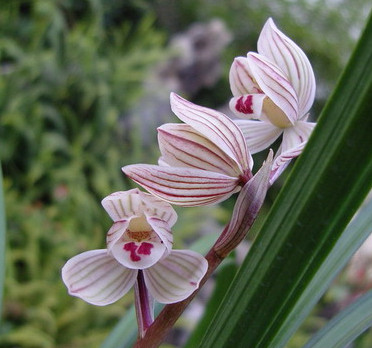
He Zhi Guan puts out flowers around January 20 each year, with two to five flowers per bloom. At the small bud stage, the flower buds are short and round, rose-red in color, like the gentle and bright glow of dawn on the horizon. After opening, the flowers are large, with thick and glutinous petals, white with a rosy tint like a baby's skin, and like the blush on a shy young girl's face, charming but not gaudy. The length-to-width ratio of the petals is about 1 to 1.2, with the three outer petals arranged in a triangular formation, with extremely regular base constriction and corner placement. The petals are soft silkworm-moth petals, covering the column without opening a skylight. The lip is a large round lip, upright, short and round, slightly tilted downward without rolling back, with red spots scattered on the snow-white lip surface as vivid and eye-catching as gemstones. The reddish flower scape is slender, round, and long, with flowers blooming above the leaves, like a dragonfly touching water, graceful and elegant, and when a breeze passes, a delicate fragrance spreads all around.
As a typical representative of lotus-petal Cymbidium tortisepalum, it has the following characteristics:
One: It is a representative of broad-leaved Cymbidium tortisepalum, with leaves 30-50 cm long and 1-1.8 cm wide, a majestic leaf type, strong structure, and imposing appearance, possessing great kingly bearing.
Two: It is a representative of lotus-petal Cymbidium tortisepalum, with stable flower color, flower shape, and flower keeping. The petal shape proportions are moderate, magnificent and dignified, with a compact center, and extremely good flower keeping. An orchid enthusiast once took the flower scape of "He Zhi Guan" and waved it vigorously in the air, yet its petals did not curl back. Its strong structure and grand petal form possess the realm of "Yan's sinew and Liu's bone" in calligraphic aesthetics.
Three: "He Zhi Guan" is a multi-flowered lotus-petal variety among Cymbidium tortisepalum, generally blooming 3-5 flowers. Its inflorescence arrangement and overall sense make people feel extraordinarily comfortable, with reasonable flower-to-leaf coordination, truly making people forget the commonplace when viewing it.
Four: "He Zhi Guan" has obvious plant-type characteristics, with leaves showing a relatively heavy dehydrated appearance and raised veins on the leaf surface. It is a typical lotus-petal plant type. This characteristic makes it possible for market circulation, and it is generally not easy to mistake.
Five: "He Zhi Guan" is easy to cultivate, with a high shoot-producing rate and strong disease resistance. At the same time, it is the most expressive flower, reblooming very easily, with a single plant often able to bloom. An even more peculiar characteristic is that a new shoot can generally grow from below the flower scape.