What is a mosaic virus orchid? Understanding the characteristics of mosaic virus orchids
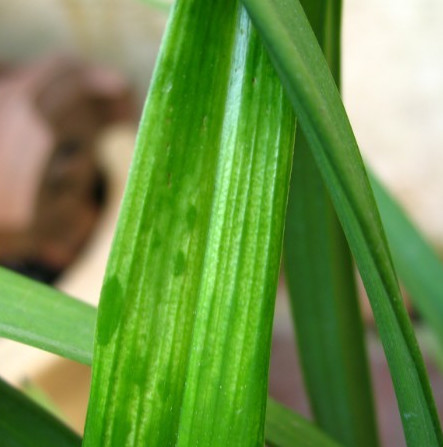
Later the new growth indeed developed the mosaic virus. A bloody lesson! As shown in the picture:
Another suspicious case is the so-called nutrient deficiency. The nutrient deficiency generally accepted on the forums is mostly that when orchid buds grow too fast, they lack some element needed by orchids and thus show lesions similar to those when an orchid has the mosaic virus. When unsure whether a lesion is mosaic virus, orchid friends and sellers often mention this. Actually, would it not become clear once the orchid leaves grow longer? Hehe.
But at least there should still be a difference between nutrient deficiency spots and mosaic virus spots: the so-called true nutrient deficiency spots should not really be described as spots. Compared with mosaic virus lesions, which have a fairly obvious boundary between the lesion and the normal green leaf, the nutrient deficiency part first differs from the green leaf part only in being paler, and there is no obvious boundary between the pale spot and the green leaf part; instead, it transitions and blends naturally with the green leaf part in a mist-like form.
Although I have never accepted that nutrient deficiency is a real thing, perhaps as stated above, only such a situation can count as the so-called true nutrient deficiency that is distinguishable from mosaic virus spots.
The latency of the mosaic virus:
Orchids carrying the mosaic virus often have a certain incubation period. As mentioned earlier, very few buyers will list orchids with obvious mosaic virus symptoms (very few, but that does not mean none; I have kept an auction item that was once listed but had obvious mosaic virus spots, later taken down, but do not ask me!). So mosaic virus symptoms generally only appear on new growth, or later, after another generation. I do not know when it started, but "new growths that the buyer grows out themselves and that develop the mosaic virus are not eligible for return or exchange" became a classic phrase that countless sellers must note in their after-sales service, and this has also led some unscrupulous sellers, when exposed after selling mosaic virus orchids, to respond mostly with a rogue's face. What is more, I even encountered a four-diamond seller who sold me an orchid with new buds, and when the new buds grew out with the mosaic virus, the response was merely "at the time of sale the leaf parts visible were fine, so no return or exchange." Utterly shameless!!! Clearly just out to cheat people.
Thus, for many orchid friends, the mosaic virus is first of all a matter of economic loss.
But ah, but -- for those who truly love orchids, when the orchid you like and cherish develops the mosaic virus, I would really be willing to spend more money, as long as my orchid is all right. Ah, what a feeling that is!
Take an orchid like this: the potting medium is completely new, the pot was sterilized with boiling water, the distance between orchid pots is appropriate, it has never been trimmed, yet its new growth still developed the mosaic virus.
The transmission of the mosaic virus:
That is, the routes by which the mosaic virus is commonly said to spread from diseased plants to healthy orchids. First we must recognize that the mosaic virus is a virus, and viruses actually spread through body fluids. I still remember an orchid friend on the forum talking about using scissors to trim several orchids one after another without disinfecting in between. In fact, this is a direct route of transmission. The same goes for blades. I have seen more than a few orchid friends or sellers, when showing me their beloved orchids, upon seeing yellowing leaves ready to drop, half-support them with the index and middle fingers, half-pinch with the ring and little fingers, give a slight pull, and at the same time press and cut downward with the tip of the thumb in the depression between the index and middle fingers, "snap" -- no orchid leaf fails to break -- and then go pot by pot inspecting and continuing to "trim" with their fingers. I dare not learn this, because I think this is also a route of transmission for the mosaic virus. But in my own case at the time, what caused transmission among my orchids was scale insects. Scale insects originally do not transmit the mosaic virus. At the time I liked to use a toothpick to flick from the leaf tip along the leaf groove all the way to the bottom, flicking this one and then that one. The reason was only one: not understanding. And so, not to mention leaving them covered in scars, at the same time I also transmitted the mosaic virus from one orchid to another. Of course, this was all more than ten years ago. (Note: disinfection of cutting tools is not simple alcohol disinfection; at the very least it should undergo the baptism of fierce fire.)
Some orchid friends also ask: will orchid seedlings being too densely packed cause transmission? Will used pots cause transmission? Will used potting medium cause transmission?
Orchid seedlings being too dense is never a good thing; it affects ventilation, and with poor ventilation even a healthy orchid will be grown into a diseased one. There is also the premise that you must understand the mosaic virus and be able to distinguish it; at the very least, for obvious and suspected cases you must carry out humane destruction or isolation. As for those who have already done the above, then friction between orchid leaves, I think, needs no mention.
If you cannot boil pots and potting medium (referring only to granular medium) that have been used to grow mosaic virus orchids in water, then it is still better to discard them.
Although the above three as transmission routes are not absolutely impossible, in fact even if the preventive measures I mentioned above are not done well, the probability of causing the mosaic virus to spread among your orchids is still absolutely very, very low, almost negligible. But for me, after the terrible ordeal of the mosaic virus, I am still foolish enough that every time I change pots, I boil the pots and recyclable granular potting medium in water.
The growth and flowering of mosaic virus orchids:
Some orchid friends have mentioned that orchids with the mosaic virus grow more slowly, and that the seedlings get smaller with each generation and eventually die. This is actually a misunderstanding. In many cases the reason is that when we discover a certain orchid has the mosaic virus or is suspected of it, unless we directly destroy it, we mostly isolate it for growing, and the area we isolate it in is often actually unsuitable for growing orchids, and moreover, with a certain feeling of disdain, we neglect its management, or even let it fend for itself. This is the main reason. Also, if it happens to be both a mosaic virus orchid and a hormone-treated plant, then it would be strange if it did not die.
Mosaic virus orchids can actually also grow, sprout and bloom normally. The picture below is one of my Yipinmei orchids. From last year to now I have auctioned about ten Yipinmei in total, yet it was this one, with a small plant shape and a longest leaf of only 28 cm, that, after purchase, although the new growth it came with developed the mosaic virus, still grew normally and bloomed first.