Detailed introduction to the Cymbidium goeringii cultivar Qiangang He
Leave aside the flowers for now and admire the foliage first. The foliage does not look like that of a lotus-type cymbidium! Any orchid enthusiast who has seen Qiangang He has this impression. The author has also seen at a fellow enthusiast's place several pots of Qiangang He whose foliage resembles the lotus-type foliage characteristics, and guesses this may be due to differences in growing environment, potting medium, light, and so on. The common foliage form of Qiangang He indeed does not have the appearance of lotus-type foliage as generally understood...
Leave aside the flowers for now and admire the foliage first. The foliage does not look like that of a lotus-type cymbidium! Any orchid enthusiast who has seen Qiangang He has this impression. The author has also seen at a fellow enthusiast's place several pots of Qiangang He whose foliage resembles the lotus-type foliage characteristics, and guesses this may be due to differences in growing environment, potting medium, light, and so on. The common foliage form of Qiangang He indeed does not have the appearance of lotus-type foliage as generally understood; the foliage shape is ordinary. As for the flower quality, apart from the relatively large flower shape, the tender yellow flower color, and the tall flower scape, there seem to be few highlights. Eye-catching blooms of Qiangang He seem uncommon. It also rarely appears at orchid shows in various places, probably because the petal texture and the keeping of the form are not quite ideal. In the minds of orchid lovers, its recognition is not high. As the saying goes: "People have their looks, and orchids have their foliage appearance." The views that predecessors reached through experience in selecting plants are indeed not unfounded!
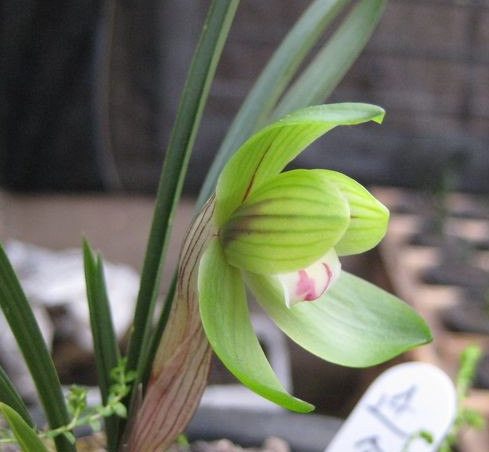
In the winter of 2001, it was collected in the Tianmu Mountains of Xinchang, Zhejiang, selected by Chen Jiang, and named by Chen Huafeng. In 2002 it won a gold award at the Zhejiang Provincial Orchid Expo. To commemorate Sima Qian, it was therefore named Qiangang He. The leaf posture is obliquely upright, the leaf texture is glutinous and moist, and the tips of new leaves are glossy; the leaves are 25-30 cm long and about 1 cm wide. The flower quality is dignified and elegant, with the five petals in separate sockets; the three outer petals are short, round, and broad, the main petal is shaped like an upper cover, the two side petals embrace in a straight-line shoulder, the center is well-formed, with short round mussel-shell-shaped sepals embracing the column, and a large liu-hai tongue that does not curl even after being open for a long time; the tongue surface has a U-shaped red blotch, and the color is brilliantly beautiful. The flower scape is tall, reaching more than 12 cm, and the flower color is emerald green with a drifting delicate fragrance; it is truly a standard lotus-petal treasure. The plant shape is graceful, it readily produces foliage, and it blooms frequently, but the flower form does not hold well.Qiangang He is famous for its tender color, large flowers, and the vivid red patch on the tongue. After many years of observation, Qiangang He that blooms under natural conditions shows the greatest charm of this flower. In 2002 it won a gold award at the Zhejiang Orchid Exhibition, and in 2013 it won a silver award at the Xinchang Cymbidium goeringii Exhibition.