Kiryu Stone: The Breathing Orchid Growing Stone
There is a stone that is white when dry and turns a brilliant golden yellow when fully soaked. There is a stone that has countless tiny air pores, able to quickly drain excess water for the orchid plant while also keeping it moist for a long time. This stone is called "Kiryu Stone," affectionately called the "breathing...
There is a stone that is white when dry and turns a brilliant golden yellow when fully soaked. There is a stone that has countless tiny air pores, able to quickly drain excess water for the orchid plant while also keeping it moist for a long time. This stone is called "Kiryu Stone," affectionately called by orchid enthusiasts the "breathing stone."
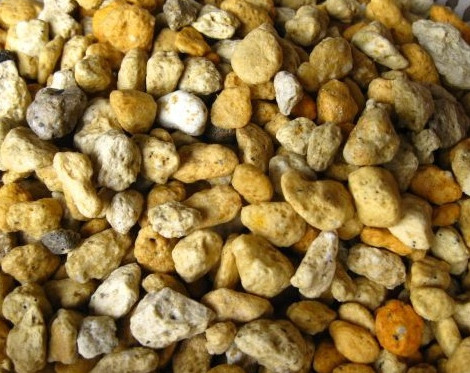
Shuiniu Horticultural Supplies Center is the sole distributor in China of the Japanese volcanic stone "Kiryu Stone." According to Chen Rongyu, general manager of the company, Kiryu Stone originates from Kagoshima, Japan. It is a stone formed after volcanic eruptions released large amounts of gas and heat, shaped at specific temperatures into a porous, lightweight stone that can rapidly absorb nutrients and retain moisture, processed with high-tech techniques after sterilization at 250°C.
After years of application, Kiryu Stone has won the favor of many orchid enthusiasts with its excellent properties, and is now widely used in the cultivation of various precious orchids. Its advantages are mainly reflected in the following aspects:
First, good air permeability, helping orchids breathe.
Kiryu Stone has an obvious feature in its physical structure: its internal voids are in the shape of flat elongated crevices, rather than the round pores inside ordinary orchid stones, and its density is lower than that of orchid stones, so its air permeability is better. Increasing the amount used in the upper half of the soil layer allows its special structure to help plants dissipate heat in summer, and because its hardness is not high, it will not hinder plant growth.
Second, it can drain water and absorb water, preventing orchids from becoming too wet or too dry.
Some orchid enthusiasts once conducted an experiment: they thoroughly watered the Kiryu Stone in an orchid pot, and after no more excess water flowed out from the bottom of the pot, they poured out the Kiryu Stone and squeezed it directly by hand. No water could be squeezed out, indicating good drainage. Then they spread the fully soaked Kiryu Stone flat on the ground, placed it in a cool, ventilated place at a temperature of about 25°C, and after one week the surface of the Kiryu Stone was still slightly golden yellow; after 15 days, the core of the Kiryu Stone was still moist at about 2 mm, indicating that Kiryu Stone has good water retention. This property is a good thing for orchid beginners, as it can reduce the damage to orchid plants caused by overwatering or underwatering.
Third, it does not shed debris and does not easily retain medicinal or fertilizer solutions.
After washing Kiryu Stone clean, soaking it in water for 12 hours and then washing it again, the water washed out is still nearly clear, indicating that its granule integrity meets requirements - it does not shed debris. Kiryu Stone has a solid structure, and medicinal or fertilizer solutions cannot penetrate and remain in it, so it will not cause the substrate solution concentration to become too high and affect orchid growth.
Fourth, high utilization rate and beautiful appearance.
Kiryu Stone can be reused. After being poured out during repotting, cleaned, soaked in medicinal solution for disinfection and washed clean, it can still continue to be used. The general service life is 2 to 5 years. After Kiryu Stone is wetted with water, its color tends toward golden yellow. Matched with elegant orchid plants, it brings out the best in each other and can enhance the grade of the orchids.
At present, there are some counterfeit Kiryu Stones on the market, which can be identified by visual observation and hand feeling. The characteristics of genuine Kiryu Stone are a light texture, powder when rubbed by hand, fine pores on the surface, a creamy white slightly yellow color under normal conditions, and a tendency toward golden yellow when placed in water.