|
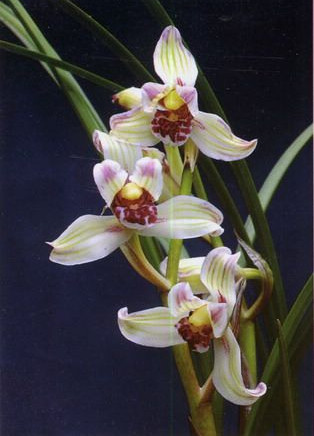
The discoverer of Qiongjue was Wu Yingkun, a native of Dujiangyan who had grown orchids for many years and was quite active among the older generation of orchid enthusiasts in Dujiangyan. In March 1990, Wu Yingkun collected a plant from the mountains; its leaves were relatively broad, its flowers were jade-colored, the outer petals were dotted with peach-pink colored patches, and the petals were like cat ears, with extremely distinctive features. After obtaining this plant, Wu Yingkun carefully restored it to vigor, and for two consecutive years he brought it into bloom, with the flower quality remaining very stable. In 1992, he sent this pot of flowers to Chengdu to participate in the National Orchid Exhibition, where it won a gold award in one stroke; at that time its name was "White Butterfly," and the variety type was classified as "Xishan Spring Sword." This differs from the current classification, and the reasons are many-sided. From the Xishan Spring Sword of that time to today's Cymbidium tortisepalum, this situation is not an isolated case. This also proves that establishing a complete system for describing orchid varieties is very necessary. After winning the gold award, it happened that Sichuan Fine Arts Publishing House was preparing to produce the "Sichuan Spring Sword Atlas." A staff member surnamed Chen at the publishing house who loved orchids felt after seeing the picture that the name "White Butterfly" was not quite appropriate, so taking the meaning of "produced in the Qionglai Mountains, shaped like fine jade," he named this flower "Qiongjue." "Jue" originally refers to a round fine jade with a gap, and "jue" shares the same rhyme as "que" (gap), which may be a borrowed use of the method of sound gloss. Looking at the flower shape of Qiongjue, the petal tips curl outward, and from the front it looks as if there is a small gap, which fits the explanation of "jue" very well. Such a unique variety naturally attracted many people's attention. Right after the Chengdu Orchid Exhibition, Korean orchid enthusiasts wanted to obtain this flower, but Wu Yingkun did not sell it. In 1994, after many rounds of negotiation, orchid enthusiasts from Qionglai finally obtained some varieties. After that, orchid enthusiasts from Dayi and Chongzhou also obtained some seedlings from Wu Yingkun. At present, Qiongjue is mainly concentrated in Dujiangyan, Qionglai, and other counties and cities around Chengdu, and the quantity is less than 1000 seedlings.
|