Detailed Introduction to the Longfeng Dacai Mei Jianlan (Cymbidium ensifolium) Variety
The origin of this orchid remains to be verified; in the early days it was mainly found in the Chaoshan area of Guangdong. Relatively early and clear photographic records were published around 2004-2005 in various newspapers, magazines, or professional orchid books. Judging from the plant type and the flower's form, it is estimated to be from Sichuan. Based on the current number of plants of this flower, there should not be many. With the popularity of online auctions...
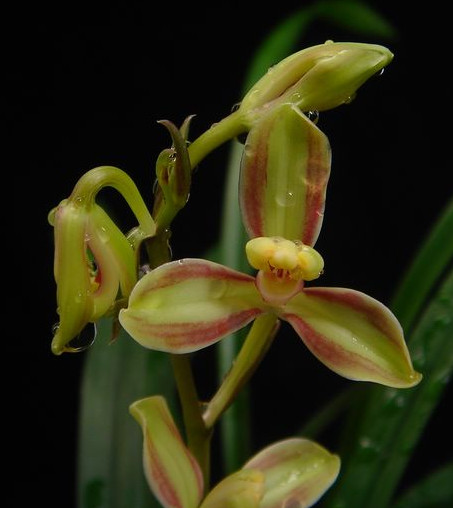
The origin of this orchid remains to be verified; in the early days it was mainly found in the Chaoshan area of Guangdong. Relatively early and clear photographic records were published around 2004-2005 in various newspapers, magazines, or professional orchid books. Judging from the plant type and the flower's form, it is estimated to be from Sichuan. Based on the current number of plants of this flower, there should not be many. With the popularity of online auctions, this variety also frequently appears in online auctions, and many orchid enthusiasts already own this variety. Jianlan Xiaohuang (summer 2006) introduced the stock at a thousand yuan per plant. The leaf material is generally not large (the plants I have seen so far number in the dozens; the leaf length of large plants is only about 35 cm). The leaf type of small plants is curved and drooping (the leaf base of large plants is somewhat higher. There are finger marks. The flower blooms on a red scape, a complex-colored plum blossom petal type, bearing 4-5 flowers. It stands above the leaves. Flower qualities: divided head and back, short tongue; the flower is about 3.5 cm at its largest (among flowers with divided head and back and short tongue, this belongs to the large-flowered type). When the plant is good, the flower form is correct; the three outer petals are broad and large, with obvious red edges (if not obvious, it should be related to climate). It often produces flowers with the side petals bearing a dish. The greatest variation in flower quality also lies in the size of the three outer petals and whether the red rimmed edge is obvious (this characteristic requires orchid enthusiasts in different regions to explore for themselves, because the environmental climate varies from place to place). Here our to (Moderator Cai) has experience regarding this flower's form. Advantages and disadvantages of this variety: the advantage lies in the plum blossom petal type plus color flower, and in breaking through the traditional single color tone of plum blossom petals. The disadvantage is that in the appreciation of plum blossom petals, its grade is somewhat lower (according to the Huilan five gates and eight forms, it ranks fourth gate, seventh form).
When growing and cultivating this flower, it is best if the flowering period can be controlled to open in July--September, which is most ideal. When the flower is in bud, increase humidity and lower temperature so that the bud can develop for a longer time. Before May-July, if conditions permit, appropriately increase humidity, lower temperature, and add shading (to avoid the problem of flowering before the pseudobulb has formed).