What is the story with orchid dragon roots and dragon eggs?
When orchid growers talk about orchids, the conversation never ends, and the center of discussion is often who has brought down another fine orchid from the mountains, and whether the plant carries a "dragon root." And every time "dragon root" comes up, it is only mentioned in terms of whether it is an authentic wild-collected seedling, and that seed-grown plants (seedlings) are worth more. However, we orchid growers...
When orchid growers talk about orchids, the conversation never ends, and the center of discussion is often who has brought down another fine orchid from the mountains, and whether the plant carries a "dragon root." And every time "dragon root" comes up, it is only mentioned in terms of whether it is an authentic wild-collected seedling, and that seed-grown plants (seedlings) are worth more. However, we orchid growers all know that judging whether an orchid is superior or inferior follows quite strict evaluation standards, and the original character of an orchid does not change based on whether it is a seed-grown plant. This shows that people's pursuit of dragon-root seedlings must have another reason. Another saying is that dragon-root seedlings have great evolutionary potential. But we know that in orchid standards, stability is one of the most critical points; if one says the evolutionary potential is great, then it can be considered an extremely unstable variety, that is, it can only be treated as a promising expectation. And who would buy an expectation at a high price? Therefore, the value of dragon-root seedlings does not lie there either.
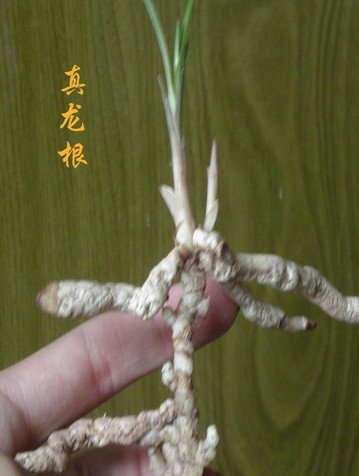
Dragon root: refers to a wild-collected orchid that has a main root developed from the original radicle, and this main root is called the dragon root. Orchid seedlings on the mountain that rely on natural reproduction from orchid seeds are called dragon-root seedlings. Dragon egg: in my personal view, it is when many orchid seeds germinate together, and their roots grow intertwined, forming a ginger-like shape, called a dragon egg. The dragon root is actually a false root, and the dragon root has stem nodes.
What exactly is the mystery of orchid dragon-root seedlings? Why is there such a huge difference in value between superior wild-collected orchid plants that are dragon-root seedlings and those that are not, and why do orchid writings always mention the explanation of dragon roots only in passing, never with detailed explanation? With this question, I developed a strong interest in dragon roots and began to observe and study them.
After several years of observation and research, although I still do not have a precise understanding of the formation of dragon roots, I have gained some understanding of their function. Here, I would like to narrate my understanding of dragon roots, hoping to make it a topic for those interested in dragon roots to comment on.
1. Conjecture on the formation of dragon roots
There seems to be a consensus in the orchid world on this, and most believe the process of dragon root formation is: after the seed ball matures, before the fruit splits, it accidentally falls to the ground, and happens to be covered by floating soil and then dead leaves. Under suitable conditions, it germinates inside the seed ball, and its form is like bean sprouts being sprouted in a covered container; all the seeds germinate at the same time, and after germination, because growth space is limited (due to plant kinship), they intertwine and adhere to one another, forming a block-like bud cluster - and the dragon root is thus formed.
2. Where the value of the dragon root lies
The growth of the dragon root: once the dragon root has formed, it either seeks a growing point and breaks through the soil, or it dies young. And when external conditions suit its growth, it gathers the strength of millions of seedlings and forms a child bud from the first growing point to break through the soil, so as to obtain photosynthesis for the survival and growth of the whole population. At this time the population is in the form of white, crystalline, bright bodies densely covered with nipple-like growing points. When external conditions are extremely suitable for its growth, many nipple-like points can rapidly sprout in competition, and the child bud that previously broke through the soil, because it loses the strong nutrient supply from the donor body, shifts into a semi-dormant state. Yet the photosynthesis it obtains instead further promotes the growth of the donor body. Thus the underground part is accomplished, namely the enlarged dragon root group and block. At the same time, as each volume of the dragon root block grows, all the seed buds lie dormant, gathering the strength of the many seed buds and supplying all nutrients to the child bud that first broke through the soil; and if external conditions at this time are relatively suitable for the growth of the child bud, together with the large amount of nutrients provided by the seed buds, the child bud quickly becomes a seedling and grows roots, and after the child bud becomes a seedling and grows roots, it automatically reduces the nutrients it takes from the population, so that the population can still grow when conditions are suitable. However, the child bud growing at this time has already formed its own nutrient organ - the lu tou (that is, the pseudobulb) - and gradually forms its own root system. And the growth of the root system then wraps and covers the original donor body (the dragon root block). This in turn creates the fact of hindering the growth of the dragon root block, causing the new growing points of the dragon root block to be suppressed, and over time, the dragon root block then rests in the soil.
A. The charm of the dragon root: once we understand the growth process of the dragon root, we know that the dragon root block is a living seedling bank. Because of plant kinship, if the dragon-root seedling is a superior orchid, then one can infer the kinship relationship of the related population, that is, all the seeds of this population may also be superior orchids. Then the remaining question is - how to use the dragon-root seedling to sprout more child buds, that is, to produce more superior orchid plants.
B. Due to limited conditions, the methods I used in studying dragon roots were all primitive soil culture methods. After 5 years of cultivation, I cultured a total of 6 different groups of plants on one Cymbidium ensifolium dragon root block. This year 3 groups have already flowered, and the result is 3 groups of flowers with similar flower shape but different flower color (including vein patterns and lip coloration). If this were a dragon root block of a series of superior orchids, one can imagine what a magnificent series of superior orchids it would produce. If we use the dragon root block as the mother stock and adopt advanced tissue culture techniques for propagation, what great results would that yield.
A. General cultivation of superior orchid dragon roots: When we obtain a superior orchid dragon-root seedling, the most helpless thing is to use general methods for cultivation. Then, how should general cultivation of the dragon root block be carried out? Generally speaking, dragon root blocks have two sources: (1) collected from the mountains; at this time the humus soil and the dead leaves on the surface from where the dragon-root seedling was produced should be brought back together. After arriving home, carefully peel the dragon root block off from under the orchid clump, take a clean flower pot, soak it in clear water for several minutes, and after the flower pot has absorbed enough water, use several layers of clean expanded foam net (the foam bags used for packaging fruit) as the bottom layer, then add expanded foam fragments to fill one half of the pot body as a cushion layer, then fill the pot mouth with the humus soil brought back from the mountain, shake and tamp it lightly, lay the dragon root block horizontally or plant it shallowly (scratch a shallow trench in the pot soil and place the dragon root block in it), then add a little floating soil to cover part of it, then cover it with dead buds, and then carefully water with a fine-holed watering can, so as not to wash out the dragon root; afterward water once every few minutes until it is completely watered through. After draining slightly, move it to a shaded, light-avoiding place for care; thereafter, do not water until the soil is dry, and when watering, water thoroughly; after about a month, leaf buds can be drawn out. When they have grown to have two true leaves and root buds begin to sprout, peel them off and plant separately, or plant them to the left and right of the dragon root block; after that, in about another month, new buds will sprout again. As long as you take careful care, one dragon root block will give you endless returns. (Because a dragon root block cultivated in this way, while growing buds, is itself also constantly growing.) (2) If it is a purchased dragon-root seedling, then apart from using the better orchid pot soil from home and giving it up for its use, all other practices are the same as the above method, except that there are no dead leaves on the covering surface, and clean Chinese fir shavings can be used as cover.
However, no matter how carefully one tends it, general maintenance, because conditions are crude, can hardly produce great benefits. The best method is still to use tissue culture, especially dragon root blocks of dragon-root seedlings with high-grade leaf variegation or with both leaf and flower variegation; if tissue culture is used, it will be a shortcut to obtaining a high-grade orchid line.
In fact, besides the dragon root block, there are also stolon dragon roots grown from pseudobulbs deeply buried by soil (that is, bamboo-node roots, also called false dragon roots); in fact, they are all excellent tissue culture materials; it only depends on whether you make use of them.
The "dragon root" and "dragon-root seedling" in orchids are divided into true and false. The so-called true "dragon-root seedling" is actually formed by seed germination, also called a "seedling." As everyone knows, orchid seeds are very small, very numerous, and very light. After the orchid capsule matures and splits, the seeds scatter in the original place where it was born and raised. When there is wind, these light seeds, some of them, drift with the wind, leave their hometown, fly far away, and scatter in strange lands. If the place where they land is a mountainside rock wall, mountain forest land, or mountain stream canyon suitable for orchid growth, some of the scattered seeds take root, sprout, and grow leaves there, settle down, and multiply and survive. In nature, after orchid seeds germinate, they first form a "dragon root" in the soil; this kind of "dragon root" is not an orchid root, but an orchid rhizome. When the "dragon root" grows to the soil surface, its tip enlarges to form a small pseudobulb, roots downward, grows leaves upward, and grows into a seedling. This kind of orchid seedling with a "dragon root" is called a "seedling," commonly known as a "dragon-root seedling," also called a "dragon-root seed-grown seedling." Generally speaking, only the original plant has a dragon root, while secondary buds do not have a dragon root.
The dragon root is relatively small and dense, with short and crisp-tender internodes, and has many nodes and internodes; each node position has a dormant bud, and each dormant bud may sprout a new seedling. Generally speaking, the lifespan of one dragon root is about 2 years; after the small seedling grows strong and the lu tou forms, its dragon egg falls off on its own, and the dragon root and dragon egg no longer reappear. After the dragon root of the original plant rots, nipple-like objects will remain for quite a long time, and the traces of the dragon root can still be vaguely recognized.
True dragon roots and dragon-root seedlings also have two situations: first, dragon-root seedlings germinated from a single seed. In nature, this type of dragon root is mostly a single, solitary, young and weak seedling plant, each plant having only one dragon root, directly below the bud, in a vertical or nearly vertical state. In the wild mountains, most young single orchid seedlings belong to this type of dragon-root seedling; sometimes in one trip to the mountain one can collect dozens of such dragon-root seedlings. This type of dragon-root seedling is weak and small, and management is very laborious; in 5-8 years it is not easy to see flowers. Second, ginger-like dragon root. Ginger-like dragon root, also called block-like dragon root by some, is shaped like ginger and also like coral; the orchid plant grows from the tuber. The production of ginger-like dragon root may be because after the orchid capsule falls to the ground, tens of thousands of seed grains germinate densely at the same time and intertwine into a block together, resembling a tuber. The dragon-root seedlings sprouting from this ginger-like dragon root sometimes grow several seedlings or even dozens of seedlings together.
Some people have proposed that dragon-root seedlings easily produce mutated new varieties, with a probability of about 1.4%, and when evaluating dragon roots they say that in dragon root length, long is superior and short is inferior, and short internodes are good while long internodes are inferior. The more bizarre the form of the dragon root, the better. Whether these views can hold remains to be further verified.
Regarding the formation of false dragon-root seedlings. Generally speaking, orchid pseudobulbs grow clustered together, and the place where they connect has a very short section of underground stem. In the natural growth process, if this underground stem, for some reason, such as being buried too deep or pressed by a large rock, has its growth suppressed and the survival of the orchid clump endangered, it will sprout a relatively long bamboo-node root (false dragon root), extending all the way to a suitable place before forming a new bud, rooting and growing leaves, and forming a new pseudobulb. This bamboo-node-like underground stem is also commonly called a "dragon root" by some, and the growing plant is also called a "dragon-root seedling." The dragon root referred to in Taiwan, China's orchid circles as "hard to find even after digging three chi deep" perhaps refers to this kind of dragon root sprouted from an orchid plant deeply buried in the soil. Some say that home-cultivated orchid plants, due to improper planting, with pseudobulbs buried too deep in the pot soil, will also produce a similar situation. And it is proposed that this kind of "dragon-root seedling" mutates relatively more often; this view also remains to be confirmed by fellow orchid growers.
In recent years, influenced by the saying that dragon-root seedlings easily produce mutated new varieties, many people, driven by profit or eager to seek fine varieties, blindly buy or recklessly dig dragon-root seed-grown seedlings in the mountains, causing devastating damage to orchid resources. Admittedly, among Taiwan, China's Cymbidium sinense famous varieties, Han Guang, Wan Dai Fu and others were all cultivated from dragon-root seedlings, and the Cymbidium sinense double-petaled strange flower has features such as strange roots, strange bracts, strange leaves, dragon roots, and three-sided thorns; this is an indisputable fact. In fact, dragon-root seedlings may produce leaf variegation and bloom strange flowers, but this is only a possibility. Because famous varieties are originally rare and hard-to-get treasures. It is exactly "strange flowers have features, but those with features do not necessarily bloom strange flowers." "Dragon root" is only one of the features of fine orchids, but it is by no means true that every dragon-root seedling with a dragon root will frequently produce fine varieties.