Jianlan cultivar Fuzhou He, also known as Daye Tiego Su
Fuzhou He, also known as Daye Tiego. The two sides of the leaf spread out like feathers from the pseudobulb, noticeably broad in the middle section, with the tip as wide as a crucian carp, bluntly pointed, finishing in a dew-receiving form; the leaf margins have fine blunt teeth, the teeth near the tip are somewhat sharper, and on the leaf tip there is a white thorn 0.5 mm thick and 1 mm long, slightly leaning to one side; the leaf texture is thick and substantial, and the leaf stance is upright...
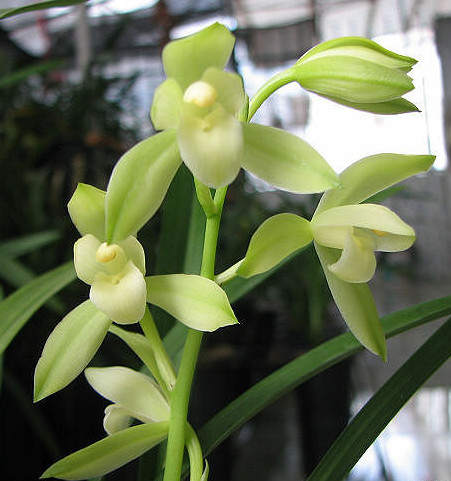
Fuzhou He, also known as Daye Tiego. The two sides of the leaf spread out like feathers from the pseudobulb, noticeably broad in the middle section, with the tip as wide as a crucian carp, bluntly pointed, finishing in a dew-receiving form; the leaf margins have fine blunt teeth, the teeth near the tip are somewhat sharper, and on the leaf tip there is a white thorn 0.5 mm thick and 1 mm long, slightly leaning to one side; the leaf texture is thick and substantial, and the leaf stance is upright (old leaves slant upright); the leaf surface is flat and spreading, the midrib protrudes on the back, and eight lateral veins are raised on the leaf surface, closely resembling silky linear variegation, while the leaf underside is smooth; the leaf is pale grayish green. Its three sepals are spindle-shaped, with angles almost equal to one another, the sepal tips bluntly rounded, and the sepal tips also, like the leaf tips, bear a small soft thorn leaning to one side; the sepal texture is fleshy and tender, white with a floating yellow-green tinge; the petals are white and tender, covering the column together, with the tips separated; the lip curls back, pale earthy yellow, and its clear fragrance spreads in all directions.
Daye Tiego and Bai Mudan both belong to the Sijisu flower varieties with relatively tall and large plant form, but under the same growing conditions Bai Mudan grows somewhat larger and more robust than Daye Tiego; Daye Tiego has a slanting-upright plant form, while Bai Mudan has a mid-drooping plant form, and Bai Mudan's leaf texture is softer and broader, like that of Cymbidium sinense.
Most flowers of Bai Mudan open with water-stain marks on the lip, and when open for a long time the three outer sepals turn outward and droop slightly, whereas the flowers of Daye Tiego hold up better and are pure and plain.