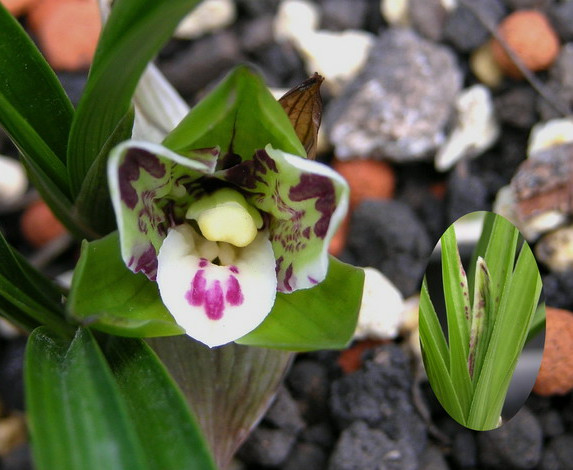
Introduction to the Cymbidium goeringii cultivar 'Zhonghua Shuangjiao' (Zhonghua Shuangjiao)
Cymbidium goeringii 'Zhonghua Shuangjiao': a premium rui-die (staminal petal butterfly) variety discovered in Zhoushan, Zhejiang. A new flower discovered in Zhoushan, Zhejiang in 2004, bearing lotus-petal rui-die flowers, selected by orchid enthusiast Lü Deyun. It won the gold award at the 2008 National Orchid Exhibition; selected by orchid enthusiast Lü Deyun. Gold award at the 2008 National Orchid Exhibition, the most beautiful leaf butterfly among Cymbidium goeringii, a legend of seedling prices in the hundreds of thousands in 2006.
Derived from a promising wild-collected plant from Zhoushan, Zhejiang. On August 12, 2004, it was selected by Lü Deyun and other orchid enthusiasts from a local orchid farmer's home in Ru'ao Town, Xinchang, Zhejiang. At the time, in a large pot of promising wild-collected plants, two clumps of orchid grass were found to have produced leaf butterflies; Lü Deyun bought a small 3-shoot seedling with dragon roots, and another orchid enthusiast bought a large 4-shoot plant with dragon roots. At that time these two clumps of orchid grass were not connected and belonged to separate dragon-root seedlings. Based on this, the orchid world later called the progeny of the larger 4-shoot plant "Da Jiao" (Great Pride) and the progeny of the smaller 3-shoot plant "Xiao Jiao" (Little Pride). This wild-collected plant bloomed again for the first time at the end of 2005, producing a rare lotus-petal rui-die, and combined with its obvious leaf butterflies, it was truly worthy of being called the peerless twin prides, hence the name "Zhonghua Shuangjiao" (China's Twin Prides). The flower buds are huge and deep purple; the bracts have thick, coarse veins that are grayish purple and extend all the way to the tip, covered with a purple sandy blush. After the flower fully opens, the three outer petals are rounded, with constricted bases and flared tips, and the color is emerald green and dripping with jade-like freshness. The flower scape reaches over 9 cm tall; the main petal has tightly incurved edges, is upright and covers upward, 1.5 cm wide and 3 cm long; the side petals are 1.35 cm wide and 3.1 cm long. With level shoulders and a cupped embrace, it can be called "eight parts long and four parts wide," a standard lotus petal. Most remarkable is its center: the two staminal petals are completely butterfly-transformed, short, round, broad and large, reaching 1.4 cm wide; the staminal petal markings alternate red, green and white, with vivid colors and strong contrast.