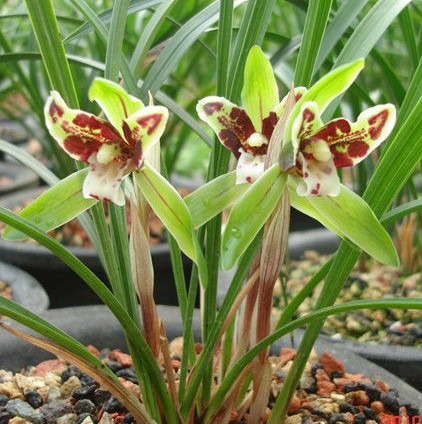
Introduction and Appreciation of the Cixi Ruibian Cymbidium goeringii Variety
Cixi nestles against the mountains and the sea. The mountains are an offshoot of the Siming Mountains, once rich in orchids and cymbidiums; the sea is the East China Sea, facing the Zhoushan Archipelago. After the orchid capsules of Cixi split open, thousands upon thousands of orchid seeds rode the wind east across the sea to the islands and multiplied there, which is why today Zhoushan has produced so many fine flowers! (Just a playful tale?) Historically, the tradition of growing and appreciating orchids in Cixi was far less developed than in Yuyang, Shaoxing and other places that were also production areas...
Cixi nestles against the mountains and the sea. The mountains are an offshoot of the Siming Mountains, once rich in orchids and cymbidiums; the sea is the East China Sea, facing the Zhoushan Archipelago. After the orchid capsules of Cixi split open, thousands upon thousands of orchid seeds rode the wind east across the sea to the islands and multiplied there, which is why today Zhoushan has produced so many fine flowers! (Just a playful tale?)
Historically, the tradition of growing and appreciating orchids in Cixi was far less developed than in Yuyang, Shaoxing and other places that were also production areas. In the past, one often saw people from Shaoxing coming up the mountains with their bedrolls, while locals rarely went up to select flowers. Perhaps some of the famous fine orchids that those places and people produced in earlier times also came from Cixi! (Also just a playful tale?) In orchid history, only a few rather unremarkable varieties are recorded as originating from Cixi, such as Taiyuan Mei (Qingyuan).
Mr. Huang Qihua of Cixi loves cultivating plants and orchids. Around 1999, he spent a large sum to collect several tractor-loads of wild-collected orchids from the mountains, enough to plant several mu of land. With wide planting and meager returns, "Cixi Ruibian" counts as the most valuable Cymbidium goeringii among them. In the early years it was grown as an ordinary orchid and showed no increase in quantity; only around 2006 was it grown routinely as a fine variety, and even now there are fewer than one hundred plants. Judging by floral quality, this flower's petals are not outstanding among today's many butterfly-type orchids, but its highlight is that the red-tipped crystal on its leaf tips is even more pronounced than in Biyao, appearing on every leaf and even on the sheaths, and the central leaves of strong plants have red lines or red blotches. Who knows whether second- and third-generation forms will appear?