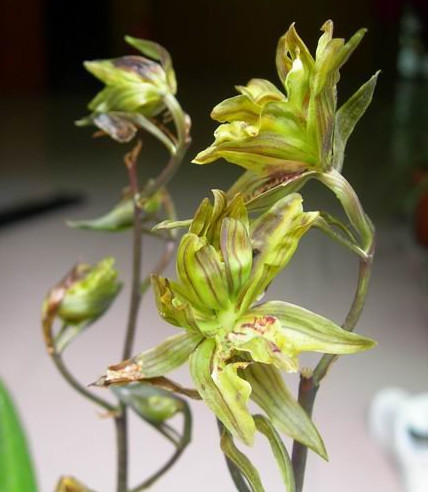
Introduction and Appreciation of the Datun Qilin Cymbidium sinense Variety
One of the five great exotic flowers of Cymbidium sinense. In 1974 (some say 1977) it was collected from the Datun Mountain area in northern Taiwan, China, and was discovered, cultivated, and named by the father and son "Guo Zonghui" and "Guo Juncheng." mzgfFNm^G) An orchid that has won special gold awards and grand gold awards many times at world, national, and regional orchid expos. The flower shape is special...
In 1974 (some say 1977) it was collected from the Datun Mountain area in northern Taiwan, China, and was discovered, cultivated, and named by the father and son "Guo Zonghui" and "Guo Juncheng." mzgfFNm^G)
An orchid that has won special gold awards and grand gold awards many times at world, national, and regional orchid expos.
The flower shape is special, presenting nested exotic petals; its main and secondary petals form two layers. Although the first layer belongs to willow-leaf petals, the second layer is narcissus petals. The column center sometimes forms a pouch but sometimes does not. The lip is double-layered and three-lobed, with a curled tongue; the large petal tongue bears bright red spots and has a strong fragrance. It is a multi-layered, multi-petaled exotic flower resulting from a mutation of Cymbidium sinense. The orchid leaves have thorns on three sides: both sides of the leaf blade and the keel on the back of the leaf have thorns, the roots are deer-antler roots, and there are leaf swords within the leaves. These are the three major characteristics of Datun Qilin leaf material. Another special trait of this variety is that it is easy to cultivate, has a high propagation rate, and blooms easily. With its special and highly ornamental flower shape, flower color, and other traits combined, it can be called a representative of the exotic New Year-flowering varieties produced in Taiwan, China; at present, this same variety already has linear leaf variations such as claw art, claw stripe art, husband-base art, and Ruiyu art.