|
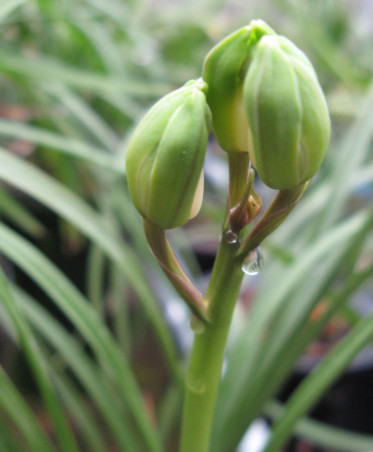
The importance of the "life dew" beneath the pedicel of orchid flowers. Anji Menghu says, "The 'life dew' is not that mystical; its scientific name is 'ant-guard honey.' By the time Cymbidium faberi blooms, it is already mid-spring, and insects in the mountains are highly active. To reproduce and keep its flowers from being gnawed, the orchid secretes nectar to guide ants to occupy the flower scape, keeping insects away from the flowers." This describes the plant's defensive instinct, but every plant form has two sides. In nature, the orchid's "life dew" not only protects itself and prevents "invasion" by natural enemies, but also plays a protective role for its own life. This is the mysterious aspect of orchids. Some Chunlan (Cymbidium goeringii) varieties have it too, but Chunlan proper does not. A drop of sweet dew at the base of the orchid's pedicel is generally called "minglu" (clear dew) or "lian gao" (orchid paste). "Life dew" is the name I gave it, simply to tell fellow orchid growers how important it is. In the wild, what Anji Menghu says is correct, but in a cultivated environment, if ants or insects crawl up again, wouldn't the orchid suffer? Haha! When I call it "life dew," I mean something else: it serves to nourish the orchid flower and extend its blooming time. At the same time, the "life dew" is sweet as honey, sweeter than sugar, and contains various amino acids that are beneficial to the human body. Marshal Zhu and General Zhang liked to lick the "life dew." It is said the "life dew" also has medicinal effects! It can especially treat coughs. If you want to taste it, wait until the last flower has fully opened and you are about to cut the flower stem, then taste it! The "life dew" is a magical symbol of orchids!
Honeydew, commonly known as orchid honey, is actually a phenomenon in which the orchid plant supplies nutrients to the orchid flowers, and when the flowers cannot consume it all, it seeps out of the body. There is especially a lot of it on days with sunlight and not much wind. Once the sun shines on it, the flowers act as if signaling the roots of their need for nutrients, and the roots at this point will send nutrients to the flowers without reservation. When too much is delivered and the flowers cannot consume it all, it seeps out at the tenderest places. |