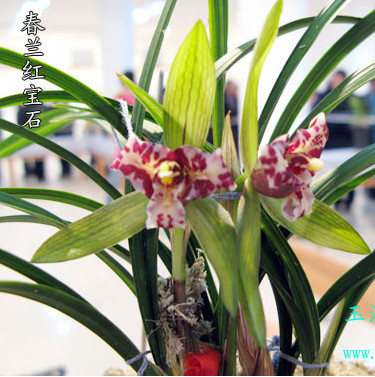
What orchid variety is Ruby Spring Orchid?
Ruby, a three-star butterfly Cymbidium goeringii, also known as Three Stars High Shine and Heaven on Earth, is a new premium three-star butterfly Cymbidium goeringii that appeared in recent years. It was collected in the wild on February 20, 2004 in Rongjiang County, Qiandongnan Miao and Dong Autonomous Prefecture, Guizhou Province. At the time of collection there were 11 plants in total, purchased by Lu Changyou and Duan Qizhi. It was later selected and developed by the well-known orchid grower Yang Long. According to Mr. Yang Long...
Ruby, a three-star butterfly Cymbidium goeringii, also known as Three Stars High Shine and Heaven on Earth, is a new premium three-star butterfly Cymbidium goeringii that appeared in recent years. It was collected in the wild on February 20, 2004 in Rongjiang County, Qiandongnan Miao and Dong Autonomous Prefecture, Guizhou Province. At the time of collection there were 11 plants in total, purchased by Lu Changyou and Duan Qizhi. It was later selected and developed by the well-known orchid grower Yang Long.
According to Mr. Yang Long, when this variety was collected in the wild, the plants were 50-60CM tall, with leaves about 2CM wide, 6-7 leaves per plant, flower scapes about 50CM tall, and flower diameter reaching about 20CM. Now this variety is about 20-30CM tall, with leaves about 1CM wide, 6-7 leaves per plant. It blooms from December to January or February of the following year, with 1-2 flowers per scape, mostly 1 flower and occasionally 2; the main and lateral sepals are normal and yellow-green; the petals are lip-like, with bright red blotches on a white background, the blotches being very large, bright red in color, and neatly and beautifully arranged; when the flower first opens the markings are dot-like, and after about half a month the blotches merge into large patches. This variety blooms easily, and even two or three plants can produce flowers.
Some leaves of this variety carry butterfly and crystal patterns, the leaf shape is fish-belly shaped, and the plant form is twisted; the leaf sheaths are bold and strong, green-white with red veins. This variety has short, thick roots, is vigorous and easy to grow, and has a relatively high multiplication rate. With proper cultivation, the multiplication rate can reach about 200%, and according to Mr. Yang Long, it can sometimes reach as high as 300%. This claim is fairly credible - according to preliminary estimates, the total number of this variety may now be around 120 plants, and only with such a high multiplication rate could such a number be reached. For some crystal patterns and leaf butterflies, the patterns and butterflies tend to "blur" over time, but the patterns and butterflies of this variety do not easily "blur."
Interestingly, the plant form, leaf shape and flower shape of this variety when collected in the wild differ considerably from those of today. It is fairly common for wild-collected plants after domestication to shrink in height by about two-fifths and in leaf width by about two-fifths. According to P87 of "Lincheng Lanxiang," when this variety was collected in the wild the plants were 50-60CM tall, and now they are only about 25-30, shrinking by about half overall after domestication; Mr. Yang Long said the flower diameter reached about 20CM at that time, while now it is about 5-6CM, a reduction of about two-thirds; for another example, according to P87 of "Lincheng Lanxiang," the leaf width of this variety was 1.8-2CM (Mr. Yang Long once said the leaf width at the time of collection reached 2.5CM), which is to say that this was a large-plant-type plant, but looking at the present plants of this variety, the leaf width is only about 1CM; small and exquisite, rather elegant; in addition, that book published the blooms of this variety for the three years 2004, 2005 and 2006. In 2004 it bloomed rather flamboyantly, or as they say in Yunnan, "flying every which way"; by 2005 it bloomed much more restrained; and by 2006 the flower shape, flower posture and flower appearance were very neat and attractive. I remember that in the spring of 2006, Mr. Li Anming and I accompanied the Sichuan orchid grower Guan Qingping to the home of the Yunnan orchid grower Mr. Ma Xinglong in Kunming, and on a wall calendar we saw that photo of this variety's 2005 bloom, and he did not think much of it. Unexpectedly, this variety has improved year after year, and by January 2007, when Mr. Li and I attended the Qujing Orchid Expo, we saw that this flower had developed very well, with elegant leaf shape and plant form, neat flower posture and appearance, well-proportioned lip arrangement, bright and eye-catching colors, huge blotches, and a strong contrast of red markings on a white background. It truly is a case of "a girl changes eighteen times before growing up, and the more she changes the prettier she becomes." One bloom of this variety at the Qujing Orchid Expo is shown in the attached photo. It is precisely for this reason that it also sold for a high price - the plant of this variety submitted for exhibition by Mr. Yang Long sold for more than 2 million for two plants at this orchid show. With the orchid market already clearly in a period of adjustment, being able to close a deal at such a high price was truly not easy.
At present this variety is mainly grown in Kunming and Yuxi in Yunnan, Panxian in Guizhou, and Leshan and Dujiangyan in Sichuan, among other places.
In 2007 this variety won the Gold Award at the 3rd China (Yuxi) Orchid Trade Fair and the Gold Award at the Qujing Spring Orchid Exhibition, among others; in 2009 it won the "Chen Shaomin Far East National Orchid Gold Award" at the 5th China (Yuxi) Orchid Trade Fair, among others.
In addition, this is not the only orchid called Ruby. For example, in Yuxi, where I am located, there is a red-flowered Cymbidium goeringii called Ruby, but because of the appearance of this variety and its great fame, this red-flowered Cymbidium goeringii in Yuxi was renamed Hongta Ruby, and it is also a fine Cymbidium goeringii variety.