What are the prevention and control methods for orchid stem rot?
The color flower "Half-Gram Red" from Rong County usually blooms with only a "half" red, so orchid growers in Rong County call it "Half-Gram Red". Most of the seedlings were taken by the greenhouse and named "Flower-Heart Radish".
Summer anti-rot
Distribution and harm
Orchid: Latin scientific name: Cymbidium, English name: boat orchids, alias: orchid grass (different varieties have different aliases), orchid flower language: indifferent to fame and fortune, elegant. There are many varieties of orchids. According to incomplete statistics, there are more than 40,000 orchid varieties in the world, among which the more famous ones are Cymbidium goeringii, Cymbidium faberi, Phalaenopsis, etc. Orchid stem rot, also known as orchid wilt, is one of the most troublesome diseases in orchid cultivation. It causes the stems of orchids to rot and shrink until they die.
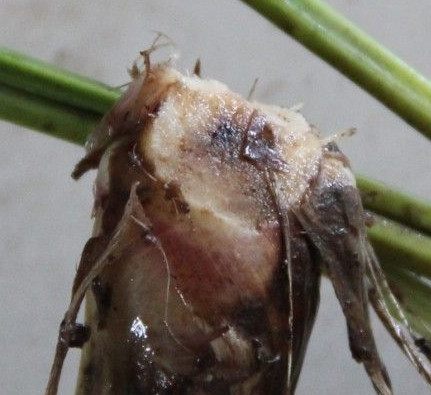
Symptoms
It usually first harms the mature orchid leaf sheaths and the tissue of the leaves near the base, from the inside outward. In severe cases, it causes deep rot of the pseudobulbs, which then causes the leaves to wilt. Dark brownish-red can sometimes be seen at the diseased area and on the cut surface.
With this kind of potting medium, and without water control, you get stem rot like the one below!
Pathogen
The initial onset is generally caused by prolonged high temperature, high heat plus high humidity, and only a small number are introduced through orchid exchanges.
1. The potting medium is not breathable.
2. The potting medium is not fully rotted.
3. The potting medium is not clean.
2. The potting medium is not fully rotted.
3. The potting medium is not clean.
4. Use fewer large pots for orchid plants; this way there is more potting medium, it is not breathable, and stem rot is also more likely
Start with the potting medium first. Pay attention to ventilation. Water reasonably. Do not water when dry? No, water only when dry, and water thoroughly when watering.
Start with the potting medium first. Pay attention to ventilation. Water reasonably. Do not water when dry? No, water only when dry, and water thoroughly when watering.
Occurrence pattern
The onset period of orchid stem rot is consistent with the rapid growth period of orchids. That is to say, the faster the orchid grows, the faster orchid stem rot will break out. This is related to the fact that the optimal temperature required for orchid growth and the optimal temperature for orchid stem rot outbreak are the same (the optimal temperature for orchid growth is 28--30°C, and the optimal temperature for orchid stem rot outbreak is also 28--30°C). Sometimes a single seedling is affected, sometimes it occurs in spring and summer, and sometimes in autumn and winter (though it very rarely occurs in winter), and in most cases the disease starts from large plants, strong plants and new plants, with a few starting from old plants and small plants.
Prevention and control methods
(1) Before potting, the orchid, orchid pot and potting medium must be disinfected. The potting medium should be relatively coarse, the orchid plant should be planted as shallowly as possible, the growing environment must be well ventilated, the pot surface should not remain overly wet for a long time, and organic fertilizer should be used as much as possible, while inorganic fertilizers and chemical fertilizers should be used less or not at all. In this way, stem rot will not occur or will occur less.
(2) Choose the broad-spectrum imported agent 70% Jingfuling emulsifiable concentrate. Method of use: dilute 1 ml of this medicine in 600 g of water, that is, a 600-fold solution (the amount used can be determined according to the number of your orchids), spray once every 7-10 days, for 4 consecutive sprays, then according to the situation spray once every 15-20 days for further prevention; however, it must be used under the following two circumstances: first, during the high-temperature period from April to October, on the second day after each soaking (watering), this medicine should be applied for prevention, because at this time the temperature and humidity on the orchid plants are suitable, which is conducive to the reproduction of pathogens and makes disease most likely; second, when newly purchasing high-grade orchids, they should be isolated for a period of time, and this medicine should also be sprayed for sterilization, to reduce the spread of pests and diseases due to the high mobility of orchids.
bingyu2008's summary of stem rot
1. Stem rot lies in prevention, not treatment. Once the pseudobulb is infected with pathogens, there is currently no medicine that can save it. I previously saw a post where a friend said plant ash could treat it. I tried it too, but it can only appropriately control the spread of the disease, because the sterilizing components of plant ash cannot get inside the pseudobulb where the pathogens are, so orchids treated with plant ash, including other so-called systemic specific medicines, may appear to have been cured, but they will definitely recur the next year.
2. In daily management, observe diligently.
1. Observe the potting soil. During the growing season, if within the normal watering cycle the potting soil dries especially slowly, or if other orchids are ready for watering while this pot's soil is still relatively moist, then you must pay special attention. It is very likely that the orchid has already been infected with pathogens, and the pathogens have already inhibited the orchid's growth. As can be seen in the photo above, the old roots of the orchid are very strong, but none have crystal tips, and their water-absorbing capacity is greatly reduced, so the potting soil dries slowly.
2. Observe the leaves. Generally, around Qingming, the growth rate of orchids begins to accelerate. If they are grown in the open or semi-open, after one or two spring rains, the leaves will visibly become glossy, and the orchid will also look especially energetic. If at this time a certain pot still looks listless, there are usually only two possibilities: one is improper winter management and the roots have completely rotted. The other is infection with pathogens, and in most cases it is caused by infection with pathogens. When necessary, decisively repot to inspect. Even if there is no infection, repotting in early spring does no great harm to growth. After repotting, the roots must be dried before potting again to prevent infection with pathogens at this time.
3. Look at the growth rate of new shoots. Generally speaking, after new shoots emerge from the soil, if the orchid is healthy and water and fertilizer management are proper, they still grow very fast, and signs of growth can be clearly seen every two or three days. If this pot has sent out many new shoots, and after the shoot tips emerge from the soil there is no sign of growth for a long time, then you must pay special attention. It is very necessary to gently push aside the soil around the new shoots to see whether the new shoots are still normal, or to lightly touch the new shoots with your finger. New shoots infected with pathogens are like wooden stakes whose bases have already rotted, and are not as firm as healthy new stakes. A special note here: when observing new shoots, accumulate more experience, because in the early stage before new shoots root and unfold leaves, growth will have a pause period, and you must not mistake this period for infection with pathogens and casually knock the plant out of the pot. When pushing aside soil, be especially careful, and remove the soil around the shoot like excavating a cultural relic. Never bruise the new shoot.
4. Detect early, divide seedlings early.
Stem rot is the number one killer of orchids. It is a stumbling block on the path forward for beginners, the main enemy of ordinary orchid growers, and an opponent that veterans encounter unexpectedly. But as long as it is detected early, stem rot can actually still be saved to a certain extent. It is rescue, not treatment. The premise is: the orchid is strong, there are many seedlings, and it can be detected in time. Once discovered, immediately repot, divide the seedlings, and separate them one by one starting from the infected seedling, until the cut no longer changes color (whether the cut on the pseudobulb changes color is the most direct and simplest way to judge whether it has been infected with pathogens). To be safe, also separate and plant singly the one that does not change color. Then, if the roots on the other side are still good, the chance of preserving that side is still quite high. Generally, after orchids are broken apart in this way, even if there are still seedlings left, they have gone back to the pre-liberation days. (The theoretical basis for doing this is that of two orchids planted in the same pot, one becomes diseased while the other can still grow normally, which shows that the pathogens spread inside the pseudobulb.) If it is a precious variety and a pseudobulb is slightly infected with pathogens, a sharp knife can be used to cut inward along the infected area until the infected part of the pseudobulb is completely cut away. If about 2/3 of the pseudobulb remains, and there is a growth point or new shoot on the other side, preferably still with roots, disinfect the wound, dry it, seal the cut, and treat it as an old back bulb to nurse. There is still a certain chance of preserving the variety.
The above methods have all been personally tested by me. At least the orchids treated with this method last year are still growing healthily to this day. Whether they can survive this period next remains to be tested by time.